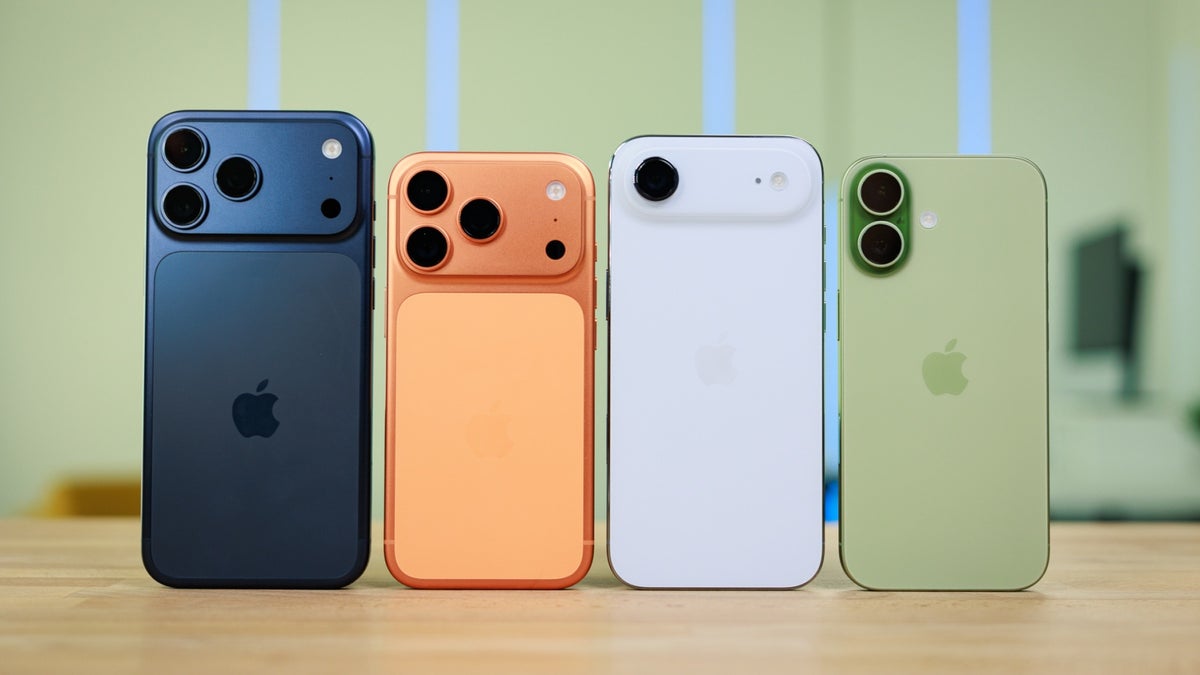
Believe it or not, exactly three in four handsets sold stateside between January and March 2026 are iPhones, which made it pointless for the analytics firm behind this new study to estimate the market share of the nation's silver or bronze medalists.
Apple is somehow growing even when everyone else is suffering
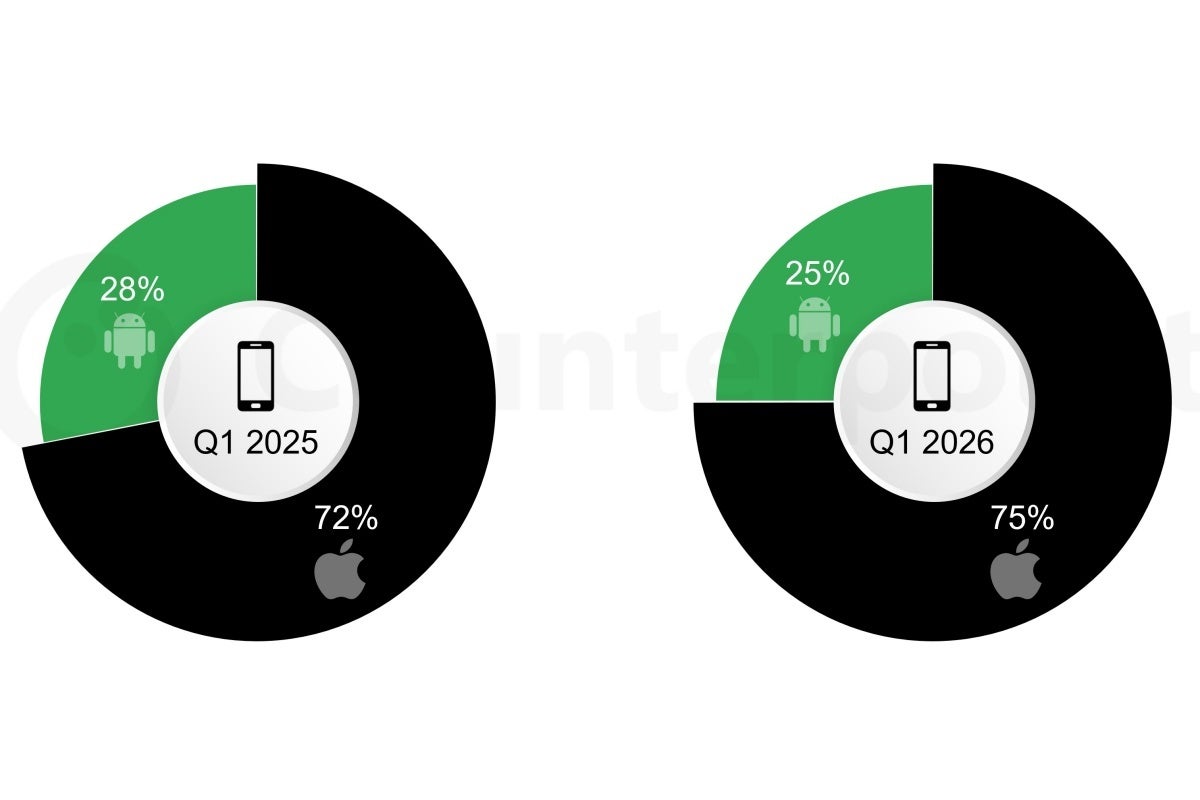
Yes, overall US smartphone sales are down 5.7 percent in Q1 2026 compared to the same timeframe of last year (which is a pretty bad decline even in the face of rising industry-wide component costs and product prices), but Apple's regional numbers are up 1.3 percent (which is obviously not a massive progress... if you ignore the other stat).
Apple has an incredible three in four smartphone sold in the US between January and March 2026. | Image by Counterpoint Research
4 percent is a figure that likely puts Cupertino's improvement at a difficult time in a better context, representing the company's year-over-year jump in market share. That stands at an absolutely mind-blowing 75 percent now, and if you compare the number with Apple's 69 percent slice of the pie from Q4 2025, the progress is even more impressive... and almost hard to believe.
It's not hard to explain why iPhones are dominating Android handsets in the US by an even larger margin than both last year and last quarter, though, as Samsung actually played a crucial role in its arch-rival's latest domestic growth.
The Galaxy S26 family left a "vacuum" in the premium space for far too long
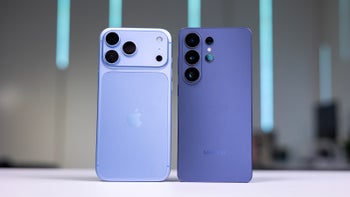
Universally regarded as global hits... when they were finally released, the Galaxy S26, S26 Plus, and S26 Ultra arrived a little too late to fend off the iPhone 17 lineup in the US in Q1 2026.
How can Android vendors make up some of the difference to iPhones in the US?
229 Votes
Lower prices are the key.
26.2%
Better specs.
14.41%
More unique designs.
15.28%
More aggressive marketing.
12.23%
More product diversity.
3.93%
You can't fight Apple in the US.
27.95%
As difficult as it might be to believe, it appears that a few extra weeks of waiting made some folks who were planning to buy a new Samsung flagship reconsider at the last minute and opt for a 2025-released iPhone instead. Clearly, it helped that Apple managed to keep the prices of the iPhone 17 family in check, and perhaps more importantly, the substantial upgrades of said family's "vanilla" member over the base iPhone 16 went a long way in broadening the appeal of the company's product roster this beginning of the year.
Recommended For You
Looking ahead, you can probably expect the Galaxy S26 trio to make a bigger impact in Q2 and Q3 2026, but of course, the iPhone 17e is also likely to connect with mainstream US audiences, further opening Apple's product lineup to more prospective buyers on tighter budgets.
The king of prepaid is about to lose its crown
While it's certainly not surprising to hear that Apple is comfortably leading the nation's smartphone sales chart as far as Verizon, T-Mobile, and AT&T are concerned, some of you might be caught off guard by the microscopic difference between the top two vendors in the US prepaid segment.
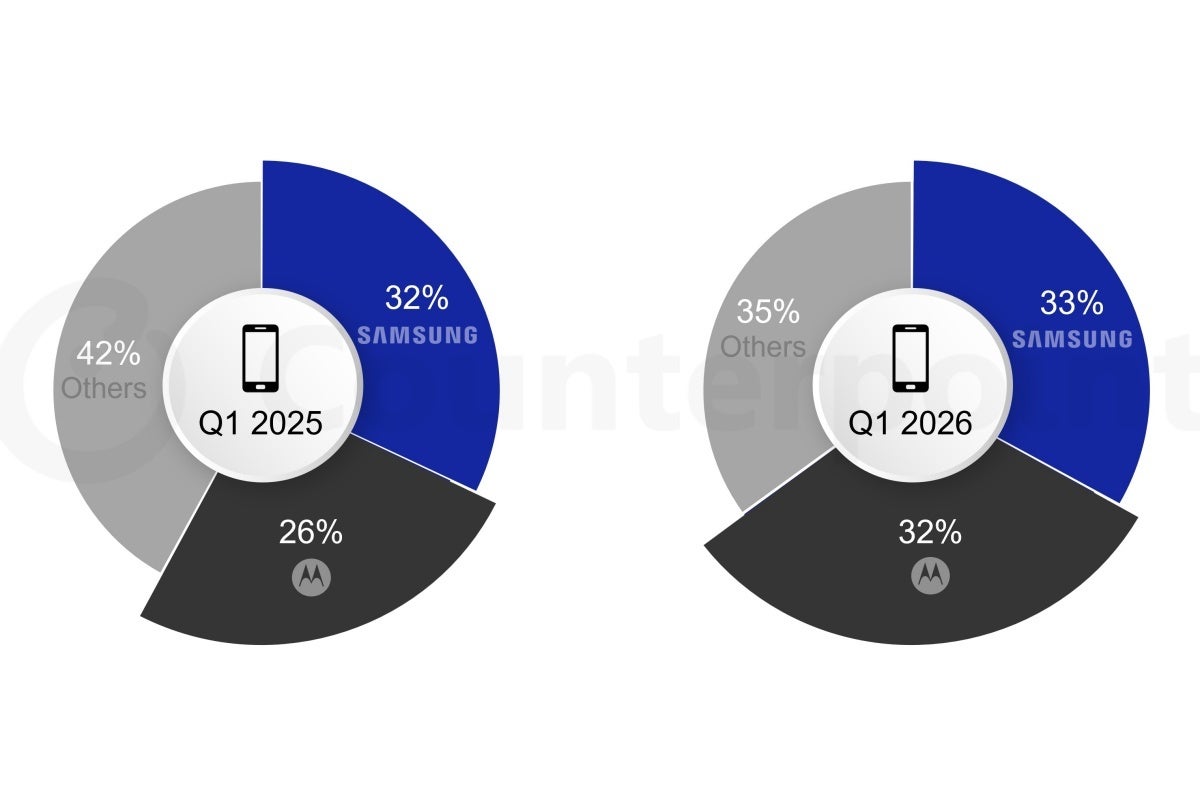
Will Motorola cancel Samsung's tiny advantage soon? | Image by Counterpoint Research
Samsung still tops that hierarchy, mind you, but Motorola has gotten incredibly close to the category's leader, holding a 32 percent share. That's up from only 26 percent this time last year, which is quite the unbelievable progress for a company with a much lower marketing budget than Apple and presumably Samsung as well.
Samsung, on the other hand, has barely gained one percent share between Q1 2025 and Q1 2026, currently standing just one percent above Motorola and looking in real danger of being overtaken soon. On the whole, the US prepaid segment is starting to consolidate around these top two brands, as names like TCL and HMD are finding it harder and harder to keep up with the increase in component costs and continue to release competitively priced devices with premium designs and respectable specs.
What's next for the US smartphone market?
In short, more declines, both at major carriers and smaller mobile network operators, not to mention retailers like Amazon and Best Buy. One of the key reasons for that is, of course, not actually tied to the mobile industry or the greater tech scene, having more to do with the general state of the US economy and how difficult it's becoming for people to maintain their "normal" buying habits.
Still, Apple has every reason to expect its US sales numbers to continue to grow in the next few quarters, at least if the company manages to keep iPhone prices unchanged, as most analysts believe. Android vendors, meanwhile, are likely to become less and less relevant, especially at the likes of Verizon, where an incredible 77 percent of all smartphones sold in the January-March 2026 timeframe were iOS-powered.
iMac (M1 series, 2021) flash sale! Limited time offer!
Save $40 on iMac (M1 series, 2021) from Back Market. Discount automatically applied at checkout. Offer ends 27 September 2026 at 23:59.
Adrian, a mobile technology enthusiast since the Nokia 3310 era, has been a dynamic presence in the tech journalism field, contributing to Android Authority, Digital Trends, and Pocketnow before joining PhoneArena in 2018. His expertise spans across various platforms, with a particular fondness for the diversity of the Android ecosystem. Despite the challenges of balancing full-time parenthood with his work, Adrian's passion for tech trends, running, and movies keeps him energized. His commitment to mid-range smartphones has led to an eclectic collection of devices, saved from personal bankruptcy by his preference for 'adequate' over 'overpriced'.
A discussion is a place, where people can voice their opinion, no matter if it
is positive, neutral or negative. However, when posting, one must stay true to the topic, and not just share some
random thoughts, which are not directly related to the matter.
Things that are NOT allowed:
Off-topic talk - you must stick to the subject of discussion
Offensive, hate speech - if you want to say something, say it politely
Spam/Advertisements - these posts are deleted
Multiple accounts - one person can have only one account
Impersonations and offensive nicknames - these accounts get banned
To help keep our community safe and free from spam, we apply temporary limits to newly created accounts:
New accounts created within the last 24 hours may experience restrictions on how frequently they can
post or comment.
These limits are in place as a precaution and will automatically lift.
Moderation is done by humans. We try to be as objective as possible and moderate with zero bias. If you think a
post should be moderated - please, report it.
Have a question about the rules or why you have been moderated/limited/banned? Please,
contact us.




Things that are NOT allowed:
To help keep our community safe and free from spam, we apply temporary limits to newly created accounts: