Last year's global smartphone sales numbers are in (from more than one market research firm), and for the most part, they're not very surprising. Counterpoint Research, Omdia, and the International Data Corporation (IDC) all put the mobile industry's 2025 volumes at a slightly higher level than 2024's total (just as the three companies predicted at the beginning of the year), and the top five vendor club is completely unchanged (both as far as brands and their order is concerned).
That sounds terribly unexciting for those of us who like to follow the quarterly and yearly shipment reports like a sporting event where everyone loves an underdog story or a race with lots of twists and turns and frequent leadership changes. Fret not, though, as I think I've found the smartphone market's most exciting development of the past year (at least for neutral spectators) and a couple of the key reasons why this happened.
One company seems to have learned from (some of) its past mistakes
Can you guess what company I'm talking about? That's right, Apple. Don't agree with me? Then you must have not paid enough attention to the iPhone 17 family launch back in September.
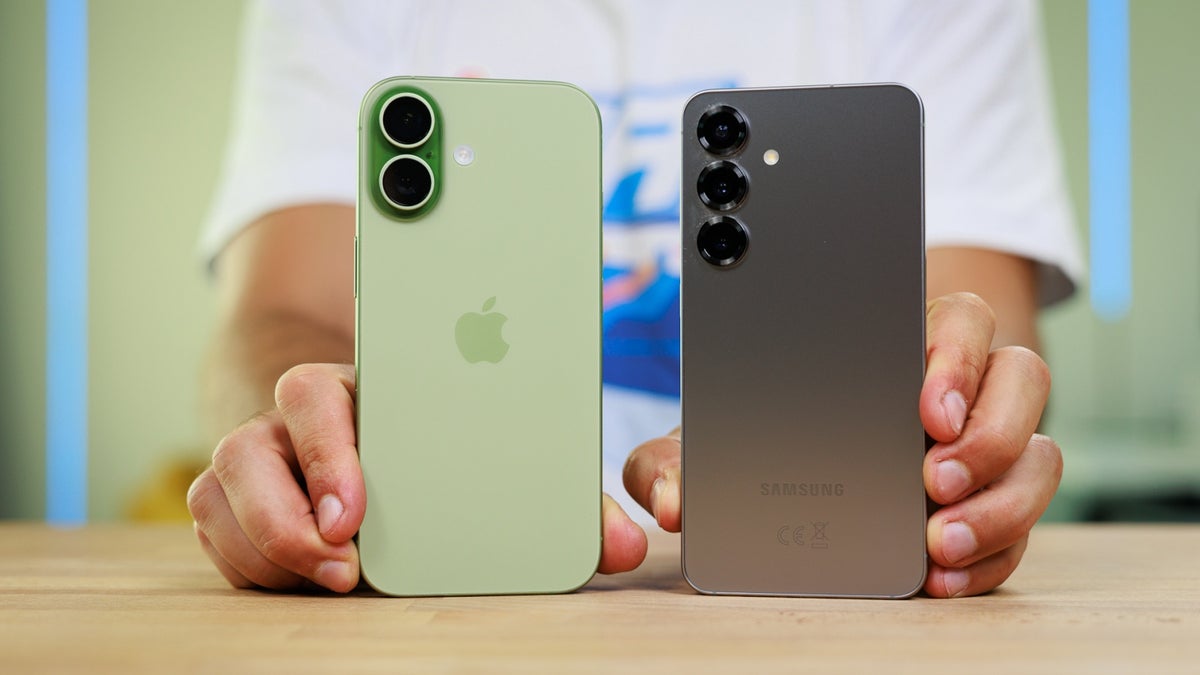
Instead of jacking up the prices of all its latest and greatest high-end handsets without rhyme or reason (which has happened a few different times in the past), the Cupertino-based tech giant made the "vanilla" iPhone 17 just as affordable as its predecessor while bumping up the base storage from 128 to 256 gigs.
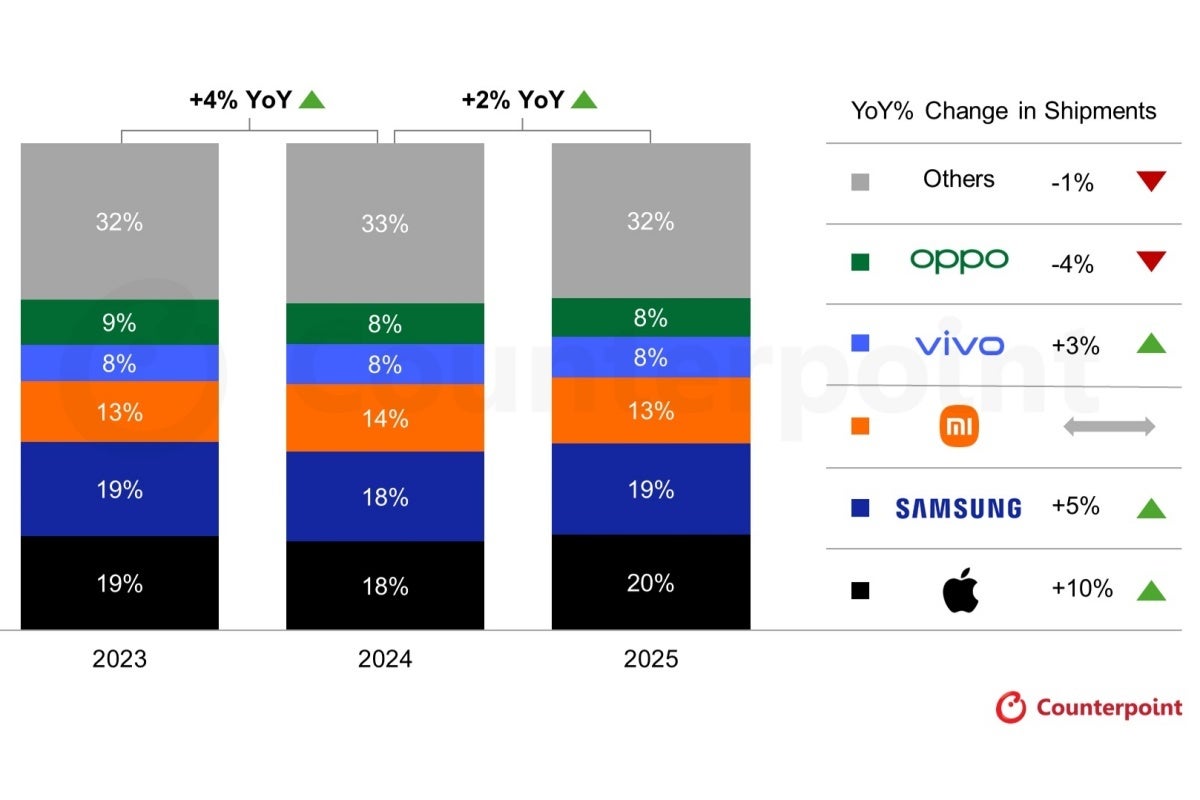
Both Apple and Samsung's numbers are up, but one progress is much more significant than the other one.
That's basically considered a price cut in many cultures, and although Apple didn't really advertise that particular upgrade very aggressively, consumers definitely noticed, especially in the crucial (and very budget-leaning) Chinese market, where the non-Pro iPhone 17 was at one point estimated to have improved the iPhone 16's demand by 31 percent.
Recommended For You
That's a huge progress for a brand that only boosted its overall handset sales by 10 percent in 2025 compared to 2024 (at least according to Counterpoint Research), which was not just enough to secure the number one spot in the vendor chart, but also eclipse Samsung, Xiaomi, Vivo, and Oppo's growth during the same timeframe.
Of course, one swallow does not a spring make, and one (massively) successful smartphone model does not a market leader make, so the iPhone 17 Pro Max certainly deserves some praise for its own popularity, especially in the US. The thing with the new 6.9-inch giant is... that it wasn't supposed to sell that well, at least as far as I'm concerned.
Why do you think Apple defeated Samsung in 2025?
266 Votes
The iPhone 17
22.56%
The iPhone 17 Pro Max
6.77%
The entire iPhone 17 family
16.17%
Samsung's lack of focus
19.92%
A repetitive Galaxy S25 Ultra
25.56%
A boring Galaxy A family
9.02%
Better put, the iPhone 17 Pro Max is not fully deserving of its success, doing the exact opposite of the "base" iPhone 17 by costing $100 more than the 16 Pro Max and offering no additional storage. While a few other specs were upgraded, a comprehensive head-to-head comparison between the two jumbo-sized super-flagships found that the new phone signifies "devolution in action" rather than evolution in many key departments, which brings me to the second major reason why I think Apple was able to keep Samsung at bay with relative ease in 2025.
One company seems to have lost its focus
There are no prizes for guessing who I'm referring to this time around, but before getting into my criticism of Samsung's... uninspired 2025 product lineup and launch strategy, allow me to clarify something.
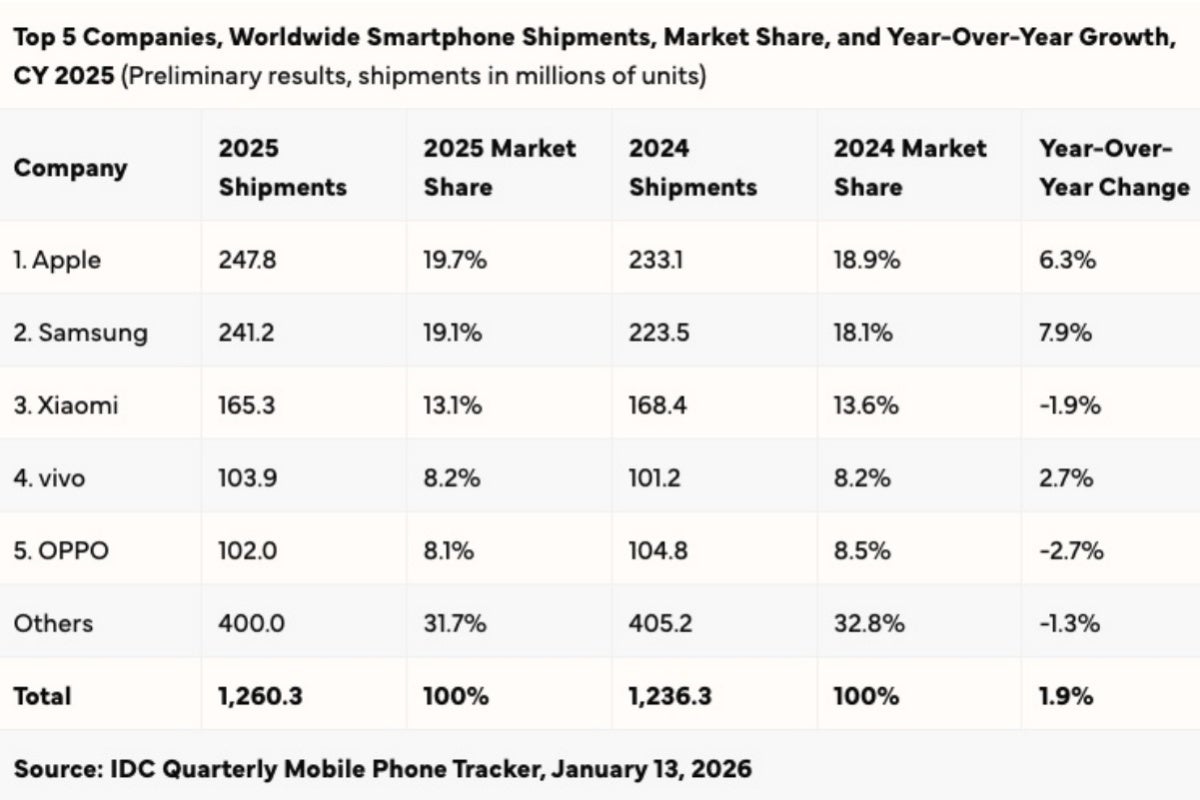
While some of you may not consider Apple's latest win over its arch-rival a complete blowout, I believe Samsung can't be happy to see a full percentage point between its market share and that of the market leader after basically drawing Apple in both 2023 and 2024. Once again, that's according to Counterpoint Research, which is important to point out because the IDC, for instance, actually puts Samsung closer to Apple's industry-leading score at the end of 2025 compared to the previous year.
These numbers look a little better for Samsung than the ones above, but Apple is still number one.
Either way, no market research firm is claiming that Samsung is the world's number one vendor this time around, and I think that's a lot due to the company's own mistakes in addition to Apple's very inspired iPhone 17 choices.
We've already established that the iPhone 17 Pro Max was a "beatable" device, and the reason why Samsung didn't release an objectively better product in 2025 is because many of its resources were wasted on pointless endeavors.
I'm obviously not saying that the S25 Ultra is a bad phone or that it flopped at the global box-office. But it could have certainly been better (or at least cheaper), which could have led Samsung back to the top spot in the handset vendor hierarchy.
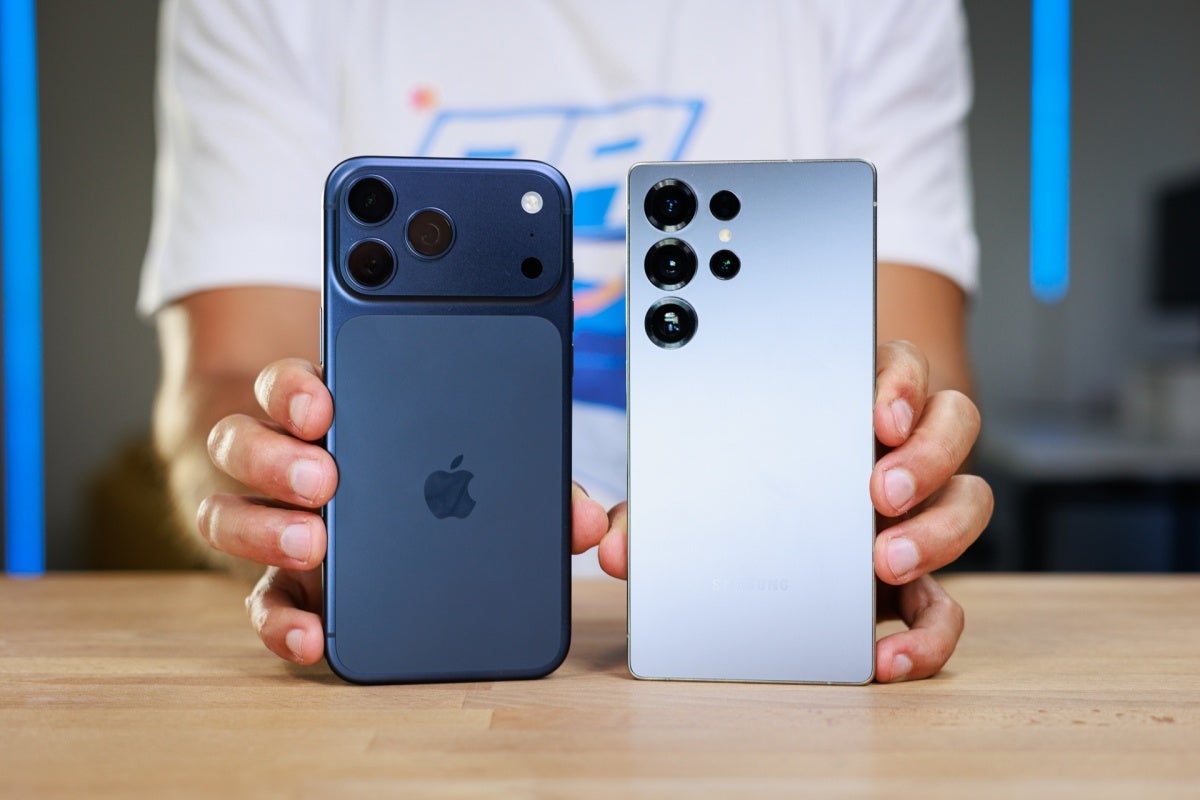
I'm not saying the iPhone 17 Pro Max is better than the Galaxy S25 Ultra, but sales numbers are... kind of saying that. | Image Credit -- PhoneArena
The same can absolutely be said about the company's 2025 additions to the mid-range Galaxy A family, which were... boring and incapable of stealing (enough) attention away from the iPhone 16e to return to the glory days of such blockbusters as the Galaxy A50 and A51. The sad thing (for Samsung fans, but also for neutrals expecting a tighter battle for supremacy in 2026) is that the Galaxy A57 and the Galaxy S26 family don't look very exciting or... inspired either (at least based on the most recent rumors), as Samsung once again seems more focused on experimenting with quirky new designs than making core products as awesome as they can possibly be.
Free Galaxy A17 5G with Straight Talk
Get a free Galaxy A17 with Straight Talk. To claim this deal, you need to pair the phone with activation on a Silver Unlimited Plan or higher. This tier costs $45 per month. Offer valid through 01/10/27 while supplies last online.
Adrian, a mobile technology enthusiast since the Nokia 3310 era, has been a dynamic presence in the tech journalism field, contributing to Android Authority, Digital Trends, and Pocketnow before joining PhoneArena in 2018. His expertise spans across various platforms, with a particular fondness for the diversity of the Android ecosystem. Despite the challenges of balancing full-time parenthood with his work, Adrian's passion for tech trends, running, and movies keeps him energized. His commitment to mid-range smartphones has led to an eclectic collection of devices, saved from personal bankruptcy by his preference for 'adequate' over 'overpriced'.
A discussion is a place, where people can voice their opinion, no matter if it
is positive, neutral or negative. However, when posting, one must stay true to the topic, and not just share some
random thoughts, which are not directly related to the matter.
Things that are NOT allowed:
Off-topic talk - you must stick to the subject of discussion
Offensive, hate speech - if you want to say something, say it politely
Spam/Advertisements - these posts are deleted
Multiple accounts - one person can have only one account
Impersonations and offensive nicknames - these accounts get banned
To help keep our community safe and free from spam, we apply temporary limits to newly created accounts:
New accounts created within the last 24 hours may experience restrictions on how frequently they can
post or comment.
These limits are in place as a precaution and will automatically lift.
Moderation is done by humans. We try to be as objective as possible and moderate with zero bias. If you think a
post should be moderated - please, report it.
Have a question about the rules or why you have been moderated/limited/banned? Please,
contact us.





Things that are NOT allowed:
To help keep our community safe and free from spam, we apply temporary limits to newly created accounts: