iPhones take great photos, but even the iPhone 17 Pro Max can't offer the versatility of the quad-camera setups, the large sensors and the dual-200 MP setups (for main and zoom snappers) that Chinese rivals offer.
Models like the Xiaomi 17 Ultra or the upcoming Vivo X300 Ultra (and the Oppo Find X9 Ultra) are at the top of the mobile game photography for a reason.
But what if the upcoming iPhone shared a piece of hardware with the aforementioned Ultras from China?! Well, that seems possible.
The latest rumors
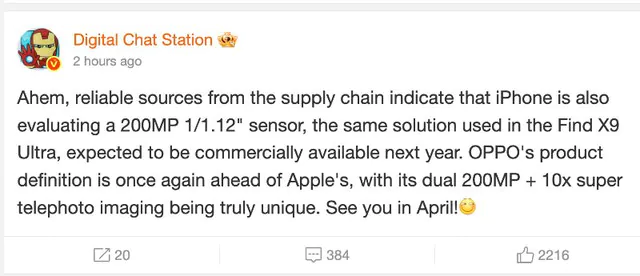
None other than the well-known Digital Chat Station tipster hints at such a possibility:
Exciting rumors! | Image by Weibo account of Digital Chat Station
Since the Find X9 Ultra by Oppo is expected to pack the Sony LYT-901 for its main camera, it's logical to assume it's the sensor that Digital Chat Station has in mind when discussing the iPhone. However, this most likely won't land on the iPhone 18 but on the iPhone in 2027 – which could be the iPhone 19 or iPhone 20 if Apple decides to skip a year in honor of the OG iPhone's 20th anniversary.
We've heard rumors that the iPhone might soon pack a 200 MP sensor, but it was rumored to be a Samsung-made one.
The Sony LYT-901 sounds exciting, though.
Unveiled at the end of 2025, the LYT-901 is a stacked CMOS sensor that measures 1/1.12 inches, making it large for phones. The sensor uses 0.7-micron pixels and Quad-Quad Bayer technology, grouping pixels together to improve low-light performance while still allowing full-resolution images through AI processing. It can shoot 200 MP photos at up to 10 fps or 50 MP images at 30 fps and supports crop zoom with minimal quality loss.
Recommended For You
Do you believe this?
22 Votes
Apple will pull this one off for 2027.
22.73%
I'm not really sure.
13.64%
I'm sure it won't happen and Apple will use an older sensor.
63.64%
How important is this?
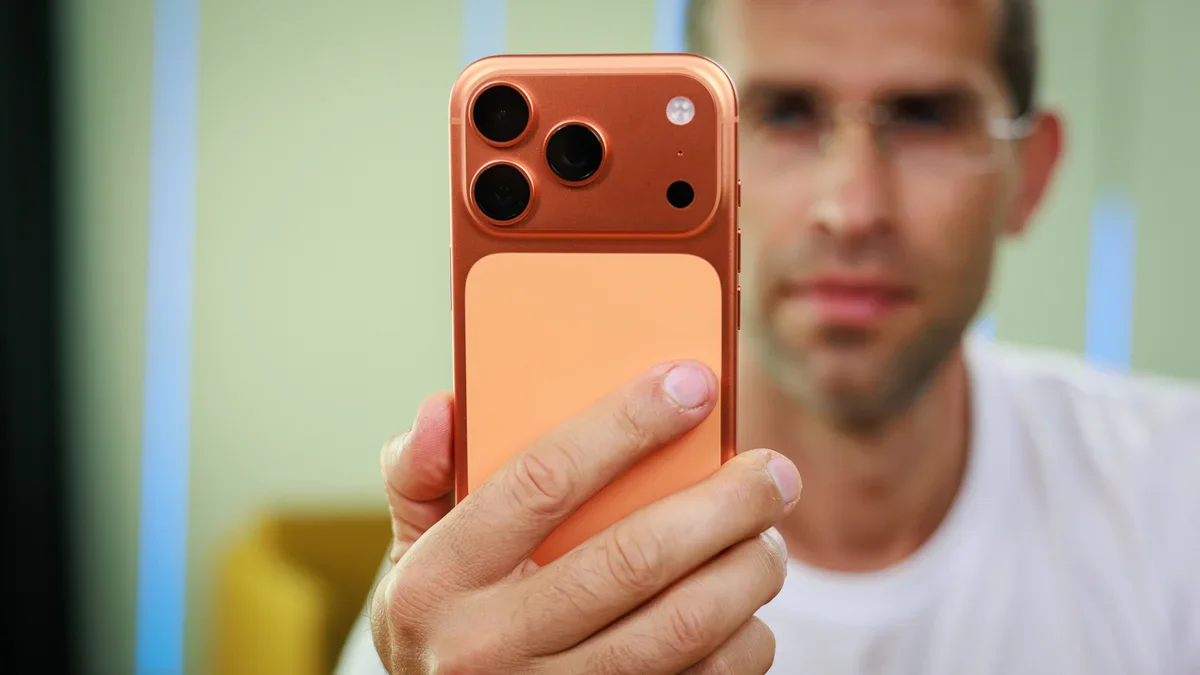
The main camera of the iPhone 17 Pro features a 48 MP Sony sensor. | PhoneArena
Flagships these days are defined by their camera systems. True, they also pack the latest and fastest chipsets, serious batteries. They come with a premium build or offer neat exclusive features (think of the Galaxy S26 Ultra's privacy display feature), but above all, flagships are about that camera experience.
It takes more to make a camera than simply installing a cutting-edge sensor. There's the lens in front of it, which has its own characteristics like an aperture, distinct elements in groups, coatings and whatnot. There's also the Image Signal Processor (ISP) which converts raw data from a camera sensor (the light that the sensor's pixels have absorbed) into viewable images or video. Then, there's the style that each company applies to its devices, the magic formula, so to speak (white balance, color reproduction, noise, etc.) – and there's the computational photography moment, too.
That's why the same sensor in two different phones (by different brands) doesn't guarantee you the same results. Not at all.
But a sensor is a central part of a camera. For example, you can spend $10,000 on a lens for your DSLR camera, but that won't force your sensor to suddenly spit out images with a higher dynamic range (the ratio between the maximum and minimum measurable light intensities). You can fine-tune a sensor, but it'll always "show" its own capabilities, characteristics and limitations.
That's why I'm fascinated by the idea of Apple using the Sony LYT-901. Right now, the Sony IMX903 is used on the main camera on the iPhone 17 Pro (1/1.28-inch, f/1.8). Moving a larger and more advanced sensor sounds great.
Fingers crossed.
iMac (M1 series, 2021) flash sale! Limited time offer!
Save $40 on iMac (M1 series, 2021) from Back Market. Discount automatically applied at checkout. Offer ends 27 September 2026 at 23:59.
Sebastian is one of PhoneArena’s senior opinionators. A veteran news writer with almost 20 years of experience in media and technology, he not only covers all the hot news about Galaxies and iPhones, but often provides hot takes on industry trends. He’s fascinated with camera-focused flagships from the likes of Oppo and Vivo, as well as foldable phones.
A discussion is a place, where people can voice their opinion, no matter if it
is positive, neutral or negative. However, when posting, one must stay true to the topic, and not just share some
random thoughts, which are not directly related to the matter.
Things that are NOT allowed:
Off-topic talk - you must stick to the subject of discussion
Offensive, hate speech - if you want to say something, say it politely
Spam/Advertisements - these posts are deleted
Multiple accounts - one person can have only one account
Impersonations and offensive nicknames - these accounts get banned
To help keep our community safe and free from spam, we apply temporary limits to newly created accounts:
New accounts created within the last 24 hours may experience restrictions on how frequently they can
post or comment.
These limits are in place as a precaution and will automatically lift.
Moderation is done by humans. We try to be as objective as possible and moderate with zero bias. If you think a
post should be moderated - please, report it.
Have a question about the rules or why you have been moderated/limited/banned? Please,
contact us.










Things that are NOT allowed:
To help keep our community safe and free from spam, we apply temporary limits to newly created accounts: