Next year will be a big one for the application processors (APs) that drive the iPhone. That's because next year's A20 and A20 Pro APs will be the first iPhone processors produced using TSMC's 2nm processor. The industry's first 3nm AP was the A17 Pro chip that was made using TSMC's first-generation N3B process for the iPhone 15 Pro and iPhone 15 Pro Max.
The first iPhone models powered by a 2nm application processor are coming next year
The A18 AP (used on the iPhone 16 and iPhone 16 Plus) and A18 Pro AP (iPhone 16 Pro and iPhone 16 Pro Max) both were manufactured by TSMC using the same cost-effective "enhanced" 3nm process node. The current iPhone 17 base model is powered by the A19 AP made using TSMC's third-gen N3E 3nm process node. The iPhone Air, iPhone 17 Pro and Phone 17 Pro Max are equipped with the A19 Pro AP produced using TSMC's third-gen 3nm process node (N3E).
With TSMC expected to move to the first-generation 2nm process node for the A20 and A20 Pro APs, Apple has reportedly turned to its standard operating procedure by reserving half of TSMC's 2nm production capacity to keep any potential rivals, including Qualcomm and MediaTek, from building enough 2nm APs to power a rival smartphone. But even with control over half of TSMC's first-generation 2nm production, there is concern that TSMC won't be able to produce enough chips to meet Apple's needs.
Apple has no plans to switch to Samsung Foundry from TSMC. Here's why.
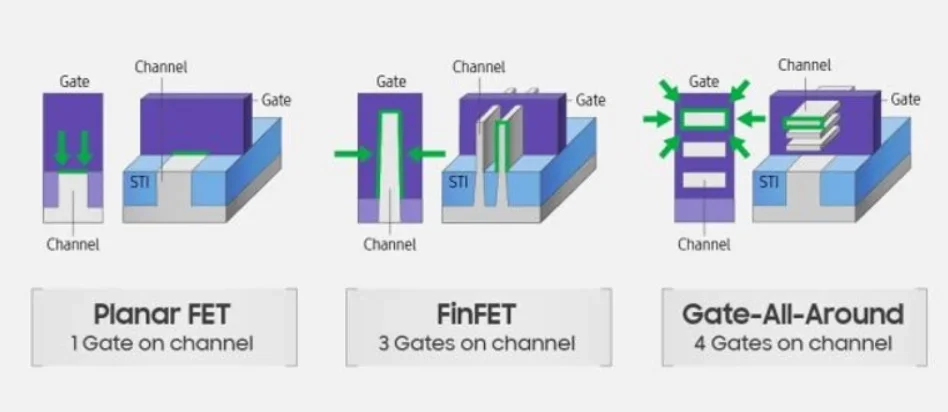
Despite a potential shortage, Apple has no plans to switch to Samsung Foundry and use its 2nm process node which also includes the use of Gate-All-Around (GAA) transistors. These transistors replaced FinFETs on Samsung Foundry's production starting with last year's 3nm Exynos 2500 AP. GAA transistors use vertically placed horizontal nanosheets to cover the channel on all four sides reducing current leaks and improving the drive current. Using GAA transistors result in a more powerful and energy efficient chip.
Heavy demand for 2nm chips from AI companies, combined with Apple tying up roughly half of TSMC's 2nm production is part of the reason that shortage rumors are floating around TSMC. There is also concern that with TSMC debuting its Gate-All-Around transistors with its 2nm production, issues over yield might surface.
Recommended For You
Should Apple switch to Samsung Foundry from TSMC?
72 Votes
Yes. It will be able to access new tech before TSMC has it.
34.72%
No. Why mess with something that is working?
65.28%
Still, Apple would prefer to stick to TSMC to build the iPhone's APs because of Samsung Foundry's past issue with yields which left Samsung no choice but to drop the Exynos 2500 AP for some Galaxy S25 and Galaxy S25+ units earlier this year. Samsung allegedly spent $400 million to replace its own decacore AP with the Snapdragon 8 Elite on those aforementioned models in markets like South Korea, Europe, and parts of Asia. Samsung hopes to use the 2nm Exynos 2600 AP to power the Galaxy S26 and Galaxy S26+ next year, in certain regions.
Apple also relies on TSMC to build its other silicon components including Apple's M-series processors, the S-series "System in a Package" (SiP) chips found in the Apple Watch (these have been built in TSMC's newest facility in Arizona starting this year), the C-series in-house modem chips, and the N-series Wi-Fi chip. There are even more silicon-based components that TSMC produces for Apple.
Sharply rising silicon wafer costs will eventually lead to higher flagship phone prices
After 2nm TSMC will switch to Angstrom to specify its process nodes under 2nm. The first will be the A16 process node (1.6nm) which is forecast to begin production in 2026. That will be followed by the A14 (1.4nm) in 2027-2028. The A16 will debut TSMC's GAA transistors and its Backside Power Rail. We've already discussed the former. The latter moves power wires to the back of a silicon wafer leaving more room in front for signal wires. This will increase transistor density and prevent power bottlenecks from reducing power.
Samsung Foundry currently uses Gate-All-Around to improve the performance and power efficiency of 3nm and 2nm APs. | Image credit-Unknown
While this is all good because who doesn't want improvements to the APs on their smartphones, it all comes at a great cost, literally. Back when Samsung launched 10nm APs in late 2016, the cost of the 12-inch (300mm) silicon wafers that the 10nm chips were layered on top of was around $6,000 each. As process nodes have dropped and have become more complex, that price has risen.
This year, silicon wafers for 2nm production have risen to $30,000 for each one. The price is forecast to rise another 50% to $45,000 for TSMC's A14 production in 2027. Eventually this os going to result in price hikes for flagship phones.
By the way, if you're wondering which phone will be the first to use a 2nm AP, it will not be an iPhone. In February we expect Samsung to release the Galaxy S26 and Galaxy S26+ and the models sold in South Korea, Europe, and parts of Asia will feature the Exynos 2600 AP built by Samsung Foundry using its 2nm GAA process node. The first iPhone models to use a 2nm AP will be next year's iPhone 18 series, which will be released six months after the Galaxy S26 series is made available.
Trade in your old phone for cash at ecoATM!
Recycle your used phone and get instant cash. Find out how at ecoATM!
Alan, an ardent smartphone enthusiast and a veteran writer at PhoneArena since 2009, has witnessed and chronicled the transformative years of mobile technology. Owning iconic phones from the original iPhone to the iPhone 15 Pro Max, he has seen smartphones evolve into a global phenomenon. Beyond smartphones, Alan has covered the emergence of tablets, smartwatches, and smart speakers.
A discussion is a place, where people can voice their opinion, no matter if it
is positive, neutral or negative. However, when posting, one must stay true to the topic, and not just share some
random thoughts, which are not directly related to the matter.
Things that are NOT allowed:
Off-topic talk - you must stick to the subject of discussion
Offensive, hate speech - if you want to say something, say it politely
Spam/Advertisements - these posts are deleted
Multiple accounts - one person can have only one account
Impersonations and offensive nicknames - these accounts get banned
To help keep our community safe and free from spam, we apply temporary limits to newly created accounts:
New accounts created within the last 24 hours may experience restrictions on how frequently they can
post or comment.
These limits are in place as a precaution and will automatically lift.
Moderation is done by humans. We try to be as objective as possible and moderate with zero bias. If you think a
post should be moderated - please, report it.
Have a question about the rules or why you have been moderated/limited/banned? Please,
contact us.














Things that are NOT allowed:
To help keep our community safe and free from spam, we apply temporary limits to newly created accounts: