If you ask Pixel users to set aside their biases and honestly tell you whether they are truly impressed with the performance of their Pixel phones given the flagship prices, the answer would most likely be a big NO. I, personally, own a Pixel 10, and after using it for several months, I have realized that it definitely has plenty of plus points, but performance isn't among them. Fortunately, it appears that Google has finally decided to give importance to this department as well, as the Tensor G7 chip, which would be powering the Pixel 12 lineup, is reported to get a big performance boost.
Pixel 12 could justify its premium price tag
While we are almost a month away from the scheduled release date of the Pixel 11 series, early rumors regarding the Pixel 12 family have already started to surface. It was recently reported that next year's Google phones will continue to use Tensor chipsets, and it will most likely be the Tensor G7. Now an X account, Reptalica, claims that the tech giant is working on making the Tensor G7 compatible with LP5x and LP6 packaging variants.
It's important to note here that the report might be talking about two different memory packages instead of two entirely different versions of the Tensor G7 chip. Most of the current flagship phones, including the Pixel 10 and the Galaxy S26, use the LPDDR5X memory. So basically, Google is reportedly considering or testing support for LPDDR6 for the Tensor G7 SoC.
If Google actually ships its Pixel 12 phones with LPDDR6 RAM, it would result in higher memory bandwidth, which could give the phones an advantage over their competition when running on-device AI tasks. This is something Google would definitely appreciate, as it is apparently giving a lot of preference to AI capabilities, which is evident from the fact that it has launched a lot of AI-related features recently, like Camera Coach, Magic Cue, and more, to its smartphones.
Recommended For You
The use of the new standard could also mean that the company would adopt a higher 96-bit bus width. Here, the memory bus refers to the connection between the chipset and the RAM. So, the use of the 96-bit bus instead of the 64-bit bus, which is most likely used in the Pixel 10, basically means that the data will transfer faster, which will eventually result in faster AI responses, smoother multitasking, and lower power consumption.
What do you think is the biggest weakness of Pixel phones right now?
363 Votes
Average performance for a flagship price.
34.71%
Poorer battery life than competing phones.
30.85%
Pixel cameras aren't as impressive as they used to be.
11.29%
Too much priority given to boring AI features.
23.14%
Most Pixel users are done with the Tensor chipset
The use of in-house Tensor chipsets allows Pixel phones to have tight software integration and really cool AI features. However, these things are not big enough to justify their mediocre performance when compared to Qualcomm Snapdragon and Apple chipsets. In fact, the use of Tensor is what has kept Pixel phones behind their competitors in departments like gaming and heat management.
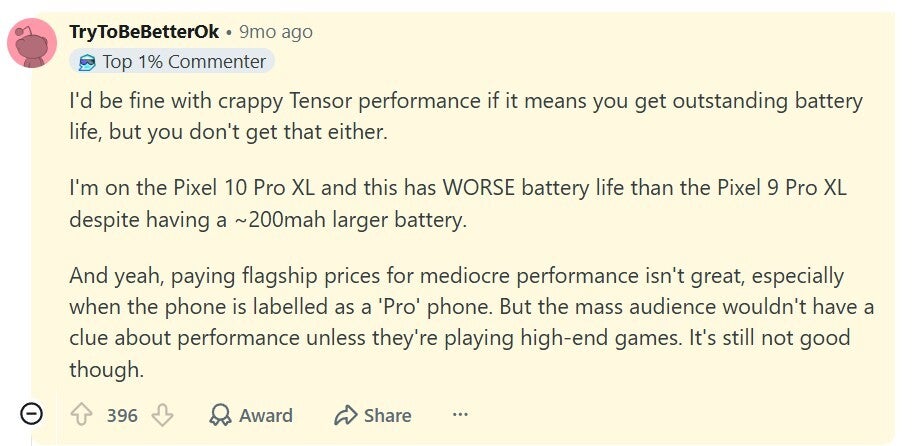
Many users say that if the use of in-house chips had allowed Google to offer an incredible battery life to its smartphones, then they would definitely have ignored the overall average performance. However, as per online reports, the battery life isn't great either.
Complaint about poor battery performance of Pixel phones. | Image by PhoneArena
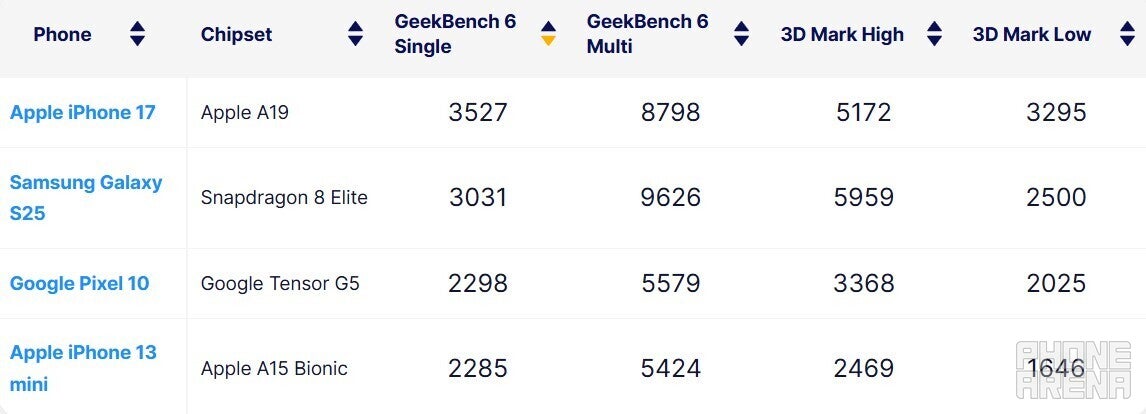
Adding fuel to everything is the price of Pixel phones. They're priced at the same level as the flagships from other brands like Apple and Samsung; however, they fail to compete, let alone talk of defeating either of them. For instance, in Geekbench 6 multicore testing, the Galaxy S25 topped the list with a score of 9,626, the iPhone 17 came second by scoring 8,798, and the Pixel 10 was defeated by a big margin with a score of only 5,579.
Geekbench 6 testing of multiple phones. | Image by PhoneArena
The multicore testing rating basically indicates how well the phone performs in heavy tasks like video editing or gaming. So, the higher the number, the better the performance you would get. Software optimization and chip efficiency play a vital role in the overall performance of a device, but if you compare the raw numbers, you will find that the Geekbench 6 multicore score of the vanilla Pixel 10 is similar to that of the iPhone 13 Mini, which received a score of 5,424 in our in-house testing.
Google might give preference to its Pro devices
Since I don't know much about the X account Reptalica, I would highly advise taking this news with a grain of salt, as I really can't vouch for their credibility. However, if it's actually true and Google is indeed testing the Tensor G7 with the LPDDR5X and LPDDR6 variants, it could be possible that the company uses the latter, faster variant in its Pro models like the Pixel 12 Pro. The brand has done something like this before as well when it made the Zoned UFS storage reserved only for the Pixel 10 Pro models. So it wouldn't be a surprise if we see something like this with the memory variants in the Pixel 12 lineup.
All that said, we should always remember that we hear this story every year that the next year's Tensor chipset will be revolutionary. It has definitely turned out to be true most of the time, but only when compared to last year's Tensor model. It'll be interesting to see if Tensor G7 can compete against the latest Apple A series and Snapdragon processors.
Mint Mobile's 6-month plans now cost $10/mo
$10
/mo
$35
$25 off (71%)
Mint Mobile is celebrating its 10-year anniversary with a special offer on its six-month subscription plans. For a limited time, you can get your preferred tier (6GB, 17GB, 23GB or unlimited) for just $10/mo. That saves you between 50% and 71% on the carrier's mobile plans, making it way easier to recommend.
Aman Kumar is a news writer at PhoneArena covering Google Pixel phones, Android features, AI-powered smartphone tools, and mobile tech news. Before joining PhoneArena, he spent over five years writing about consumer technology for publications like MakeUseOf, How-To Geek, and Guiding Tech. His current daily drivers are the Pixel 10 and Samsung Galaxy S26 Plus, while his red iPhone SE (2nd gen) remains a personal favorite. Aman also appreciates bold smartphone experiments and still considers the Nokia N-Gage one of the industry’s most iconic designs.
A discussion is a place, where people can voice their opinion, no matter if it
is positive, neutral or negative. However, when posting, one must stay true to the topic, and not just share some
random thoughts, which are not directly related to the matter.
Things that are NOT allowed:
Off-topic talk - you must stick to the subject of discussion
Offensive, hate speech - if you want to say something, say it politely
Spam/Advertisements - these posts are deleted
Multiple accounts - one person can have only one account
Impersonations and offensive nicknames - these accounts get banned
To help keep our community safe and free from spam, we apply temporary limits to newly created accounts:
New accounts created within the last 24 hours may experience restrictions on how frequently they can
post or comment.
These limits are in place as a precaution and will automatically lift.
Moderation is done by humans. We try to be as objective as possible and moderate with zero bias. If you think a
post should be moderated - please, report it.
Have a question about the rules or why you have been moderated/limited/banned? Please,
contact us.













Things that are NOT allowed:
To help keep our community safe and free from spam, we apply temporary limits to newly created accounts: