Here it is, guys, the next big thing in the world of Android smartphones. Let us introduce you to the Samsung Galaxy Nexus – the third Google phone, which comes to succeed the Nexus S by Samsung and Nexus One by HTC. Тhe Nexus line-up represents probably the hottest and most desired selection of Android handsets, at least by die-hard geeks around the world. Always cutting-edge as far as technology goes, always having that invisible appeal built-in, making consumers lust after these phones. Have Samsung and Google done well with this latest addition?
In a landscape that competitive, it's really hard for manufacturers to produce a long-lasting handset which has enough potential to stand out from the crowd and kind of rule them all. We've witnessed this only on very few occasions within the Android ecosystem, but knowing what a milestone this is for Google's mobile OS, we just can't help it but set our expectations high. Because of this, in order to be a success, the Galaxy Nexus has to treat us to the best, and nothing but the best. Anything less would be considered a failure. And isn't that the general concept behind the Nexus phones – to obtain the status of being reference devices for all other manufacturers? Besides this, however, the Galaxy Nexus is the first handset to come with the Ice Cream Sandwich version of the OS – a version which could as well be considered as a brand new platform, having in mind its complete redesign.
We know what you're thinking – let's not waste any more time and see if the Samsung Galaxy Nexus lives up to the expectations!
Please note that we're testing the global model of the Galaxy Nexus, which is equipped with an HSPA+ radio, but the handset is also expected with Verizon, where it'll sport LTE, but will also be slightly thicker.
Design:
The Nexus One was one of the most refined Android devices from design standpoint, while the Nexus S came with that attractive curved glass on top of its display. Now, with the Samsung Galaxy Nexus, we again witness this curved design, as well as some other little treats. For example, the back cover uses the so-called Hyper Skin finish, which provides a better grip, and an overall nice feel to the touch. However, the phone's body is still entirely made of plastic, which translates to a relatively light weight, but also to a somewhat standard feel, which fails to captivate or wow the user. There's nothing premium with the build quality and construction of the Samsung Galaxy Nexus, and this is our biggest disappointment with its design. Really, it feels somewhat underwhelming when you take such a well-specced, premium phone, snap the back cover off, and realize that it's one of the thinnest pieces of plastic ever used for the outer shell of a consumer electronics device. Thankfully, the handset doesn't feel cheap in the hand, but it doesn't feel classy as well.
Recommended For You
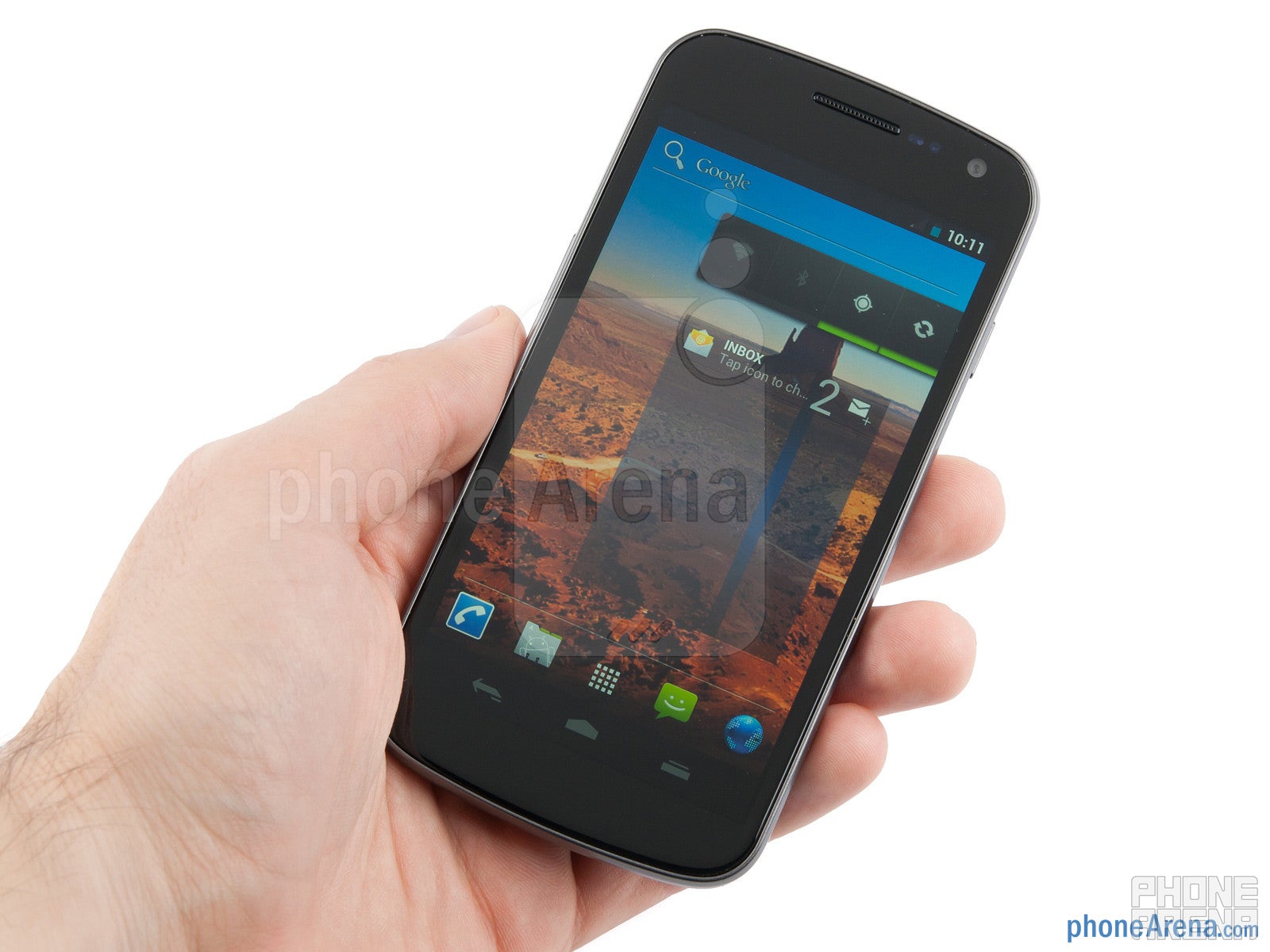
With the Samsung Galaxy Nexus, we again witness the curved design of its predecessor
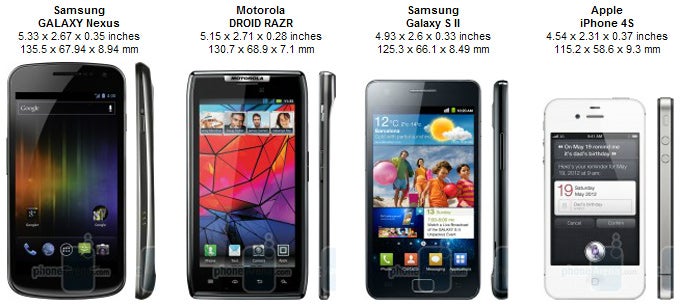
You can compare the Samsung Galaxy Nexus with many other phones using our Size Visualization Tool.
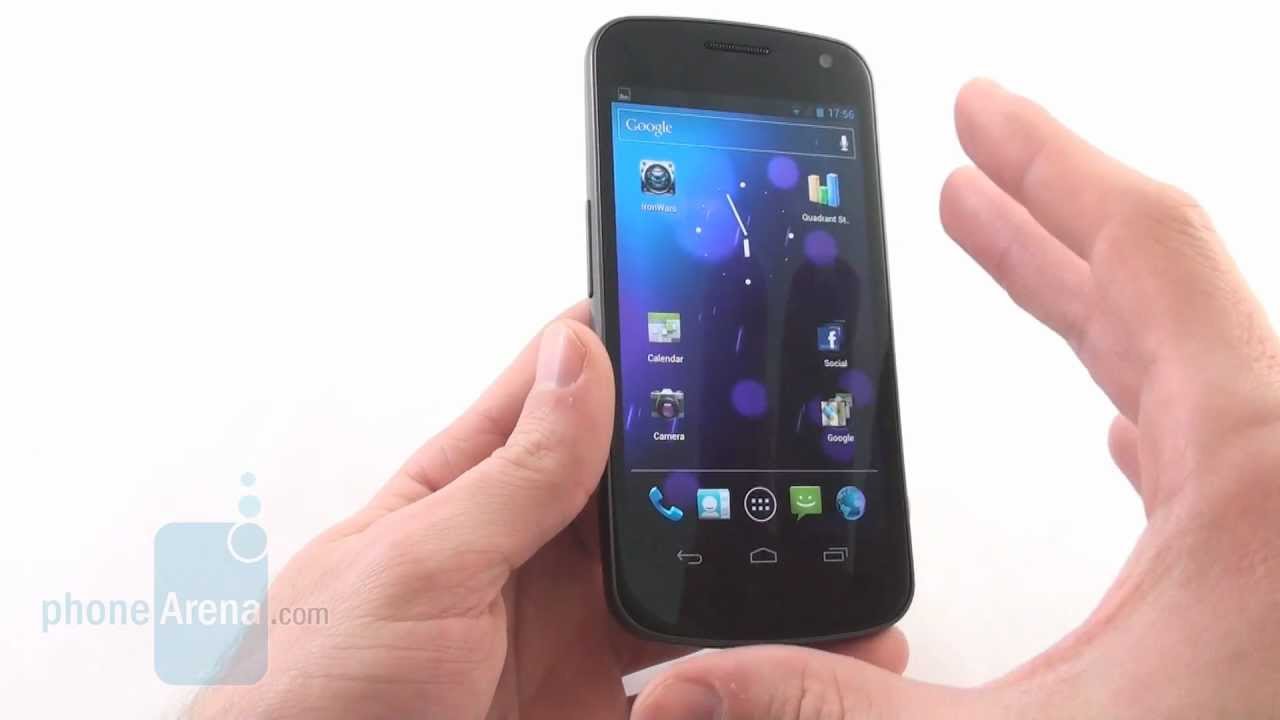
Yes, there's still this curved glass on the front, but we don't consider it as being something beneficial in any way. The curve is actually very slight, so we really see no difference between this and a completely flat glass. Otherwise, the display beneath it is quite impressive. The Galaxy Nexus sports an enormous 4.65” screen with an HD resolution of 720x1280 pixels. And even with a screen this big, we're happy to report that the pixel density is 316 ppi, which means that all kinds of fine details and small text that appear on this display remain clearly visible. The Galaxy Nexus sports an HD Super AMOLED screen, which uses an RGBG PenTile matrix for pixel arrangement. This actually shouldn't trouble anyone, as we don't find the overall image quality to be inferior compared to what you see on standard RGB matrix-based displays. Well, if you look really closely at certain elements, like white text on black background, for example, you can actually notice the individual pixels, but this can't be seen when using the phone normally. Naturally, having an AMOLED screen, the Galaxy Nexus offers those characteristic high contrast levels, wide viewing angles, and very saturated colors, that kind of bring images to life. The screen is usable outdoors (and in sunny conditions), though legibility isn't perfect. Samsung definitely has some room for improvement in this respect.
The Samsung Galaxy Nexus sports an enormous 4.65” screen with an HD resolution of 720x1280 pixels
Due to the large screen, you can imagine that the handset can't be compact. Indeed, the Galaxy Nexus is quite large, but interestingly, it isn't uncomfortable to hold and use with one hand only.
For the first time in an Android handset, you won't find any buttons below the screen. That's because the Galaxy Nexus has been designed to run Ice Cream Sandwich, which now features on-screen keys for navigation in Android, just like in Honeycomb tablets. As a result, the front side of the device is completely clean and looks very cool.
Around the device we find a standard microUSB charging port, 3.5mm headset jack, volume rocker and a power key. Interestingly, there is also a three-dot connector on the handset's right side, which will be used for docking the device with some kind of a docking station. On the back side is what many would consider the Galaxy Nexus's downfall – a 5MP camera, instead of something more contemporary like an 8MP one. While we would have really liked it more if it had an 8MP shooter, we'd still be satisfied with this one, if the Galaxy Nexus manages to produce some good-looking results. But more on this later.
Overall, the Samsung Galaxy Nexus is a very well-made device, which looks good, but lacks personality. The neutral color scheme and the non-premium materials in use don't help as well.
Samsung Galaxy Nexus 360-degrees View:
Drag the picture or use the keyboard arrows to rotate the phone. Double click or press keyboard
Space to zoom in/out.
Drag the picture in the desired orientation to rotate the phone.
Interface:
Being the very first handset to run Android Ice Cream Sandwich, the Samsung Galaxy Nexus represents a true milestone for the Android operating system. Ice Cream Sandwich is one of the most-anticipated Android iterations ever, since it finally bridges the phone and tablet experience. What this means is that both Android phones and tablets will run Ice Cream Sandwich (and the versions after it), and not two separate platforms, like it has been until now with Android Gingerbread and Android Honeycomb. The case with ICS is that it's built on top of Honeycomb and not Gingerbread. Because of this, ICS brings a brand new experience to Android phone users, equal to a complete redesign of the platform.
First of all, if you have used a Honeycomb tablet, you'll feel right at home with the Samsung Galaxy Nexus. Most of the UI elements are preserved, and pretty much the whole interface follows the same logic. If you haven't had the chance to work with Honeycomb yet, there'll be a slight learning curve, but very slight indeed - we promise! After all, this is still Android.
As always, your homescreen is divided into multiple pages, on which you can place widgets, app shortcuts and so on. The beauty in this is that you can get instant access to various features of your handset like email, weather, etc., right from your homescreen, whereas on a device with a more static homescreen, like the iPhone, you have to launch a separate application in order to get to such information. Both approaches have their pros and cons though, and the one in Android isn't flawless by any means. More stuff on your homescreen means a more complicated environment and higher demand for system resources, but overall, it basically comes down to personal preference whether you'd prefer a more “open”, customizable approach like in Android or a more streamlined one like in the iPhone. A new element in ICS is that you can create application folders by simply dragging an app shortcut and placing it over another one, just like in iOS. The styling of the new folders is also quite appealing.
Samsung Galaxy Nexus represents a true milestone for the Android operating system
No buttons design:
An interesting aspect of the ICS software is that, similarly to Honeycomb, the navigational keys “Back”, “Home” and “Multitasking” are part of the interface, and not separate touch-sensitive keys. So, these buttons do take a certain part from your screen real estate, but the Galaxy Nexus has enough of this with its 4.65” display, so there's still more than enough room for the important stuff. But don't think there's so much of a benefit associated with this all-screen thing, at least for now. It looks cool and is useful for some apps like the video player, where the on-screen buttons disappear to allow the app full use of the display. Unfortunately, not many apps take advantage of this feature right now, as you may imagine. If developers decide to optimize their apps for this feature in the future however, we do see some pretty sweet possibilities.
The notification dropdown is now transparent; and overall, notifications have been improves with the addition of the 'swipe away' gesture to remove unwanted items. They are also accessible from the lock screen. The Settings app has also been enhanced to have a more organized feel, though there are still some unintuitive elements like the way you get into the screen which was previously called “WiFi Settings” (the one where you get to pick a Wi-Fi network).
System performance:
As a whole, Google has made terrific progress with the beautified interface and stramlined functionality of the Ice Cream Sandwich platform. Using an Android phone has never looked or felt better. On top of this, the handset treats us to a spectacular performance. It just flies no matter if you're swiping through homescreen, scrolling long lists, webpages, or opening and closing heavy applications. The occasions where we noticed a slight slowdown (like when switching to landscape QWERTY) were so few, that we'd go as far as to say that the Samsung Galaxy Nexus is one of the fastest smartphones out there today. This is probably due to the ICS software being well-optimized to work with the TI OMAP 4460 processor that's inside the Nexus. The processor itself sports two cores, clocked at 1.2GHz, so you can rest assured that you'll be able to take advantage of the potential performance boost that comes with applications and games, optimized for dual-core CPUs.
People app:
The highlights of the new UI start with the brand new People app. This replaces the Contacts app and is a much cleaner, visual solution to showing your contacts. “Visual” because the person’s image occupies a much larger space, and “cleaner” because it gets rid of all boxes and many delimiters, leaving some nice blank spaces between fields, so you don’t feel in a clutter. Contact images borrow a magazine-style UI in Google’s words, but the Windows Phone community cried foul that ICS is borrowing Metro UI elements. The Phone app has also been redesigned allowing you to call contacts with a single tap.
The People app
Messaging:
Overall, Google is moving to a simplistic interface, just as the one it launched on its web services. A good example of this are the new messaging and email applications, which are very easy and pleasant to use. Google has also improved some other aspects like auto-completion of recipients, as well as auto-correction, among other enhancements.
The on-screen QWERTY keyboard has been vastly improved. The portrait option is very comfortable to use with one hand only, despite the phone's not so compact dimensions. To make things even better, the landscape QWERTY is one of the very best that we've ever used. It's keys are very nicely sized and spaced from each other, thanks to the 4.65” screen, while the haptic feedback is doing wonders to improve the overall experience of typing.
The on-screen QWERTY keyboard has been vastly improved
Setting up and operating with email (and Gmail) is a trouble-free process. While straightforward in their nature, the Email and Gmail apps are still equipped with lots of options to let you customize and refine your mail usage. Strangely, you can pinch-to-zoom in the Email app for a better view of the content of an email, but you can't do that in Gmail, which can make viewing of certain messages (some picture-rich newsletters, for example) a bit cumbersome.
Calendar:
The Calendar has been swipe-enabled, so you can now use gestures in the Calendar. Here, though, by swiping you switch between days, weeks and months. You can also pinch-to-zoom for a more detailed view of your agenda, which can be really helpful when you have set lots of appointments.
We were especially thrilled upon opening the ICS web browser on the Samsung Galaxy Nexus. Being one of the most used applications on a phone today, the web browser needs to be flawless. That's exactly what we find on the Samsung Galaxy Nexus. All kinds of navigation like scrolling, panning around, zooming in using pinch-to-zoom and double-tap work very smoothly, which is very important for us. If we have to compare it to the iPhone 4S, the Galaxy Nexus is a few frames-per-second behind, but the difference is negligible. The Android browser has always offered very quick page loading times (when coupled with the right hardware), and this tradition has continued with ICS on the Galaxy Nexus.
You may think that when all high-end Android phones lately have come with support for Adobe Flash Player, the latest and greatest newcomer will have this feature as well. Think again, as Adobe is yet to optimize Flash Player for ICS. As you've probably heard, the company has also announced that it's dropping support for Flash Player for mobile, but the good news is they will at least support Ice Cream Sandwich, so Galaxy Nexus user wannabes don't have a reason to worry.
The ICS web browser on the Samsung Galaxy Nexus
Now, the browsing experience itself is awesome, not only because of the outstanding responsivenes, but also because of this giant screen with an incredibly high-resolution. Naturally, the bigger the display, the better your experience, as long as the pixel density is kept high, and in the case of the Galaxy Nexus, you can be sure that its HD resolution, providing for a pixel density of 316 ppi is more than enough to make even small text very legible, on par with what you get with the iPhone 4S's Retina Display, if not slightly better.
A good extra new feature of the browser is that you can save a web page for offline viewing, which may be very handy if you know that you won't have internet access later. In addition, the user can also “request” to see the desktop version of a site, without having to scroll to the bottom of the page in search for a special link.
Connectivity:
As you can imagine, the Samsung Galaxy Nexus comes with a complete set of connectivity options, including Wi-Fi b/g/n/a and Bluetooth 3.0, as well as some exotics like NFC and MHL. Despite the fact that the Galaxy Nexus sports NFC, keep in mind that the handset is not support by Google Wallet yet. For this review, we've been testing the HSPA+ version of the phone, which offers theoretical peaks of up to 21.1 Mbit/s download, and up to 5.76 Mbit/s upload. However, the Galaxy Nexus is also expected to hit Verizon's shelves a bit later, where it'll come in an LTE flavor, so that users of the carrier can enjoy some blazing-fast data speeds.
The GPS of the Galaxy Nexus works very well. Even without the help of wireless networks, our location got pinpointed in just a couple of minutes.
Camera:
The new camera interface looks pretty simple and is relatively easy to get used to. In the meantime though, it does offer an array of basic options like white balance, exposure and scene modes. Video recording, on the other hand, comes with a set of fun face-detection-based effects like Big Eyes, Big Mouth, Big Nose and so on. We doubt that anyone would be using the much, but we're sure they will be particularly funny and entertaining for little kids (great way to get some alone time).
The new camera interface
The new Camera app also comes with a built-in Panorama mode, which works surprisingly well.
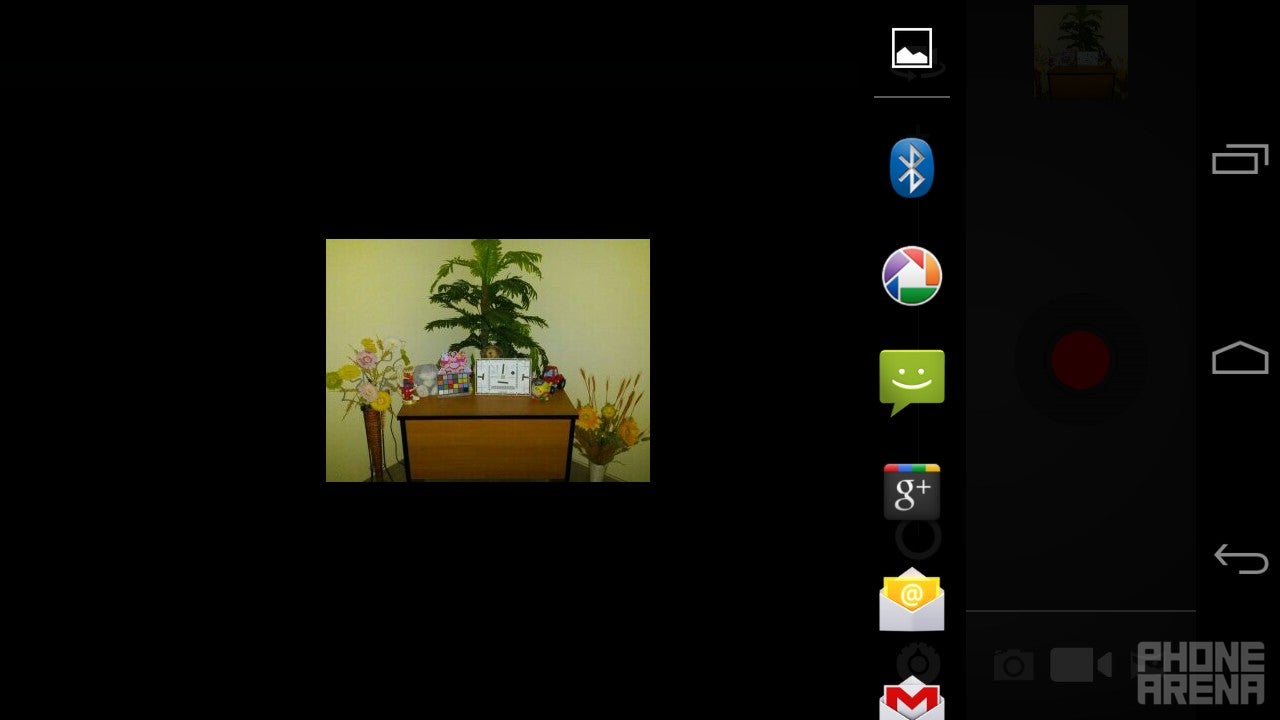
Google promised to strip shutter lag off the Camera app, and indeed we found the Samsung Galaxy Nexus to be extremely speedy in this aspect. As a whole, the Galaxy Nexus's camera is very fast. While testing the actual photo- and video-taking capabilities of the handset, we ran into a couple of problems. The first one is with image previews. When you've taken a photo and you want to preview it, as always, what you need to do is hit the little preview button on the side of the on-screen camera shutter key. However, this takes you to a photo-sharing screen, where you have a list of services, on which you can share your creation. In order to get to the actual preview screen (where you where you can zoom in, pan around, or even do some image editing), you have to tap on the image once again, and wait for another half a second. Of course, this isn't much, but we wonder why they have designed it this way, when you can easily choose to share your photo from the image preview screen as well... What we want to say is that we feel this intermediary “sharing screen” is unnecessary.
Dedicated photo-sharing screen
Anyways, the other issue is related to the continuous autofocus capabilities of the Samsung Galaxy Nexus. Sometimes, the phone will be very, very slow to shift the focus from the background to the object that's closer. At other times, it won't even change it, no matter how patient and stubborn you are. This doesn't happen always, but often enough to cause frustration.
The new Gallery comes with image-editing options built-in. Google has chosen a nice selection of tools that would definitely come in handy when you want to quickly tweak a photo that you've taken (or any other image). You can do various kinds of stuff like adjusting exposure or saturation, fixing the red-eyes, as well as applying different effects to your pictures.
The Gallery
Photo quality:
The Galaxy Nexus only has a 5-megapixel camera, but the photos that it produces aren't bad by any means. Quite the contrary, they exhibit natural and lively colors, as well as a pretty decent amount of detail. Objects are usually normally exposed, but the camera doesn't handle more dynamic scenes very well, meaning if your shot's going to be a more contrast one, some areas will probably turn out overexposed (as in our case).
Doing macros with the Nexus is very easy and fun, using the touch-to-focus functionality of the device. We found this to work flawlessly.
Outdoor samples taken with the Samsung Galaxy Nexus
Samples taken with the front facing camera
When we moved indoors to check how the smartphone's camera performs in lower-light conditions, we noticed that it managed to come up with some pretty tolerable pictures when shooting in situations with a strong light-source. However, once we started dimming the lights, the Nexus quickly started to lose quality. The LED flash is also pretty weak, causing some considerable loss in color quality, and failing to illuminate objects even at close distances.
Indoor samples
Video recording:
To tell you the truth, we're a bit underwhelmed by the video we shot with the Samsung Galaxy Nexus. Yeah, it's 1080p and all, but it's a bit choppy at 24 fps, which isn't something that we normally expect to see in a contemporary smartphone of this class. It's also somewhat jerky, and lacks fine detail.
Samsung Galaxy Nexus Sample Video:
Samsung Galaxy Nexus Indoor Sample Video:
Samsung Galaxy Nexus Time-lapse Sample Video:
Honestly, if you tend to be really strict with regards to the quality of your phone's camera, keep in mind that the Galaxy Nexus is good for outdoor, daylight images only. And its video-recording capabilities shouldn't be seriously considered at all. Compared to the iPhone 4S, for example, the Galaxy Nexus is visibly worse in this respect.
Multimedia:
The Music app is nothing to write home about, but this doesn't mean it isn't good. Actually, in line with the rest of the interface, it's rather simplistic in its nature, but naturally, it doesn't save you important content like album art covers. Digging deeper into its options, we actually find a full-fledged equalizer that can be freely adjusted by the user. Of course, it has a number of presets as well.
Video playback with the Samsung Galaxy Nexus is flawless. The handset easily plays 1080p videos of all sorts, including MPEG-4, DivX, Xvid and H.264, without a hint of stuttering. Not only that, but the Nexus makes the experience even better thanks to its larger than life screen, with super-vibrant colors and high contrast, courtesy of the Super AMOLED technology.
Performance and Conclusion:
Call quality on the Samsung Galaxy Nexus is fine. The handset is equipped with a decent earpiece, which manages to emit some natural tones. On the other end of the line, things to sound a bit more robotic, especially when the Nexus user is at a loud location, when the noise-cancellation would kick in. But the mic is also quite strong, so you'll surely be heard on the other side. Unfortunately, the loudspeaker of the device is on the quieter side.
Talk-time with the Galaxy Nexus's 1750mAh battery is rated at up to 8 hours and 20 mins on 3G, while it should stay operational for up to 11 days if it's just kept at stand-by.
Make no mistake, the Samsung Galaxy Nexus is an industry-leading smartphone. It easily trumps most of its competition by combining a pleasant appearance, killer performance, and a brand new phone operating system in Android 4.0 Ice Cream Sandwich. With such a list of assets, it's very hard for the Galaxy Nexus to fail. And that's what's making it such a good offering for smartphone users – it's a very balanced product, with no truly weak points (if you're not a camera maniac) and at least several very strong ones.
As we said, the Galaxy Nexus is one of the fastest phones we've seen. It just feels like it does everything with ease, without hesitating one bit. That's the kind of performance that we expect from a device of this caliber, and the Nexus manages to deliver it.
And then, we have Ice Cream Sandwich, which can be seen as a true game-changer in the world of phones. Of course, it's still Android, but it's not Gingerbread (or the ones before it) with its bleak visuals and confusing design. It's not even Honeycomb – the good, but not-quite-there tablet OS. The Ice Cream Sandwich experience on a phone feels much more polished than anything out of Android's camp until now, and it looks so much better. It's still futuristic, but not as uninviting as Honeycomb. This time, Google has nailed it with an OS which is both impressive, appealing, and approachable at the same time.
On the subject of its weak sides, we can mention the 5MP camera, which is quite good for outdoor photography, but mediocre (at best) at anything else. If we have to be perfectionists (which we have to be), we should also say that the Nexus needs some personality in the appearance department. Don't get us wrong – it's one good-looking handset, but it's just not eye-catching.
All of this makes for one of the best phones we've seen to date. Samsung has done a terrific job by producing this handset, which is surely going to become a reference phone for most other manufacturers. Of course, they would never have achieved this if it wasn't for Google's incredible software, which, dare we say, redefines the experience of using a cell phone.
A decent, but not as good alternative is the Motorola DROID RAZR, which is constructed much better, using higher-quality materials, but is also wider and not as comfortable in the hand, and runs Gingerbread (though it will receive an update to ICS later). The HTC Rezound is another suitable alternative on Verizon. And, if you feel like trying something non-Android, feel free to check out the iPhone 4S – it will present you with similar performance and rich ecosystem, but a significantly smaller, 3.5” screen as well.
Software version of the reviewed unit: Android 4.0.1, Build ITL41D
Every product we review or recommend is thoroughly tested by our in-house experts in real-world conditions, following our
review methodology
and
ethics statement
to ensure honest, independent, and data-driven results.
Rad Slavov is the Editor-in-Chief at PhoneArena. He joined the media in 2008, right on the cusp of the modern smartphone revolution. Through time and perseverance, he amassed a great deal of knowledge and industry know-how, allowing him to guide and organize the company's growing line-up of talented content creators and ever-expanding content portfolio.
A discussion is a place, where people can voice their opinion, no matter if it
is positive, neutral or negative. However, when posting, one must stay true to the topic, and not just share some
random thoughts, which are not directly related to the matter.
Things that are NOT allowed:
Off-topic talk - you must stick to the subject of discussion
Offensive, hate speech - if you want to say something, say it politely
Spam/Advertisements - these posts are deleted
Multiple accounts - one person can have only one account
Impersonations and offensive nicknames - these accounts get banned
To help keep our community safe and free from spam, we apply temporary limits to newly created accounts:
New accounts created within the last 24 hours may experience restrictions on how frequently they can
post or comment.
These limits are in place as a precaution and will automatically lift.
Moderation is done by humans. We try to be as objective as possible and moderate with zero bias. If you think a
post should be moderated - please, report it.
Have a question about the rules or why you have been moderated/limited/banned? Please,
contact us.









Things that are NOT allowed:
To help keep our community safe and free from spam, we apply temporary limits to newly created accounts: