U.S. makes progress on selecting spectrum for 6G
The NTIA shares the progress being made as four bands are being tested for 6G use.
U.S. starts analyzing possible 6G bands. | Image by Unknown
Have you started thinking about 6G yet? If you haven't, don't worry because there are organizations and groups that are doing their jobs and are getting ready for the next generation of wireless connectivity. You might think that there's plenty of time left, but we are expected to see the 6G era begin in 2030.
All signs point to the use of 7GHz for 6G
The president's chief adviser on matters related to telecom is the National Telecommunications and Information Administration (NTIA). Currently, the NTIA is working to open up spectrum for 6G. Back in October 2024, a group called 5G Americas shared a White Paper that suggested the use of the 7GHz band for 6G use, a recommendation that was seconded by networking firms Nokia and Ericsson.
President Donald Trump, who showed an early interest in 6G, signed a memorandum titled "Winning the 6G Race" last December. The NTIA was ordered to analyze frequencies in the lower 7GHz band (7125MHz–7400MHz), and in his "Big Beautiful Bill," President Trump ordered that 600MHz of spectrum in the frequency range between 1.3GHz and 10GHz be set aside for exclusive licensed use. Additionally, some federal government users might be forced to relocate to other bands between 7.4GHz and 8.4GHz.
Other bands being looked at for 6G include the 4.4GHz, 2.7GHz and 1.6GHz airwaves
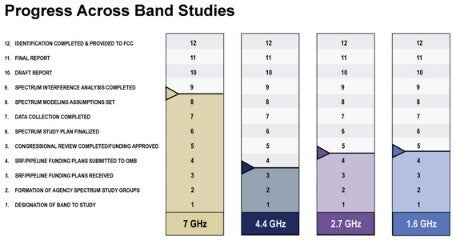
The NTIA launched a new website this week that shows how much work has been done on each band being considered for 6G use. For example, out of 12 specific tasks that each band must pass, the front-running 7GHz band is in between task eight and task nine with spectrum interference analysis next.
When do you believe 6G service will debut in the U.S.?
127 Votes
6G will launch in the U.S. in 2030 as expected.
32.28%
6G will be ready for the 2028 Summer Olympics.
16.54%
I expect 6G to arrive in the U.S. later than 2030.
30.71%
A miracle will happen and before 2028 6G will be in the U.S.
8.66%
Gee, I don't have an answer.
11.81%
The 4.4GHz band has completed three tasks with number four coming next. The 2.7GHz and 1.6GHz bands are coming up to task five. The NTIA's chief administrator Arielle Roth spoke last Thursday stating that the organization is working to identify spectrum in the 7GHz band. The NTIA's final report is due this coming December.
In her remarks made at the CTIA Summit on Wednesday, Roth said about spectrum, "We can reconfigure, modernize, and make more room." She also said that the more efficiently spectrum is being used, the more value it creates.
What seemed at first like a ridiculous tweet by Trump actually showed his interest in telecom and 6G
Roth also discussed the Spectrum Relocation Fund (SRF) used to pay for the spectrum analysis. Unlocking that money requires "submission of detailed pipeline plans, review by the Technical Panel, signed approval by the OMB director, and a 60-day Congressional notification period." Congress has 54 days left to fund the studies for the 2.7GHz band and the 4GHz band is right behind.
Trump Administration wants three 6G phones available for 2028 Summer Olympics
In her remarks, Roth continually praised President Donald Trump who famously tweeted in February 2019 that he wanted 6G in the U.S. "as fast as possible." What sounded like a joke back then actually seems to show a strong interest by Trump in the future of wireless telecommunications.
Where each proposed 6G band stands in spectrum studies. | Image by NTIA
Two months ago, a Qualcomm executive said that the chip designer had been in touch with the Trump Administration and the latter wanted three new 6G phones available by the time the Summer Olympics start in 2028. That doesn't mesh with current plans, but it doesn't mean that it won't happen.
Over a year ago, T-Mobile tested Nokia equipment in the 7GHz band as the carrier received a waiver from the FCC to perform such tests. Back then, T-Mobile said that the testing was done to "support the advancement of potential future wireless technologies," which we said sounded very much like 6G.
All signs seem to point to the use of 7GHz as one of the bands employed in 6G communications. As we get closer to the actual launch of the next generation of wireless connectivity, we will obviously know more.
We should see plenty of changes in the way that the carriers start to build out their 6G networks. Surely AT&T and Verizon won't make the same mistake by chasing speed over coverage. That was the fatal mistake that allowed T-Mobile to snatch up Sprint and its hoard of 2.5GHz mid-band airwaves that created the top 5G service in the U.S.


Popular stories
Latest News

Things that are NOT allowed:
To help keep our community safe and free from spam, we apply temporary limits to newly created accounts: