More often than not, we, the tech fans, are obsessed with chipsets (for the ultimate performance), batteries (10,000 mAh+ capacity, if you please!), super-bright displays or quad-camera setups with hundreds of millions of pixels and large apertures. That's fine and all, but at the end of the day, aren't we forgetting a phone's primary purpose? That's to keep us connected.
This is where modems come in – of what use would a blazing-fast processor be if your connection isn't particularly good?
Apple has gone to great lengths to cut its Qualcomm reliance over modems… and has largely succeeded, the latest Ookla findings show clearly.
A big upgrade
Back in 2025 when the iPhone 16e was launched, it arrived with the C1 modem under the hood. The C1 is Apple's creation, not Qualcomm's – and like almost all first-gen products, it had its fair share of shortcomings and hiccups. The C1 clearly lagged behind its Qualcomm counterparts.
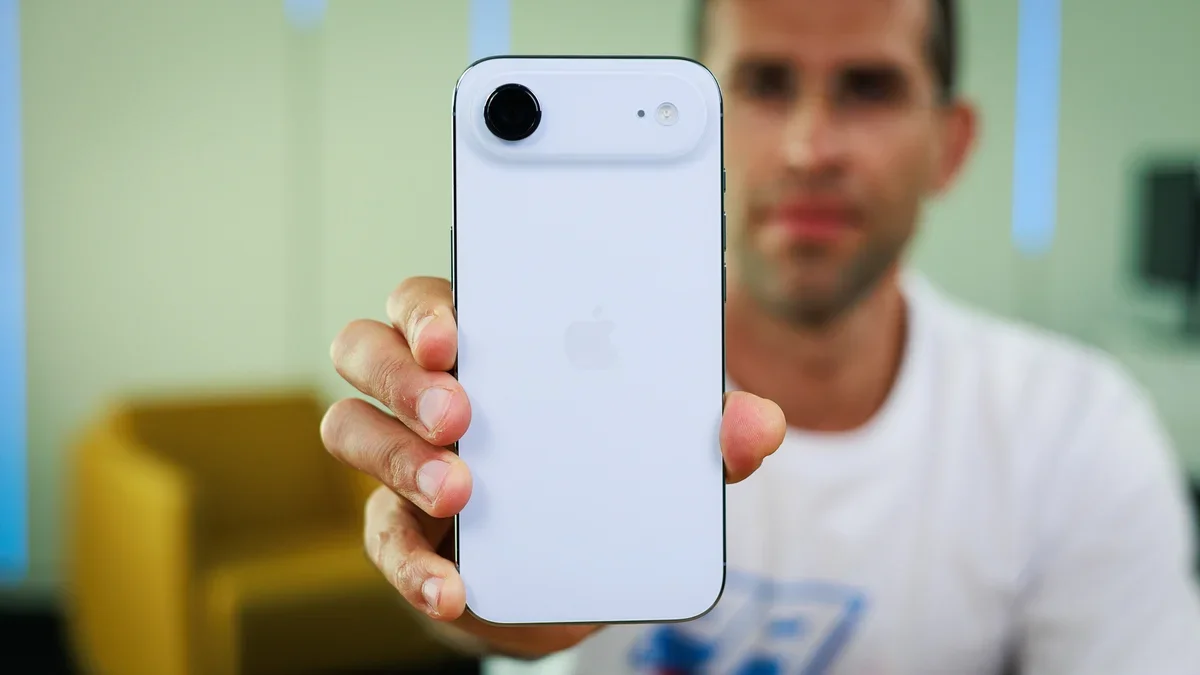
Mere six months later, when the iPhone Air arrived (this happened in September 2025), it showed off the C1X – another Apple-made modem, but this time, the project was executed with greater success. Maybe Apple wasn't convinced about the C1X, because it equipped the iPhone 17, the iPhone 17 Pro and the iPhone 17 Pro Max with the Qualcomm X80 modem.
Recommended For You
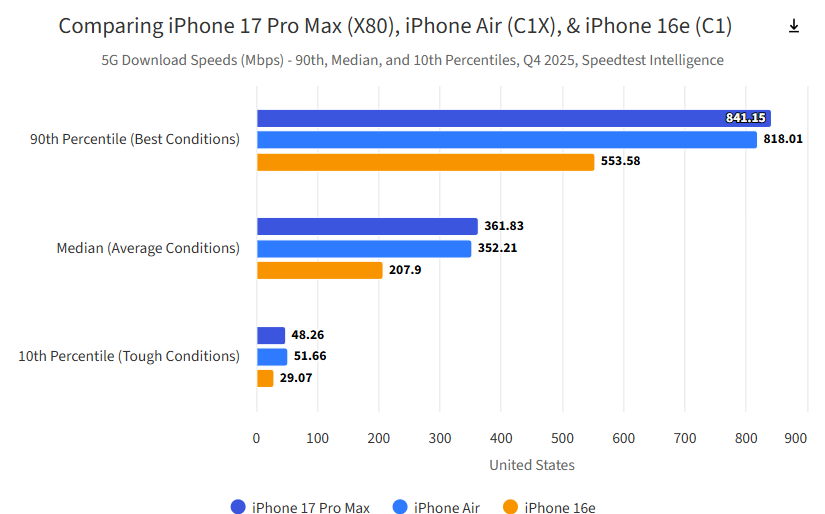
Ookla compared these and the findings show that the C1X has largely caught up with Qualcomm in terms of performance.
Speed tests results in the US. | Image by Ookla
While Apple's C1X modem in the iPhone Air is not as powerful on paper as Qualcomm's X80 modem in the iPhone 17 Pro Max, in everyday use the difference is much smaller. Tests that examined the best, average, and worst network conditions show that the C1X is a big improvement over Apple's earlier C1 modem.
The median results represent what most people experience daily, such as normal network congestion and average signal strength. The improvement was especially noticeable in places like the US, UAE, Saudi Arabia, China, Sweden, Singapore, and Japan, where the modem handles mid-band 5G more efficiently during busy hours. However, the C1X showed little or no improvement over the C1 in Brazil, India, and Malaysia. This likely happens because those markets rely more on low-band 5G or have heavier network congestion, which limits the modem's advantages.
Have you experienced modem issues with the iPhone 16e?
13 Votes
Yes, too often.
38.46%
Yes, rarely.
0%
Can't really say.
38.46%
No, everything's fine.
23.08%
Interestingly enough, when it comes to latency, the iPhone Air outperformed the iPhone 17 Pro Max in most markets. The iPhone Air showed lower latency than the Qualcomm-powered iPhone 17 Pro Max in 19 of the 22 markets that were tested.
The results could mean that Apple's closer integration between its modem and processor helps deliver a quicker and smoother experience.
So, maybe one should get the iPhone 17e over the iPhone 16e in the US. Of course, if you can wait another six months, it's best to see what Apple's C2 modem will be like in the iPhone 18 Pro. It seems that Apple will be waving Qualcomm goodbye sooner… rather than later.
Trade in your old phone for cash at ecoATM!
Recycle your used phone and get instant cash. Find out how at ecoATM!
Sebastian is one of PhoneArena’s senior opinionators. A veteran news writer with almost 20 years of experience in media and technology, he not only covers all the hot news about Galaxies and iPhones, but often provides hot takes on industry trends. He’s fascinated with camera-focused flagships from the likes of Oppo and Vivo, as well as foldable phones.
A discussion is a place, where people can voice their opinion, no matter if it
is positive, neutral or negative. However, when posting, one must stay true to the topic, and not just share some
random thoughts, which are not directly related to the matter.
Things that are NOT allowed:
Off-topic talk - you must stick to the subject of discussion
Offensive, hate speech - if you want to say something, say it politely
Spam/Advertisements - these posts are deleted
Multiple accounts - one person can have only one account
Impersonations and offensive nicknames - these accounts get banned
To help keep our community safe and free from spam, we apply temporary limits to newly created accounts:
New accounts created within the last 24 hours may experience restrictions on how frequently they can
post or comment.
These limits are in place as a precaution and will automatically lift.
Moderation is done by humans. We try to be as objective as possible and moderate with zero bias. If you think a
post should be moderated - please, report it.
Have a question about the rules or why you have been moderated/limited/banned? Please,
contact us.








![The Galaxy SmartTag 3 is here offering an alternative to the AirTag for iPhone users [UPDATED]](https://m-cdn.phonearena.com/images/article/183654-wide-two_350/The-Galaxy-SmartTag-3-is-here-offering-an-alternative-to-the-AirTag-for-iPhone-users-UPDATED.webp)



Things that are NOT allowed:
To help keep our community safe and free from spam, we apply temporary limits to newly created accounts: