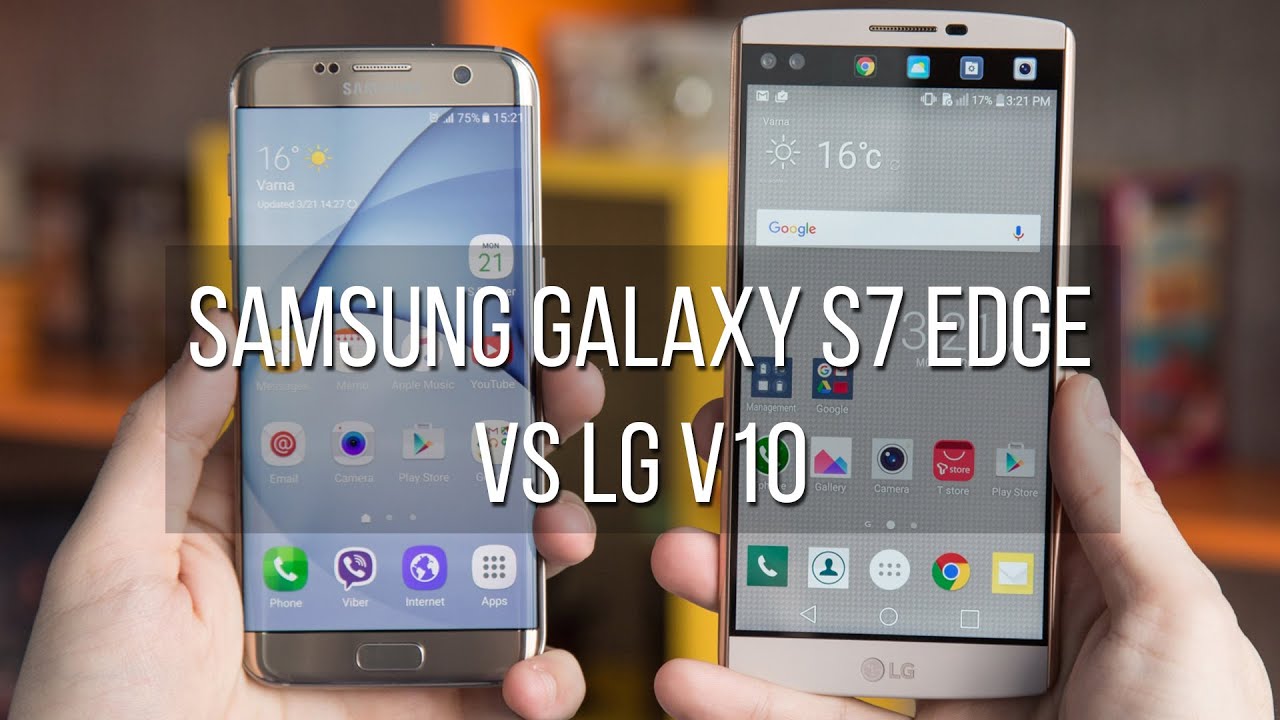
Samsung Galaxy S7 Edge vs LG V10
Introduction
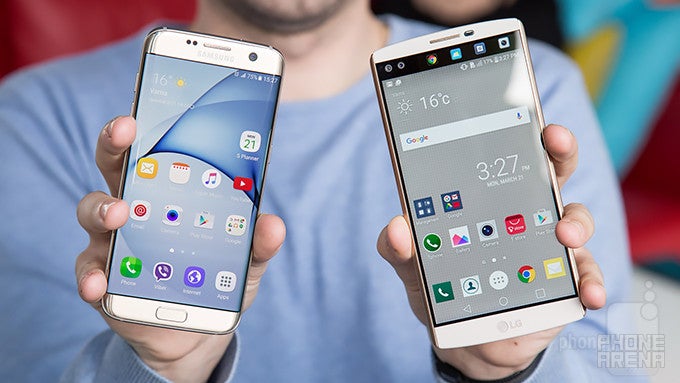
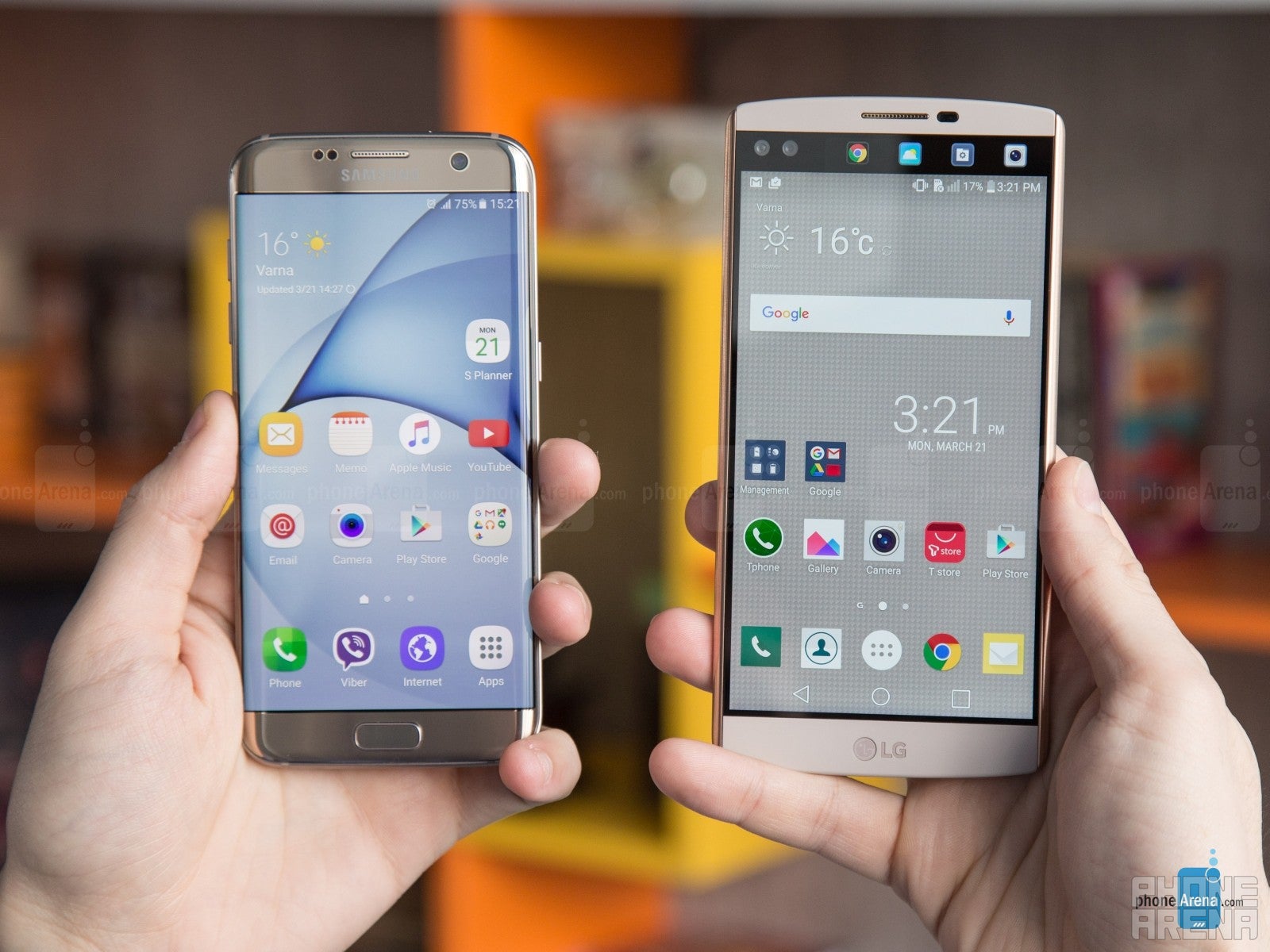
Samsung’s newest trendy phone is the Galaxy S7 Edge, a 5.5” device that does not feel as big as other devices with the same size screen, and that has a futuristic dual-curved display and a polished, stylish design.
How can LG counter this alluring new phone? Well, it’s got an ace up its sleeve as well: the 5.7” LG V10 is not as new, but it’s the latest phablet from LG and it is lauded for having one of the finest cameras you can find on a phone. It’s also got a fancy secondary screen and an interesting dual front camera system.
Design
Beauty and the beast: the Galaxy S7 Edge is stylish and extremely well made, while the LG V10 feels like a crude prototype in comparison
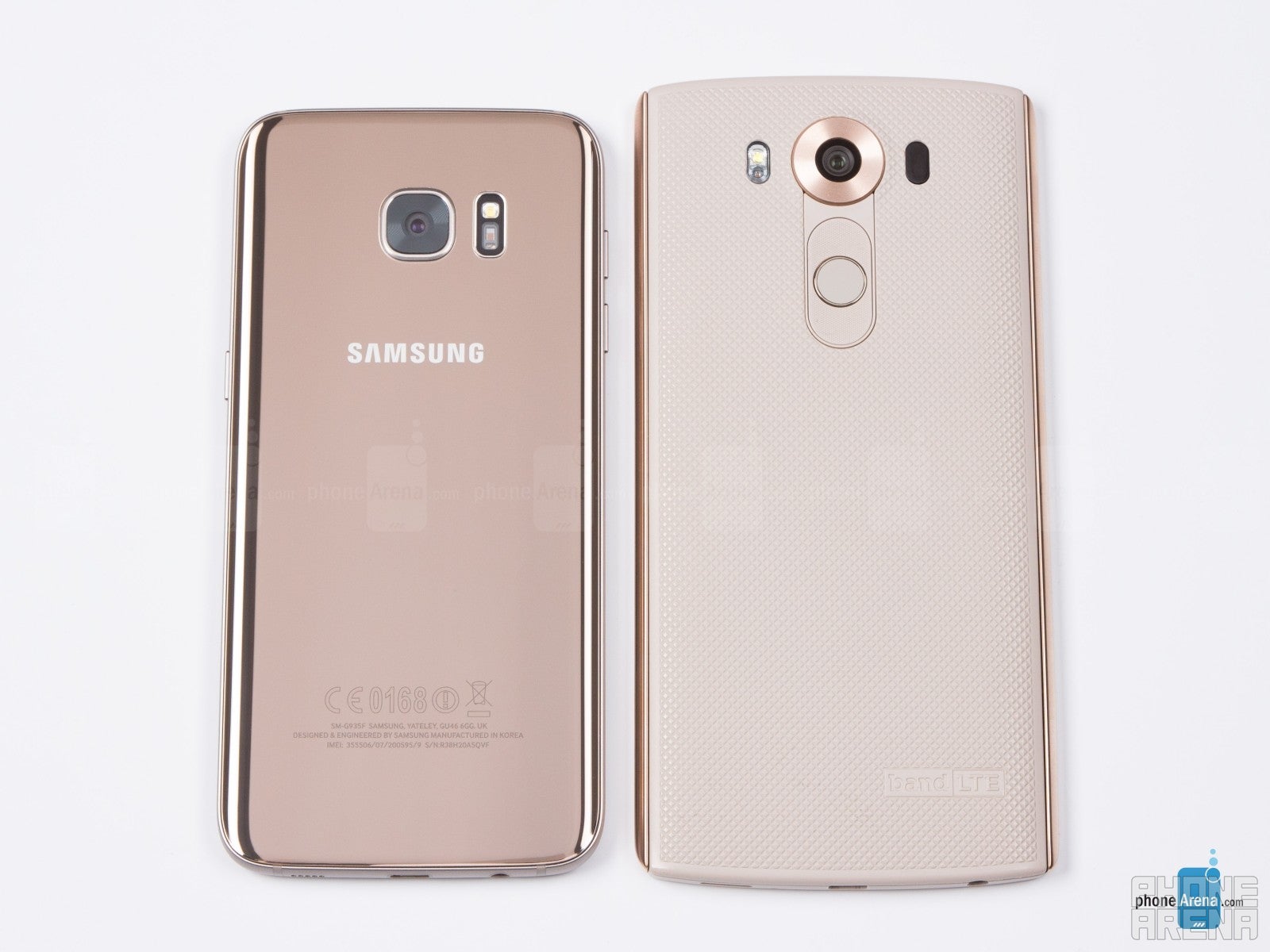
Despite the very minimal difference in screen size, the Galaxy S7 Edge feels vastly more compact than the LG V10. Samsung has done some truly amazing work designing the S7 Edge: its screen curves towards both sides, and while that is cool, it also comes with the benefit of minimizing the bezel on the side. In fact, the S7 Edge has more the feel of your common 5.2-incher than that of a 5.5” phablet. The V10, in stark contrast, has a fairly big footprint (or should we say, handprint): its shiny metal sides stick out and make it appear super wide, much harder to use with one hand.
S7 Edge (x, y, z, weight): 5.94 x 2.86 x 0.30 inches (150.9 x 72.6 x 7.7 mm), 5.54 oz (157 g)
LG V10: 6.28 x 3.12 x 0.34 inches (159.6 x 79.3 x 8.6 mm), 5.3 oz (152 g) 6.77 oz (192 g)
There is also big difference in the feel of the two: the S7 Edge with its tapered back lays naturally in the hand, as there are no sharp edges. And it feels better-made, the glass back and metal frame carry an exquisite, premium feel. The V10 with its rigged, rubbery plastic… well, let’s put it this way: it looks as elegant as a truck driver at work. It’s utilitarian and feels sturdy, but it’s not a design marvel by any stretch of the imagination. That practical approach has one benefit: you don’t need to worry about maintaining it clean and good-looking, while the S7 Edge is an absolute fingerprint magnet and if you use it without a case, you’d have to wipe it clean very, very often.
Then, there is the button feel: the very clicky and responsive buttons on the S7 Edge are in contrast with the okayish, but wobbly power/lock key on the V10.
Last, but not least: water protection! Yes, the Galaxy S7 Edge has it and it's awesome. Samsung has magically made this possible with no annoying plugs. We sit it aside playing music while in the shower and never worry about water damage. Technically, it has IP68 certification, which means that it is safe to submerge it in up to 5 feet deep water for as long as half an hour, but Samsung says it’s not meant to be used for underwater photography, but rather is there to ensure your phone won’t die on you when you accidentally drop it in water or spill something on it. The V10 lacks such water protection, hence, it’s less cool.

5.94 x 2.86 x 0.3 inches
150.9 x 72.6 x 7.7 mm
5.54 oz (157 g)

6.28 x 3.12 x 0.34 inches
159.6 x 79.3 x 8.6 mm
6.77 oz (192 g)

5.94 x 2.86 x 0.3 inches
150.9 x 72.6 x 7.7 mm
5.54 oz (157 g)

6.28 x 3.12 x 0.34 inches
159.6 x 79.3 x 8.6 mm
6.77 oz (192 g)
See the full Samsung Galaxy S7 edge vs LG V10 size comparison or compare them to other phones using our Size Comparison tool.
Display
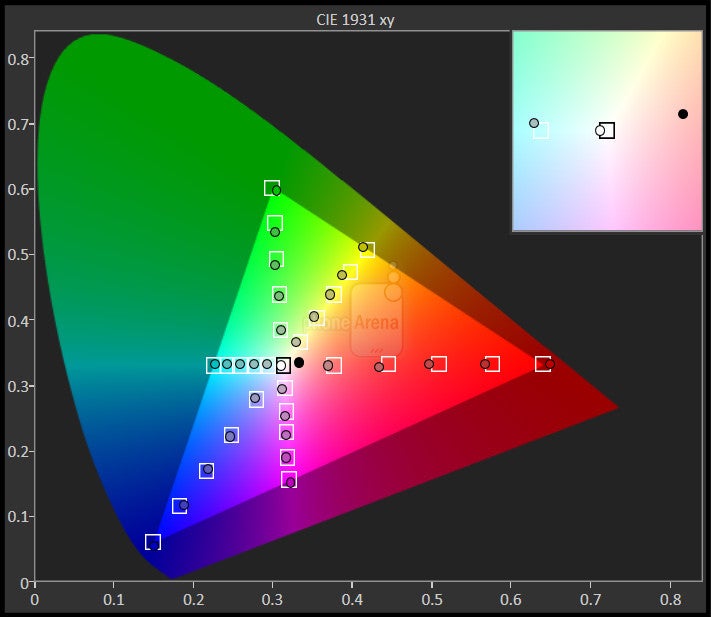
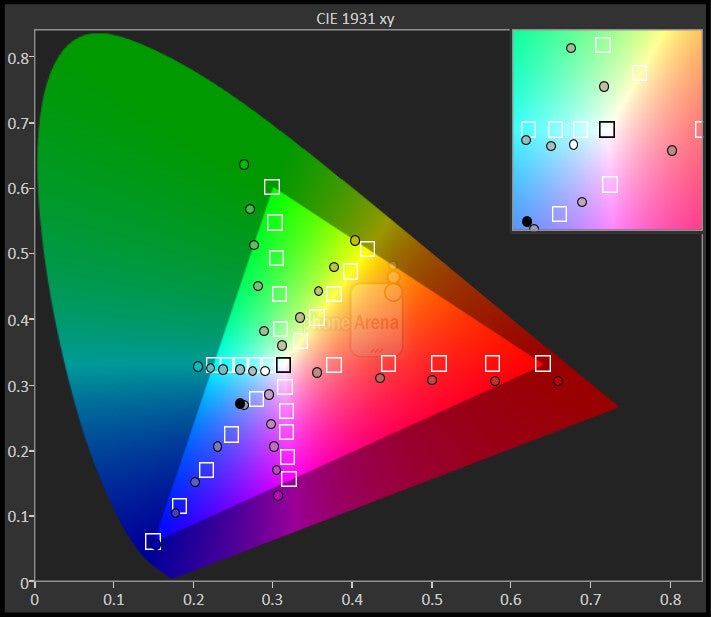
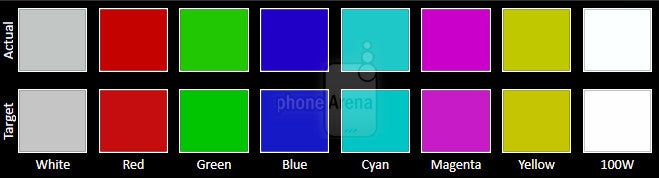
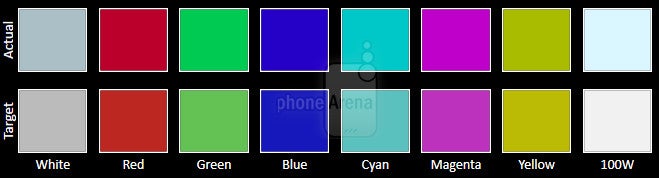
The S7 Edge’s Super AMOLED screen looks great, while the V10 display is not bad, but colors on it appear unnaturally oversaturated.
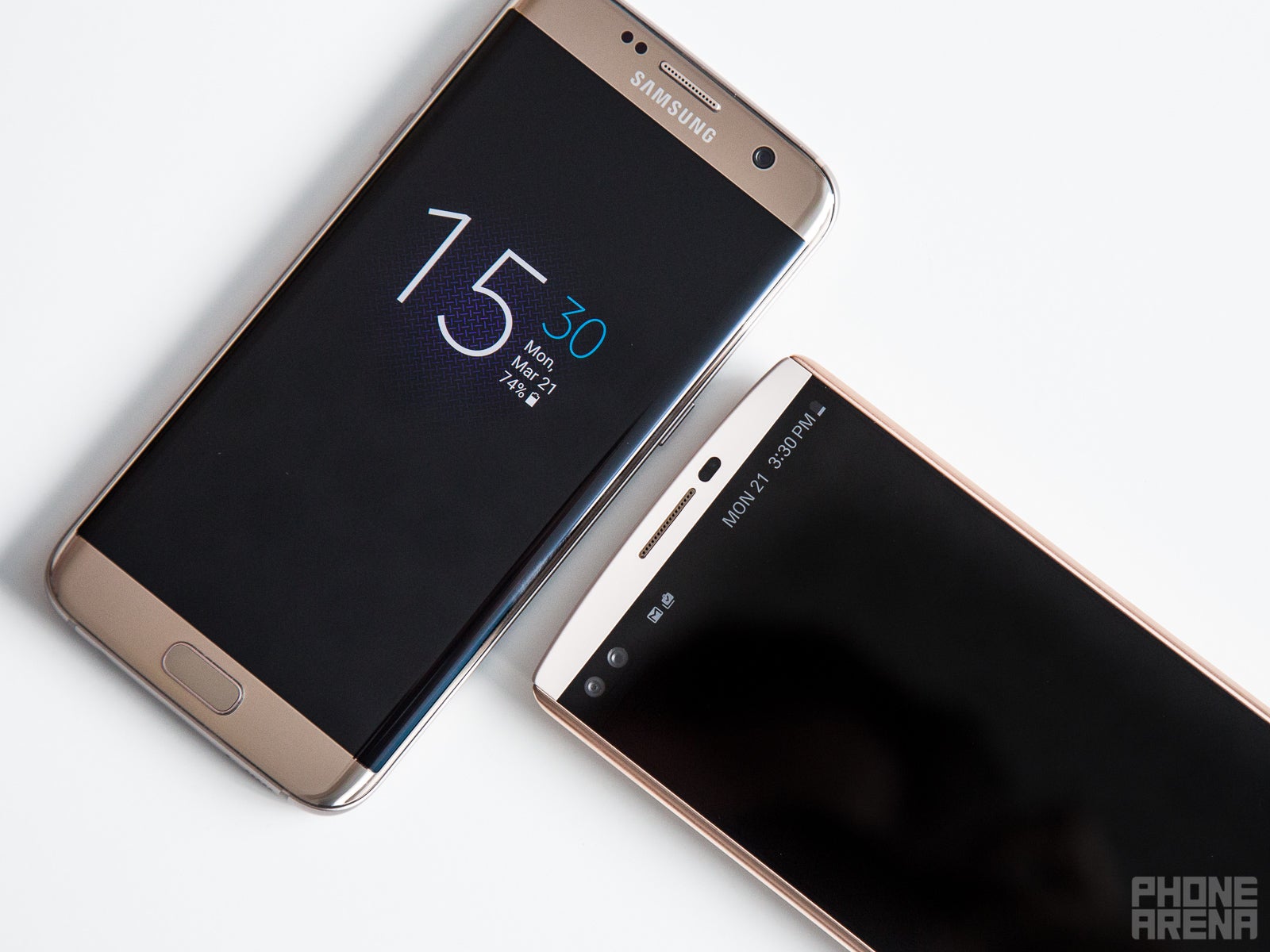
Always-on displays
First, the main screen story: 5.5” Super AMOLED on the S7 Edge meets 5.7” IPS LCD on the LG V10. Both are Quad HD panels, both are super sharp at pixel densities above 400ppi, so you won’t see jagged edges or pixelization on either. Our V10 unit has an annoying light spill coming from the top area where the dual front cameras are: it’s not a huge deal, but it’s noticeable and annoying.
Viewing angles are very good on both devices: colors turn a bit different on the S7 Edge when you look at it from the sides, but brightness is retained very well.


Interface and features
Both phones feature heavily modified versions of Android, but with the Edge UX and useful Always-on Display, Samsung offers more excitement.
While both Samsung’s Galaxy S7 Edge and LG V10 are technically Android devices, they come with very profound custom user interfaces that change the appearance of stock Android.
The two signature new features of the S7 Edge are the reformulated Edge UX and the Game Launcher. The Edge UX on the S7 Edge features a two-column interface where you can have apps or widgets that show you the weather, news or something else. The useful thing about the Edge UX is that you can bring it up from any place in the interface, and even when you are in an app. It’s not a game-changer by any means, but it’s a nice thing to have - either for quick multitasking shortcuts or short snippets of information. Then, there is the Game Launcher which allows you to do things like block notifications, as well as block the capacitive keys and optimize the frame rate to conserve battery on your phone, making for a more advanced gaming experience.
TouchWiz is running on top of Android 6.0.1 Marshmallow on the S7 edge
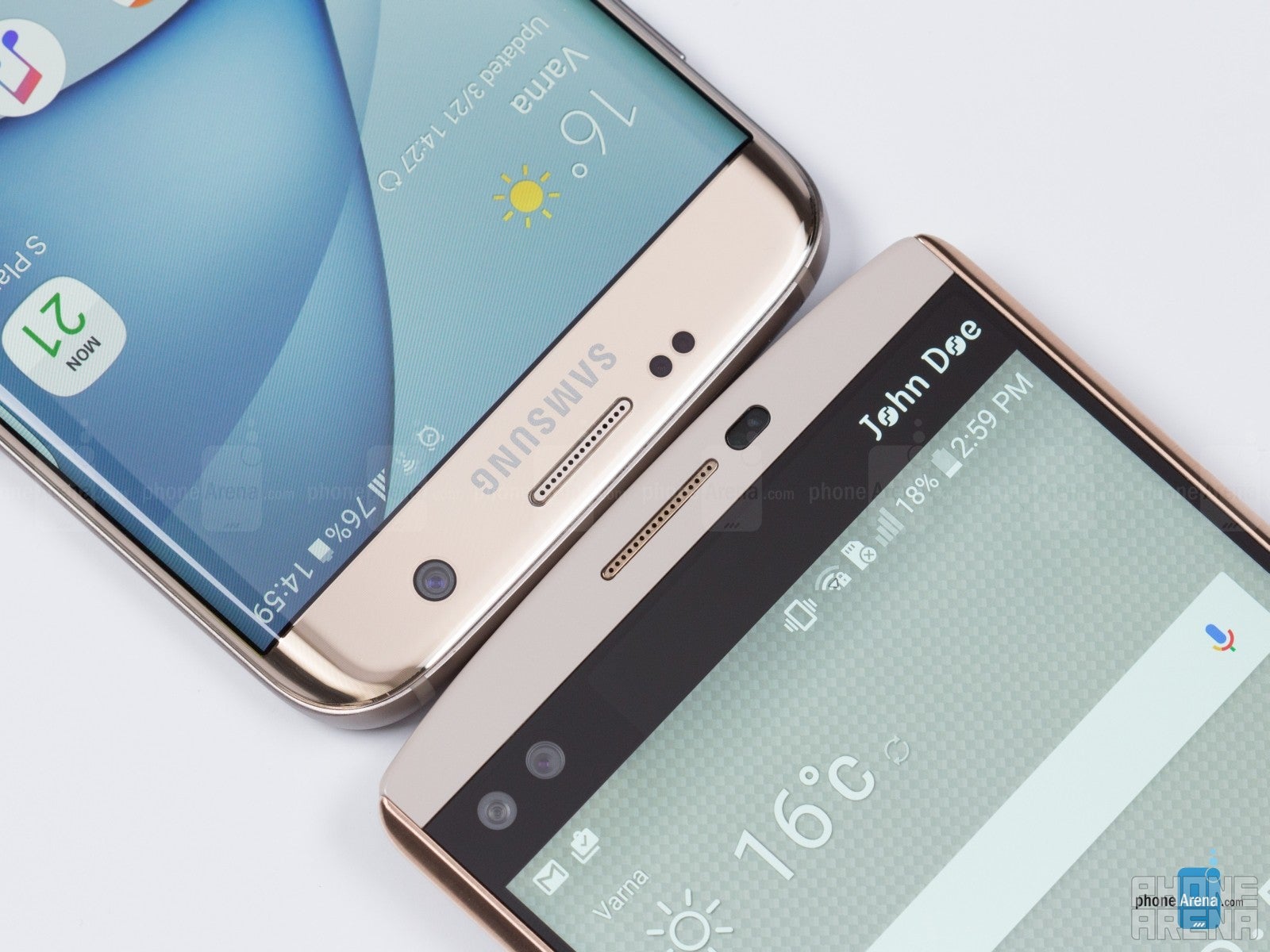
While the V10 does not have the Edge UX, it has a somewhat similar functionality in the form of the secondary ticker display located right above the main one and next to the front-facing cameras. It’s obviously a much smaller screen, and one that is fairly limited in functionality. However, it has one important advantage: it’s always on and you don’t need to do that one extra swipe to bring it up as the Edge UX. This is an important advantage, because that one extra swipe may happen to be enough to discourage you from doing something.
Then, there is the new always-on display feature on the S7 Edge. The V10 also has something similar on the small ticker display that shows the date, time and battery level in very tiny letters that are barely discernible. What’s worse is that the secondary display is very dim and it’s often extremely hard to even see what’s on it. Barely useful, if you ask us. Samsung’s Always-on screen is different: with large fonts, more info and very contrasty, easy to spot letters. It’s the right way to do it.
The LG-made software running on the V10 is incredibly flexible, customizable, versatile, powerful even
Performance, Processor and memory
The Snapdragon 820 on the S7 Edge is vastly better than the Snapdragon 808 on the V10 in benchmarks, but in real-life, the difference is minimal.
The Samsung Galaxy S7 Edge features the latest and most powerful Snapdragon 820 system chip, while the LG V10 runs on the much more modest in terms of silicon power Snapdragon 808.
Here’s the deal, though: for most people, this difference in chips does not matter all that much these days. The fact is that both phones run very fast and mostly smooth. Yes, both stutter a bit in certain places, but for the most part performance is fluid and fast.
Next, we will look at the benchmarks, gaming load times and other details, but before we do that, we’d like to emphasize that the difference in daily performance is far less radical than benchmark numbers might suggest.
When it comes to memory, both feature 32GB of internal storage and come with the handy option to have expandable storage via microSD cards. The storage on the S7 Edge is of the newer UFS 2.0 kind and you will notice this in the form of faster app installs and slightly faster file transfer speeds.
Camera
Mind-bogglingly fast auto-focus, cool new shooting modes (yay for Motion Photos) and excellent low-light performance on the S7 Edge, but the slower V10 camera captures more natural colors that we like a bit better.
The Galaxy S7 Edge and LG V10 come with huge ambitions: these are lauded to be two of the best phone cameras on the market currently.
Camera UI of the Samsung Galaxy S7 edge
The LG V10 sports a 16MP camera with an f/1.8 lens and OIS as well. The Samsung shoots in 4:3 by default, while the V10 goes for 16:9 for images.
The camera app of the V10 is very rich in settings
There are three undeniably cool new shooting options on the Galaxy S7 Edge: Motion Picture (akin to Apple’s Live Photos), Motion Panorama (a first), and Hyperlapse (a moving time-lapse, previously only available via third-party apps). We are sold on the Motion Picture concept, it’s absolutely awesome, but it’s a shame there is absolutely no way to share those cool moving images. If you could share them on Facebook or in some other way with friends, this would really feel complete.
In dim light, the S7 Edge takes a big step forward as it is able to gather more light and produce a usable image in conditions where the V10 is getting a too dark photo.
Up front, there’s a 5-megapixel camera on both the S7 Edge and the V10. The S7 Edge captures good looking images, but tends to smudge details a lot, which results in somewhat weird, unnatural-looking selfies. Skin, in particular, looks very smudged out, especially in low light when that effect kicks in with full force. The V10, on its part, pulls a clever trick: with its dual camera you can have a regular angle of view for a single-person selfie, or you can have a wide field of view using the secondary camera to get a whole group of people in the picture. It does not smudge the skin so terribly, and we prefer the selfies from it more.
Samsung Galaxy S7 Edge vs LG V10
In terms of video quality, both are doing an excellent job. You can record at 4K UHD resolution and 30 fps on both phones, but in that mode you only get the optical image stabilization and no visible software stabilization, which results in very visible wobbly, jello effect to videos, especially closer to the edges. If you want more stable video, you can switch to 1080p at either 30fps or 60fps, where the added software stabilization makes footage appear smoother. Speaking of the actual quality of video recording, both record very sharp-looking video, with very good dynamics, but there is a slight difference in the color representation: colors are a bit warmer and slightly oversaturated on the S7 Edge, while on the V10 they look a bit more natural. We also notice a slight motion blur especially visible on the S7 Edge.
Samsung Galaxy S7 Edge vs LG V10
Multimedia and sound quality
When it comes to media and watching videos or browsing through images on your S7 Edge or V10, both do a similarly great job with their large screens. The slightly curved screen on the S7 Edge is a bit of an inconvenience for watching videos as the content towards the edges gets warped, but this is a rather minor thing.
The S7 Edge ships with a single bottom-firing speaker that is not particularly loud or impressive. This could be due to the waterproofing of the handset, but in an ideal world we would like to see a better speaker. The one on the V10 is a bit louder and more capable, with some depth to the lows.
Music players
Call quality
The S7 Edge has a nifty extra loud mode that will be of use to construction workers and others who work in noisy environments, or those with somewhat impaired hearing.
Battery life
The LG V10 is a disappointment in terms of battery life: it can barely last a full day, while the S7 Edge lasts the whole day for even heavier users.
The LG V10, on the other hand, is quite the disappointment in terms of battery life, and you might have a hard time getting through a busy day without recharging. Its 3,000mAh battery cell definitely seems insufficient for the large display and the additional drain of the secondary ticker screen.
Luckily, both support quick charging, which would allow users to quickly top up the juice and even a short recharge could give the battery enough of a boost to last more.
Conclusion
On paper, the two are also vastly different in terms of performance, with the newer Snapdragon 820 on the S7 Edge beating the hell out of the older Snapdragon 808 on the V10, but in reality, both feel impressively snappy and the difference cannot be felt in the daily grind. The cameras on both are different in very subtle ways, but at the end of the day both capture excellent looking images and videos. We like the quality of images and video better on the V10, but the S7 Edge is not much behind and its camera app and auto-focus are ridiculously fast.
The thing that holds the V10 back the most is the disappointing battery life, as the phone often won’t last the whole day if you’re a heavier user. The S7 Edge does much better in terms of battery life and can last a full day under most circumstances.
There is a neglectable, $50 price difference between the two, and at the end of the day, it’s the S7 Edge that seems like the better device: with more cool features, much better design, better battery life and an excellent camera.
Samsung Galaxy S7 edge
Pros
- Gorgeous, stylish and comfortable design
- Very good-looking 5.5” Super AMOLED screen
- Ridiculously fast auto-focus in camera
- Future-proof Snapdragon 820 chip
- Cool camera features like Motion Picture, Motion Panorama and Hyperlapse
- Actually usable Always-on display feature
LG V10
Pros
- Camera shoots impressive photographs with realistic colors, excellent video
- Manual video recording mode
- Interface works fast in daily usage, almost no hiccups
- Built sturdy like a tank (but not all that good-looking)
- Slightly more affordable


Popular stories
![Verizon denies SpaceX is buying it [UPDATED]](https://m-cdn.phonearena.com/images/article/182254-wide-two_350/Verizon-denies-SpaceX-is-buying-it-UPDATED.webp)
![T-Mobile continues to experience major network issues across the nation [UPDATED]](https://m-cdn.phonearena.com/images/article/182238-wide-two_350/T-Mobile-continues-to-experience-major-network-issues-across-the-nation-UPDATED.webp)






Latest News


Things that are NOT allowed:
To help keep our community safe and free from spam, we apply temporary limits to newly created accounts: