Samsung Galaxy Z TriFold vs Galaxy Z Fold 7: Main differences

We may earn a commission if you make a purchase from the links on this page.
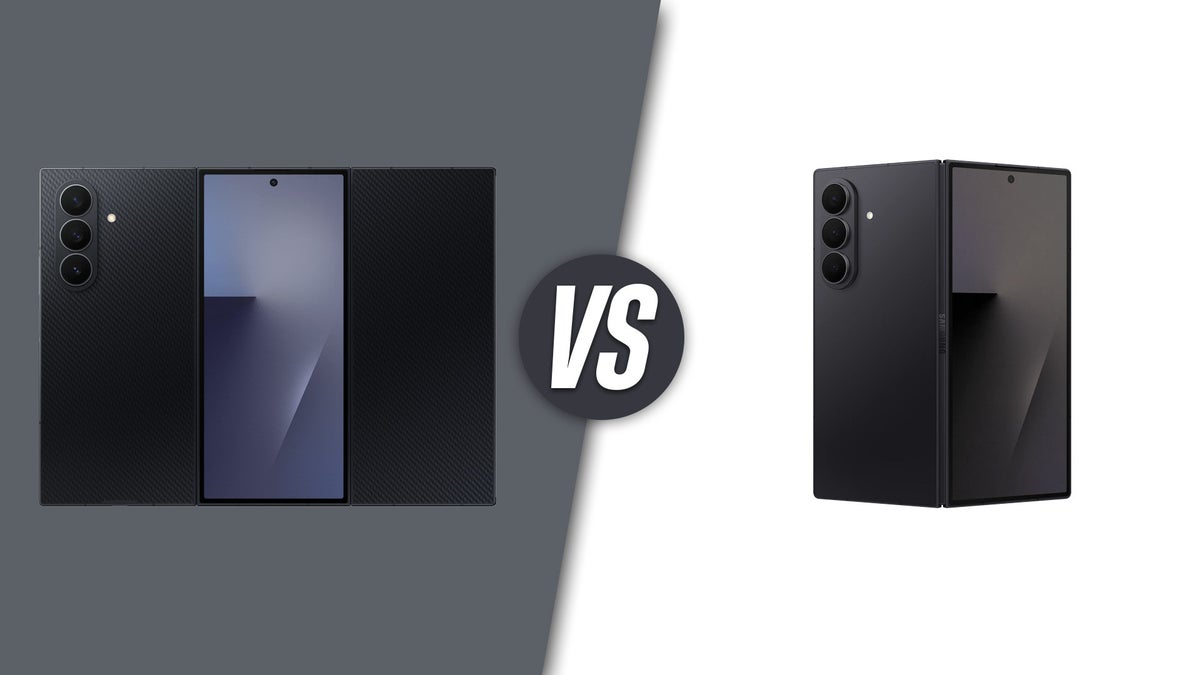
Samsung's latest Galaxy Z TriFold has successfully stirred the foldable market by allowing a wider audience to enjoy a device that packs a triple-unfolding 10-inch internal display (previously, it was the Huawei Mate XT/XTs that stood alone as the world's only triple-folding devices).
Granted, not all the chatter has been positive. Our own Rad Slavov had the chance to take the Galaxy Z TriFold for a spin, and the verdict was lukewarm at best. Samsung's spic-and-span new device has a lot of catching up to do in comparison with its more sophisticated and better-designed Huawei Mate XT rival.
But how does the Galaxy Z TriFold compare to Samsung's Galaxy Z Fold 7, the slightly less flashy but more mature foldable alternative in the same ecosystem?
The phone is already on sale in the US; foldable enthusiasts rejoice! The device starts at $2,900 and will be available at Samsung Experience Stores near you.
Galaxy Z TriFold vs Galaxy Z Fold 7 differences:
| Galaxy Z TriFold | Galaxy Z Fold 7 |
|---|---|
| Design Triple-folding foldable 12.9 mm thick, 309 gr Aluminum frame | Design Book-styled foldable 8.9 mm thick, 215 gr Aluminum frame |
| Displays 10-inch internal, 6.5-inch cover Dynamic AMOLED 120 Hz, HDR 1600 nits | Displays 8.0-inch internal, 6.5-inch cover Dynamic AMOLED 120Hz, HDR 2600 nits |
| Chipset Snapdragon 8 Elite 16GB LPDDR5X RAM 512GB/1TB storage | Chipset Snapdragon 8 Elite for Galaxy 12GB LPDDR5X 256GB/512GB |
| Camera 200 MP main 12 MP ultrawide 10 MP telephoto | Camera 200 MP main 12 MP ultrawide 10 MP telephoto |
| Battery & charging 5,600 mAh 45 W wired 15 W wireless | Battery & charging 4,400 mAh 25 W wired 15 W wireless |
Table of Contents:
Read more:
Design and Size
The TriFold has some catching up to do
The Galaxy Z TriFold is unlike your regular book-style foldable; it's U-shaped with one of the screen panels folding on itself. The internal screen is a massive 10-inch one, making the device essentially a pretty decent Android tablet size-wise.
This essentially makes the "TriFold" name a bit misleading, as you don't really have access to three separate folding scenarios. You have two options here: either use it folded or unfolded. That's unlike the other triple-folding out there, the Huawei Mate XT, which gives you a secondary, middle-ground state where two display panels can be used (like a regular book-style foldable).
The frame of the TriFold is made of aluminum, and the glass for the back panel is Gorilla Glass Victus 2. The bezels on the internal screen are a bit on the thicker side, especially when you compare them against other current-gen foldables.
When folded, the device is 12.9 mm thick, which is normally expected since we are talking about a triple-folding device here. However, when unfolded, the TriFold measures an impressive 3.9 mm thick. Granted, the compact size is further reinforced by the relatively low weight of 309 grams. It's essentially a 10-inch tablet, after all.
| Galaxy Z TriFold | Galaxy Z Fold 7 |
|---|---|
| Thickness 12.9 mm / 3.9 mm | Thickness 8.9 mm /4.2 mm |
| Dimensions 159.2 x 75 mm / 159.2 x 214.1 mm | Dimensions 158.4 x 72.8 mm / 158.4 x 143.2 mm |
| Weight 309 gr | Weight 215 gr |
In comparison, the Galaxy Z Fold 7 is a traditional-style foldable. Unlike previous Galaxy Z Fold devices, this one scored some major design improvements, making it much thinner and sleeker than before, with a greatly minimized display crease and a zero-wedge design.
Both the Galaxy Z TriFold and the Galaxy Z Fold 7 are IP48-rated, meaning they'd survive most dust particles, but ideally keep them away from water.
And, interestingly, while both phones have "Z" in their names, neither one opens in a Z-pattern. Interestingly, it's the Huawei Mate XT that is the one capable of making a Z pattern.
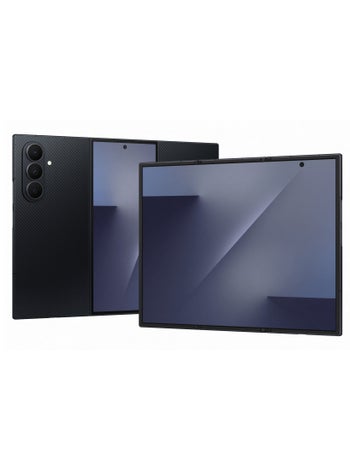
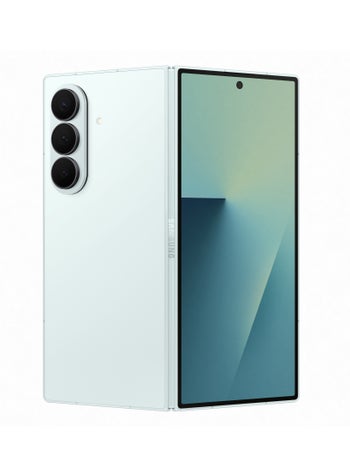
In terms of colors, the new TriFold is available in a Crafted Black color, while the Galaxy Z Fold 7 can be had in Jetblack, Silver Shadow, Blue Shadow, or Mint colors.
Display Differences
The Galaxy Z TriFold comes with a 10-inch main screen, a Dynamic AMOLED one with 120Hz refresh rate, HDR support, and up to 1,600 nits of peak brightness. We're definitely in flagship tablet territory here.
The Galaxy Z Fold 7, on the other hand, comes with a slightly smaller 8.0-inch screen, once again with a 120 Hz refresh rate but a significantly higher 2,600 nits peak brightness.
The cover screens of both phones are identical: 6.5 inches, 120 Hz refresh rate, 2520 x 1080 pixels. Fairly wide and usable, but still on the compact side, so you don't have to feel compelled to unfold either one for just about any task.
| Galaxy Z TriFold | Galaxy Z Fold 7 |
|---|---|
| Main size 10.0" | Main size 8.0" |
| Cover size 6.5" | Cover size 6.5" |
| Brightness 1,600 nits (peak) | Brightness 2600 nits (peak) |
Performance and Software
Snapdragon's finest, almost
Both of these high-profile foldables come with Qualcomm's ex-flagship chipset, the Snapdragon 8 Elite. This 3nm chip is pretty much still kicking strong, even in the wake of the newer and faster Snapdragon 8 Elite Gen 5. Both the efficiency and the performance are top-notch as well, and we don't really feel the need for anything faster.
| Galaxy Z TriFold | Galaxy Z Fold 7 |
|---|---|
| Chip Qualcomm Snapdragon 8 Elite | Chip Qualcomm Snapdragon 8 Elite |
| Process 3nm | Process 3nm |
| RAM, Storage 16/256GB 16/512GB LPDDR5X RAM UFS 4.0 storage | RAM, Storage 12/256GB 12/512GB LPDDR5X RAM UFS 3.1 storage |
Both devices come with Samsung's exceptional and feature-rich One UI interface, probably the best one available on the western market. It comes with a ton of AI features, if you're into that thing.
Both phones will be supported for seven years, or until 2032, which is as good as they come right now.
Camera
Same cameras, same image quality
The shared DNA between the Galaxy Z TriFold and the Galaxy Z Fold 7 continues in the camera department, as both of these foldable champs share the same camera setups.
We get a high-res 200MP main camera, joined by a 12 MP ultrawide and a 10MP telephoto with 3X optical zoom. Samsung has been reusing this exact setup on many of its phones for a hot minute, so we have a pretty good understanding of what the TriFold image quality would be: pretty much identical to the Galaxy Z Fold 7.
This means a pretty decent camera quality that's a bit lacking in terms of zoom quality. But hey, nobody buys a foldable phone for the camera, and then again, this shouldn't be used as an excuse to ship these devices with subpar cameras.
| Galaxy Z TriFold | Galaxy Z Fold 7 |
|---|---|
| Main 200 MP | Main 200 MP |
| Ultrawide 12 MP | Ultrawide 12 MP |
| Telephoto 10 MP 3X zoom | Telephoto 10 MP 3X zoom |
Battery Life and Charging
Not that well-endowed
The Galaxy Z TriFold and the Galaxy Z Fold 7 come with relatively small batteries when you compare them against other foldable phones out there. The TriFold packs a 5,600 mAh battery, and the Z Fold 7 has a 4,400 mAh one. Not particularly large, but should be enough to last you a day of usage.
| Galaxy Z TriFold | Galaxy Z Fold 7 |
|---|---|
| Battery size 5,600 mAh | Battery size 4,400 mAh |
Charging speeds 45W wired 15 W wireless charging | Charging speeds 25W wired 15W wireless charging |
In terms of charging, the Galaxy Z TriFold boasts 45 W wired charging, while the Z Fold 7 is slower at 25 W. Wireless charging is 15 W on both devices.
Specs Comparison
|
|
| Samsung Galaxy Z TriFold | Samsung Galaxy Z Fold 7 |
| Dimensions | |
|---|---|
| 159.2 x 214.1 x 3.9 (~9 mm with camera bump) | 158.4 x 143.2 x 4.2 mm (~8.6 mm with camera bump) |
| Weight | |
| 309.0 g | 215.0 g |
| Size | |
|---|---|
| 10.0-inch | 8.0-inch |
| Type | |
| Dynamic AMOLED, 120Hz | Dynamic AMOLED, 120Hz |
| System chip | |
|---|---|
| Snapdragon 8 Elite SM8750-AC (3 nm) | Snapdragon 8 Elite for Galaxy SM8750-AB (3 nm) |
| Memory | |
| 16GB (LPDDR5X)/512GB (UFS) 16GB/1TB |
12GB (LPDDR5X)/256GB (UFS 4.0) 12GB/512GB 16GB/512GB |
| OS | |
| Android (16) | Android (16) |
| Type | |
|---|---|
| 5600 mAh | 4400 mAh |
| Charge speed | |
| Wired: 45.0W Wireless: 15.0W | Wired: 25.0W Wireless: 15.0W |
| Main camera | |
|---|---|
| 200 MP (OIS, PDAF) Aperture size: F1.7 Focal length: 24 mm Sensor size: 1/1.3" Pixel size: 0.6 μm | 200 MP (OIS, PDAF) Sensor name: Samsung ISOCELL HP2 Aperture size: F1.7 Focal length: 24 mm Sensor size: 1/1.3" Pixel size: 0.6 μm |
| Second camera | |
| 12 MP (Ultra-wide, PDAF) Aperture size: F2.2 Focal Length: 13 mm Sensor size: 1/2.55" Pixel size: 1.4 μm | 12 MP (Ultra-wide) Sensor name: Sony IMX564 Aperture size: F2.2 Focal Length: 13 mm Sensor size: 1/2.55" Pixel size: 1.4 μm |
| Third camera | |
| 10 MP (Telephoto, OIS, PDAF) Optical zoom: 3.0x Aperture size: F2.4 Focal Length: 67 mm Sensor size: 1/3.94" Pixel size: 1.0 μm | 10 MP (Telephoto, OIS, PDAF) Sensor name: Samsung S5K3K1 Optical zoom: 3.0x Aperture size: F2.4 Focal Length: 67 mm Sensor size: 1/3.94" Pixel size: 1.0 μm |
| Front | |
| 10 MP | 10 MP (HDR) |
See the full
Samsung Galaxy Z TriFold vs Samsung Galaxy Z Fold 7 specs comparison
or compare them to other phones using our
Phone Comparison tool
Summary
Starting at $2,900, the Galaxy Z TriFold feels uncannily similar to the very first Galaxy Fold released back in 2019: a slightly crude device that's more of a proof of concept and a clear statement by Samsung that it is willing to populate this niche as well. It's a bit rough around the edges; the successor will hopefully improve the formula.
Add the exorbitant price tag, and you get just that, a very niche device aimed at a tiny range of consumers.
The Galaxy Z Fold 7, on the other hand, is a much more fleshed-out device that finally doesn't lag the competition. In fact, it's one of the nicer foldables you can get, especially so if great software is a priority.
Add the exorbitant price tag, and you get just that, a very niche device aimed at a tiny range of consumers.


Related Content

Popular stories



Latest News



Things that are NOT allowed:
To help keep our community safe and free from spam, we apply temporary limits to newly created accounts: