Samsung Galaxy Z TriFold vs Huawei Mate XT: Main differences

We may earn a commission if you make a purchase from the links on this page.
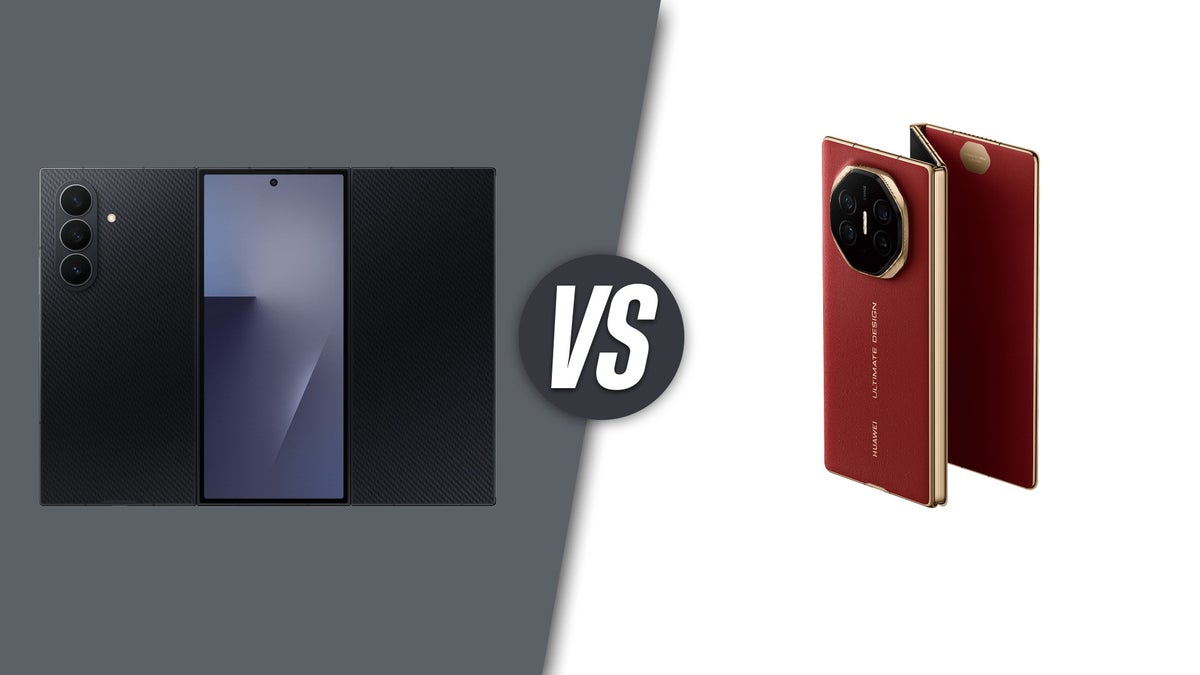
The latest foldable phone in Samsung's portfolio is the Galaxy Z TriFold, and it's the perfect example of tech decadence. A foldable phone that unfolds to essentially become a decent Android tablet is something a very exclusive club of Android devices can do, with the only other active player in the field being Huawei.
The Mate XT and its subsequent versions were the first devices to offer a triple-folding design language, and it was a pretty adequate first attempt. Arguably better than Samsung's first triple-folding phone, which is more crude in comparison.
Which of these excessive foldables is the better one?
The Galaxy Z TriFold is now available for purchase in the US, making it the only triple-foldable phone on the market in the foreseeable future.
Galaxy Z TriFold vs Huawei Mate XT differences:
| Galaxy Z TriFold | Huawei Mate XT |
|---|---|
| Design Triple-folding foldable 12.9 mm thick, 309 gr Aluminum frame | Design Z-style foldable 12.8 mm thick, 298 gr Aluminum frame |
| Displays 10-inch internal, 6.5-inch cover Dynamic AMOLED 120 Hz, HDR 1600 nits | Displays 10.2-inch/7.9-inch/6.4-inch OLED 90Hz, HDR |
| Chipset Snapdragon 8 Elite (3nm) 16GB LPDDR5X RAM 512GB/1TB storage | Chipset Kirin 9010 (7nm) 16GB RAM 512GB/1TB |
| Camera 200 MP main 12 MP ultrawide 10 MP 3x telephoto | Camera 50 MP main 12 MP ultrawide 12 MP 5.5x telephoto |
| Battery & charging 5,600 mAh 45 W wired 15 W wireless | Battery & charging 5,600 mAh 66 W wired proprietary 50 W wireless proprietary |
Table of Contents:
Read more:
Design and Size
One of these is more fleshed-out, and it's not the Samsung phone
Although both devices are technically triple-folding, there's a pretty major difference in terms of their folding design language.
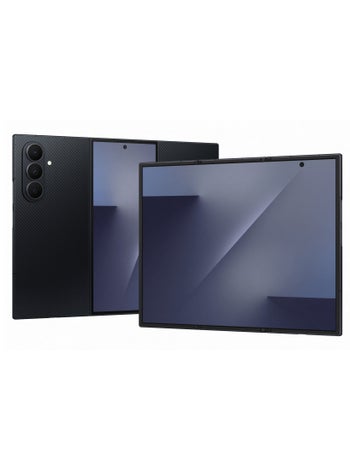
The Galaxy Z TriFold is more of a U-shaped device with a separate cover screen, and its panels unfold to the sides to reveal its massive 10-inch display. This reveals the biggest shortcoming of the Galaxy Z TriFold––you can only use it fully folded or fully unfolded, so you don't get a middle-of-the-ground dual panel view, like the Huawei Mate XT does.
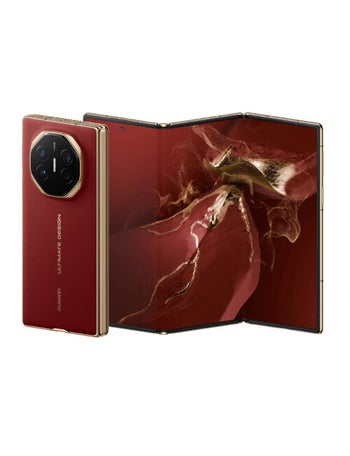
The Huawei foldable is a very different foldable. It basically has one screen that folds in a Z-shape. You can keep it fully folded and use just one panel (essentially a 6.4-inch cover screen), two panels revealing a 7.9-inch screen real estate, and finally, fully unfolded, the Mate XT boasts a 10.2-inch tablet display.
Both foldables are made of aluminum and feature glass backplates, but the overall aesthetics are slightly different. The Huawei foldable is definitely more stylish, available in red and black, both with snazzy golden frames. The bezels are way thinner and more appealing. In stark contrast, the Galaxy Z TriFold looks like an engineering prototype––thick bezels, a single understated black color, and less flashy overall appearance.
The Huawei foldable is a very different foldable. It basically has one screen that folds in a Z-shape. You can keep it fully folded and use just one panel (essentially a 6.4-inch cover screen), two panels revealing a 7.9-inch screen real estate, and finally, fully unfolded, the Mate XT boasts a 10.2-inch tablet display.
| Galaxy Z TriFold | Huawei Mate XT |
|---|---|
| Thickness 3.9 / 12.9 mm | Thickness 3.6 / 12.8 mm |
| Dimensions 159.2 x 75 / 159.2 x 214.1 mm | Dimensions 156.7 x 73.5 / 156 x 143 / 156.7 x 219 mm |
| Weight 309 grams | Weight 298 grams |
As mentioned, the Galaxy Z TriFold only comes in black, while the Mate XT can be yours in either red or black, but we should also mention the golden design elements as well, as these make the device essentially dual-tone ones.
Display Differences
Both phones have similarly sized 10-inch internal displays. Only the TriFold has a separate cover screen, while the leftmost portion of the Mate XT's screen doubles as a cover display when you fold the phone. The latter is definitely the more efficient design and also gives you more options in terms of screen configurations.
In terms of properties, the Galaxy Z TriFold comes with the better display. It's a Dynamic AMOLED one and goes up to 120 Hz. The peak brightness is said to be 1,600 nits, which should be higher than the Mate XT's peak brightness that we measured to be just 850 nits. The Huawei foldable also only goes up to 90 Hz.
| Galaxy Z TriFold | Huawei Mate XT |
|---|---|
| Main size 10.0" | Main size 10.2" |
| Cover size 6.5" | Cover size 6.4" / 7.9" |
| Brightness 1,600 nits (peak) | Brightness 850 nits (poor) |
Performance and Software
Decent, but not the best
For more than half a decade, Huawei has been in the Entity List, restricting US companies without the necessary license to conduct business with it. That's the reason why Huawei has been largely cut off from the grander chipset market and has been essentially forced into relying on its own line of chips.
This is the reason why the Mate XT is equipped with the 7nm Kirin 9010. It's not a slow chip at all, but it lacks the efficiency that tinier fabrication processes have introduced in the meantime. As a reference, the last Snapdragon chip to rely on the 7nm fabrication was the Snapdragon 865+/870 chips from 2021.
The TriFold is equipped with Qualcomm's ex-flagship chipset, the Snapdragon 8 Elite. It's a much faster and more efficient 3nm chip that is still exceptionally capable, even though the faster Snapdragon 8 Elite Gen 5 exists.
| Galaxy Z TriFold | Huawei Mate XT |
|---|---|
| Chip Qualcomm Snapdragon 8 Elite | Chip Huawei Kirin 9010 |
| Process 3nm | Process 7nm |
| RAM, Storage 16/256GB 16/512GB LPDDR5X RAM UFS 4.0 storage | RAM, Storage 16/256GB 16/512GB 16/1TB |
The Mate XT and the TriFold both come with 16GB of RAM, which might soon become a thing of the past due to the exorbitant pricing and shortage of DRAM chips. Storage starts at 256GB on the Huawei and the TriFold, and both are available with 512GB as well. The Mate XT can also be yours with 1TB of storage as well.
The Galaxy comes with One UI 8, probably the best and most feature-rich Android interface at the moment. The Huawei Mate XT, on the other hand, arrives with HarmonyOS. The Galaxy will enjoy seven years of software support, while our guess as to how many years of software updates the Mate XT has remaining is as good as yours. Our review unit has hardly received a major update in 2025 at all, which doesn't exactly inspire confidence in the company's support policy.
Camera
Triple-camera shenanigans
Either one of these two foldables comes with triple-camera systems, but they are a bit different from one another.
The TriFold arrives with a 200MP main camera utilizing a 1/1.3" sensor and an F1.7 aperture, while the Mate boasts a 50MP camera with switching F4/F1.4 aperture. The Huawei foldable also has a much more intriguing 12MP telephoto with long 5.5x zoom, better than the Galaxy's 3x 10MP telephoto. Both phones have 12MP ultrawides.
The Galaxy has dual 10MP selfie cameras, one on the internal screen and one on the cover screen, while the Mate XT has a single 8MP selfie camera.
| Galaxy Z TriFold | Huawei Mate XT |
|---|---|
| Main 200 MP | Main 50 MP |
| Ultrawide 12 MP | Ultrawide 12 MP |
| Telephoto 10 MP 3X zoom | Telephoto 12 MP 5.5X zoom |
Battery Life and Charging
The Galaxy might have the upper-hand
Intriguingly, both the Galaxy Z TriFold and the Huawei Mate XT come with 5,600 mAh batteries. While such a coincidence usually suggests the devices should have similar battery life, this could be an exception here. That's because the 7nm chip on the Mate is most certainly way less efficient, so it would use more power. We'd expect the TriFold to have a better battery life.
| Galaxy Z TriFold | Huawei Mate XT |
|---|---|
| Battery size 5,600 mAh | Battery size 5,600 mAh |
Charging speeds 45W wired 15 W wireless charging | Charging speeds 25W wired 15W wireless charging |
Charging-wise, the Galaxy can't match its Huawei counterpart: it's a decisive 45W versus 66W wired charging speed in favor of the Mate. The wireless charging margin is even wider: 50W versus 15W on the Galaxy! However, Huawei relies on proprietary technology for its charging solutions, so to achieve these speeds you'd better use the manufacturer-recommended chargers.
Specs Comparison
|
|
| Samsung Galaxy Z TriFold | Huawei Mate XT Ultimate Design |
| Dimensions | |
|---|---|
| 159.2 x 214.1 x 3.9 (~9 mm with camera bump) | 156.7 x 219 x 3.6 mm |
| Weight | |
| 309.0 g | 298.0 g |
| Size | |
|---|---|
| 10.0-inch | 10.2-inch |
| Type | |
| Dynamic AMOLED, 120Hz | OLED |
| System chip | |
|---|---|
| Snapdragon 8 Elite SM8750-AC (3 nm) | Kirin 9010 (7 nm) |
| Memory | |
| 16GB (LPDDR5X)/512GB (UFS) 16GB/1TB |
16GB/256GB 16GB/512GB 16GB/1024GB |
| OS | |
| Android (16) | HarmonyOS |
| Type | |
|---|---|
| 5600 mAh | 5600 mAh |
| Charge speed | |
| Wired: 45.0W Wireless: 15.0W |
Wired: 66.0W Wireless: 50.0W |
| Main camera | |
|---|---|
| 200 MP (OIS, PDAF) Aperture size: F1.7 Focal length: 24 mm Sensor size: 1/1.3" Pixel size: 0.6 μm |
50 MP (OIS, PDAF) Aperture size: F4.0/F1.4 Focal length: 24 mm |
| Second camera | |
| 12 MP (Ultra-wide, PDAF) Aperture size: F2.2 Focal Length: 13 mm Sensor size: 1/2.55" Pixel size: 1.4 μm |
12 MP (Ultra-wide) Aperture size: F2.2 Focal Length: 13 mm |
| Third camera | |
| 10 MP (Telephoto, OIS, PDAF) Optical zoom: 3.0x Aperture size: F2.4 Focal Length: 67 mm Sensor size: 1/3.94" Pixel size: 1.0 μm |
12 MP (Telephoto, Periscope, Sensor-shift OIS, PDAF) Optical zoom: 5.5x Aperture size: F3.4 Focal Length: 125 mm |
| Front | |
| 10 MP | 8 MP |
See the full
Samsung Galaxy Z TriFold vs Huawei Mate XT Ultimate Design specs comparison
or compare them to other phones using our
Phone Comparison tool
Summary
Samsung is a bit late to the foldable party, and it doesn't come dressed in its best clothes yet––the Galaxy Z TriFold is a very impressive foldable phone, but it's a bit crude and rough around the edges. And starting at $2,900, it's not exactly affordable either.
The Huawei Mate XT was the first tri-foldable phone, and in many ways, it's a better device than the TriFold. In many others, it's not. Samsung's appetite will come with eating, and we have no doubt that the next Samsung triple-folding phone will be even better than this one.
Which one should you get? Currently, either one of these feels like a proof of concept rather than a device you should absolutely get. A regular book-style foldable is a more mature product, and still, a regular phone + a tablet still makes a lot of financial sense.


Popular stories



Latest News



Things that are NOT allowed:
To help keep our community safe and free from spam, we apply temporary limits to newly created accounts: