T-Mobile recently blindsided its satellite partner SpaceX by announcing plans to form a joint venture (JV) with arch-rivals AT&T and Verizon. The Big Three aim to collaborate on a multi-operator satellite initiative by pooling spectrum resources and creating unified industry specs. The broader industry, and certainly SpaceX, views this as an attempt to keep Elon Musk's influence in check.
SpaceX is taking note
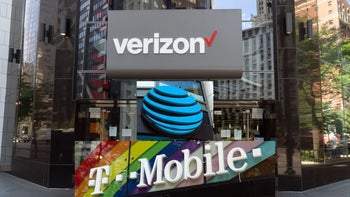
Do the Big Three want to corner SpaceX? | Image by David Goldman
While SpaceX hasn't officially commented, company execs couldn't help reacting to the news online, as PCMag first noted.
Gwynne Shotwell, SpaceX's President and Chief Operating Officer, framed the joint venture as a calculated move by established telecom players to suppress SpaceX.
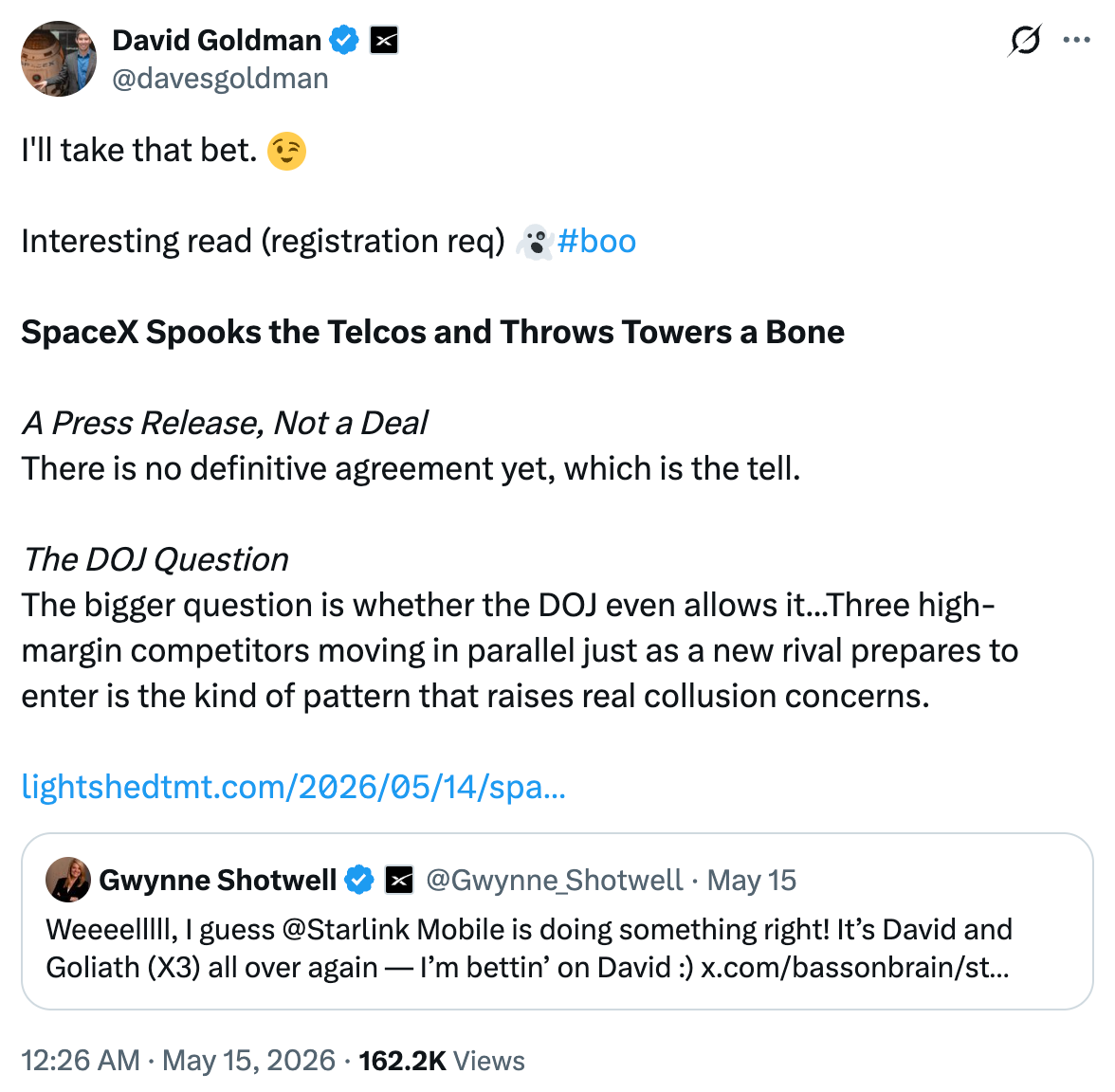
David Goldman, Vice President of Satellite Policy, implied that legal action is very much on the table by sharing an article highlighting potential Department of Justice (DOJ) intervention to block the anti-competitive move.
The case for the Big Three
T-Mobile's exclusivity deal with SpaceX is reportedly expiring in a few months. Meanwhile, SpaceX has secured spectrum assets that allow it to provide satellite service to smartphone customers without T-Mobile as the middleman.
With the Federal Communications Commission (FCC) becoming a proponent of satellite features, the stakes are massive.
SpaceX, with its technological lead, could come out the big winner.
But let's not paint SpaceX as the ultimate savior, or the Big Three as the pariahs just yet. It's a little more nuanced than that.
For instance, SpaceX recently raised Starlink internet prices, sparking consumer backlash and underscoring why its monopoly on space is a bad idea.
Recommended For You
According to Recon Analytics founder Roger Entner, AT&T, T-Mobile, and Verizon's partnership should be approved because it aims to tear down the fragmentation currently holding space-based connectivity back.
This is life-saving tech, and making it universal should be the top priority.
GSM roaming and 911 Phase II are two examples of carriers collaborating for the greater good of the public. Satellite connectivity deserves the same unified approach.
Why have the Big Three teamed up?
38 Votes
To remain the strongest connectivity players.
31.58%
To prevent SpaceX from setting prices.
39.47%
To bring satellite features to more customers.
28.95%
Stepping back
In the grand scheme of things, most smartphone users rarely need a satellite connection. Heck, this might not even be a very lucrative business.
The data backs this up: the average user is disconnected from a carrier network just 2.79% of the time, and most customers are only willing to fork over about $5 a month for satellite backup.
Spectrum is power
The Big Three's tentative deal feels more like a symbolic announcement than an operational one. Dropping this announcement right after SpaceX acquired spectrum and right before its rumored initial public offering sends a clear signal meant to intimidate.
But a little corporate posturing shouldn't be reason enough for regulators to dissolve a venture that could benefit the public.
Get iPhone 18 Pro with Visible, get $480 off!
$719
/mo
$1199
$480 off (40%)
On the Visible+ Pro plan, you get access to 5G Ultra Wideband data on Verizon's fastest network. Along with unlimited roaming across Mexico and Canada, 2 days of Global Pass per month, 3x hotspot speeds, 4K streaming, and Smartwatch service.
Anam Hamid is a computer scientist turned tech journalist who has a keen interest in the tech world, with a particular focus on smartphones and tablets. She has previously written for Android Headlines and has also been a ghostwriter for several tech and car publications. Anam is not a tech hoarder and believes in using her gadgets for as long as possible. She is concerned about smartphone addiction and its impact on future generations, but she also appreciates the convenience that phones have brought into our lives. Anam is excited about technological advancements like folding screens and under-display sensors, and she often wonders about the future of technology. She values the overall experience of a device more than its individual specs and admires companies that deliver durable, high-quality products. In her free time, Anam enjoys reading, scrolling through Reddit and Instagram, and occasionally refreshing her programming skills through tutorials.
A discussion is a place, where people can voice their opinion, no matter if it
is positive, neutral or negative. However, when posting, one must stay true to the topic, and not just share some
random thoughts, which are not directly related to the matter.
Things that are NOT allowed:
Off-topic talk - you must stick to the subject of discussion
Offensive, hate speech - if you want to say something, say it politely
Spam/Advertisements - these posts are deleted
Multiple accounts - one person can have only one account
Impersonations and offensive nicknames - these accounts get banned
To help keep our community safe and free from spam, we apply temporary limits to newly created accounts:
New accounts created within the last 24 hours may experience restrictions on how frequently they can
post or comment.
These limits are in place as a precaution and will automatically lift.
Moderation is done by humans. We try to be as objective as possible and moderate with zero bias. If you think a
post should be moderated - please, report it.
Have a question about the rules or why you have been moderated/limited/banned? Please,
contact us.












Things that are NOT allowed:
To help keep our community safe and free from spam, we apply temporary limits to newly created accounts: