HTC's most recent flagships, the
HTC One and the
HTC One (M8), have been getting quite a lot of flak due to their underperforming Ultrapixel rear cameras, but the company has been rarely criticized for failing to endow its high-end phones with good front-facing snappers. It looks that the company is trying to push the limits in this segment even more, as its latest device can easily snatch the crown and become the ultimate selfie phone from a well-known manufacturer.
At its long-scheduled press event today, HTC unveiled the 5.2” HTC Desire EYE, a device that is equipped with a humongous 13MP (not a typo) front-facing camera. Whoa. Undoubtedly, HTC's newest smartphone is a direct rival to the selfie-centric mid-rangers of its bigger rivals, namely
Sony's Xperia C3,
Samsung's Galaxy Grand Prime, and
Microsoft's Nokia Lumia 730. There's a vital difference between these devices and the HTC Desire EYE, though - the latter has nothing to be ashamed of in the hardware department.
Design
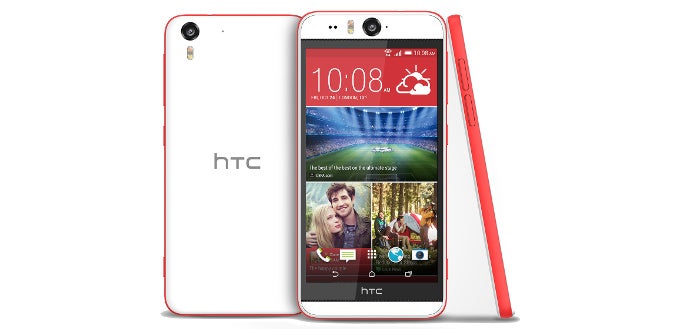
Frankly said, the two-color, unibody Desire EYE is not as compact as similar 5.2” devices. It has dimensions of 151.7 x 73.8 x 8.5 mm and tips the scales at 154 gr, which is just a tad larger than the 5.2”
Sony Xperia Z3, for example. Among most probable causes for the elongated silhouette of the device is the additional space required to fit in the large sensor of the front facing camera.
The front-facing BoomSound speakers at the front of the device have most probably taken their toll on the size, too – you might not see them at first sight, but they are right there, hidden between the display's black bezels and the contrasting frame. The BoomSound speakers also come with the signature built-in audio amplifiers. Meanwhile, a trio of noise-canceling microphones and HTC's Sense Voice technology take care of your voice reproduction.
Oh, and HTC has finally jumped on the trendy-of-late water-resistant bandwagon, as the HTC Desire EYE is IPX7-certified, meaning that it can survive in up to 1 meter of water for as long as 30 minutes.
Hardware specs and features
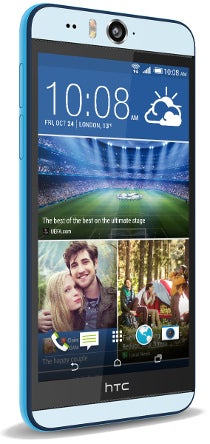
As we said, although not the absolute top-of-the-line, the Desire EYE is rather well-equipped in the hardware department. HTC has fitted a 5.2-inch IPS LCD display at the front of the device. The combination between its resolution of 1080 x 1920 pixels and the screen's real estate delivers a pixel density of 423 ppi, a little lower than the
HTC One (M8) and the
Samsung Galaxy S5, yet on par with the
Sony Xperia Z3.
The whole HTC Desire EYE shebang is being powered by a quad-core Qualcomm Snapdragon 801 SoC, which is turning and churning the gears at 2.3GHz. The 2GB of RAM on board pave the way for a rather hassle-free multitasking experience. Speaking of memory, the Desire EYE has 16GB of on-board storage (roughly 8.9GB available to the user right out of the box) and a microSD slot, which supports up to 128GB microSD cards.
The present 2,400mAh Li-Po battery will allegedly keep the lights on for as long as 538 hours in standby mode. Moving on to the connectivity department, we are happy to see that the HTC Desire EYE is LTE-enabled and supports AT&T's 2, 4, 5, 17, 29 bands, among others. Software-wise, HTC's latest comes with Android 4.4.2 KitKat out of the box, and rather unsurprisingly, HTC's homemade Sense 6 UI can be found on top of it.
Camera
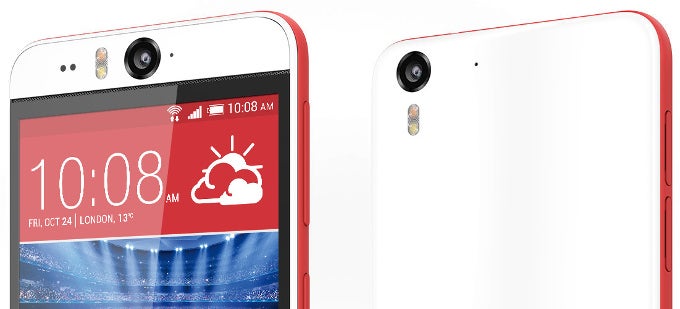
Well, this is where the HTC Desire EYE truly shines, as the front-facing shooter of the device is a true zinger, at least on paper! We can find a duo of 13MP snappers both at the front and at the back, both endowed with dual LED flashes. The cameras are not strictly the same, though. The rear one has a wide-angle BSI (backside-illuminated) sensor with a 28mm lens and an f/2.0 aperture, whereas the selfie camera comes with a wider 22mm lens, but a smaller f/2.2 aperture. The front-facing camera also comes with auto-focus and will allow users to zoom in and out before taking the coveted self-portrait.
Both cameras of the HTC Desire EYE are HDR-capable and can record 1080p videos. The camera prowess of the device is also hinted by the dedicated two-step camera button on the side – a pretty rare sight these days. Unsurprisingly, HTC has also equipped the Desire EYE with a surplus of camera-oriented software features – we are dealing with HTC EYE™ Experience with Face Tracking, Screen Share, Split Capture, Face Fusion, Live Makeup, Auto Selfie, Voice Selfie, Photo Booth, and Crop Me In here, folks. Of course, a slightly redesigned HTC Zoe is also on board.
HTC elaborately explained what most of these do and it looks like that they are nothing short of welcome. EYE Experience's face tracking does not only keep your face in focus at all times, it can also track the faces of up to four people and keep them on focus and in the frame. Split Capture, on the other hand, uses the front camera to take a picture of you and the rear camera to record a brief video, afterwards combining them into one. Voice Selfie allows you to take a picture or record a video by saying one of the supported voice commands.
Read the latest from Peter Kostadinov








Things that are NOT allowed:
To help keep our community safe and free from spam, we apply temporary limits to newly created accounts: