If you landed here, you are probably trying to figure out which carrier makes the most sense for your next plan. And yeah, it’s not the easiest choice – every provider promises something different, yet they overlap in plenty of ways, too.
Google Fi and Verizon couldn’t be more opposite in how they operate. One runs as a prepaid service, while the other sticks to the classic postpaid setup. Verizon sits at the top as the largest carrier in the US, covering basically the entire country with its 4G LTE and 5G networks.
Google Fi, on the other hand, is a smaller prepaid option (technically an MVNO) that relies mainly on T-Mobile’s network for its coverage. So if you’re torn between Google Fi and Verizon, this breakdown should make it easier to see what each one brings to the table.
Coverage is its biggest advantage, with a huge 4G LTE and 5G footprint that reaches deep into suburban and rural areas.
Upper-tier plans come with larger hotspot buckets, which is great if you tether often.
You get a massive device lineup to choose from, including all the popular flagships and plenty of budget picks.
There’s also the whole in-store support system, so you can walk in and get help from actual tech staff.
Cons
Recommended For You
Monthly costs lean on the higher side, especially if you are running a single line.
Taxes and fees usually get added after the listed price, which bumps the final bill even more.
Customer service can be hit or miss.
Google Fi
Pros
Pricing is straightforward and easy to follow.
Plans are flexible, letting you manage your bill with things like bill protection and simple data controls.
Fi uses partner networks plus automatic Wi-Fi switching to keep things steady in cities.
Cons
Rural coverage isn’t as reliable, so performance can drop once you are outside major metro areas.
Hotspot data is limited – or missing completely – on the cheaper plans.
Premium data amounts are lower compared to what you get from the top carriers.
Speeds can dip when the network gets crowded.
And since Google Fi doesn’t have physical retail stores, there’s no dedicated in-person support option.
Pricing and plans comparison
Google Fi usually ends up being the more budget-friendly pick for people running a single line or anyone who travels a lot. Verizon, on the other hand, fits better if you’ve got a family to cover or you burn through a ton of data and want bigger premium data limits plus more hotspot flexibility.
Verizon sticks to three main postpaid Unlimited options: the $65/month Unlimited Welcome plan, the $80/month Unlimited Plus plan, and the top-tier Unlimited Ultimate at $90/month.
All of them include unlimited talk, text, and data in the US, Mexico, and Canada. The two higher plans also throw in monthly hotspot data. On top of that, Verizon lets you stack extra perks – things like streaming, gaming, shopping, music, and travel add-ons – for another $10–15 each through its myPlan setup.
Google Fi goes a different route with four total plans, three of which fall under the unlimited category. You’ve got Unlimited Essentials at $35/month, Unlimited Standard at $50/month, and Unlimited Premium at $65/month. And just to keep things clear, those prices all apply to a single line.
All Fi plans support select smartwatches, but that’s pretty much where the similarities end. Each one comes with different data limits, and only the Standard and Premium tiers include hotspot access. If you want the full experience – extra perks, better features, and global coverage – the Premium plan is the one that delivers it.
Now let’s break things down and look at how the top-tier plans from both carriers stack up in the table below.
Plan
Price for 1 line
What's in the plan?
Freebies
Hotspot
Video streaming
Verizon Unlimited Ultimate
$90/month $80/month with AutoPay Additional taxes and fees may apply.
Unlimited talk, text & data. 5G Ultra Wideband with Enhanced Video Calling & Streaming. International calling from the US with Global Choice. Unlimited international data, talk & text when traveling internationally. Ultimate Phone Upgrade. 3-year price lock guarantee.
Call Filter spam blocker. Up to 50% off 2 data plans for a watch, tablet and more.
Unlimited mobile hotspot data.
Streaming can go all the way up to 4K Ultra HD when you’re on Verizon’s 5G Ultra Wideband with a supported phone, and it tops out at 1080p when you’re connected to regular Verizon 5G or 4G LTE.
Google Fi Unlimited Premium
$65/month Monthly prices do not include taxes and gov't fees.
Data, calls, and texts in the US. Unlimited data, with slower data at 256 kbps after 100 GB per person. Data included in Canada and Mexico. 50 GB of high-speed data in over 200 destinations and 256 kbps after. Free texts from the US to over 200 destinations, and while traveling internationally. Free calls from the US to over 50 destinations.
Connectivity for tablets and laptops. 6 months of free YouTube Premium. 100 GB of storage with Google One. Full connectivity for select smartwatches.
50 GB of high-speed hotspot tethering.
n/a
Coverage comparison
Verizon’s 4G LTE network has long been viewed as the strongest in the US, regularly outperforming AT&T and T-Mobile. Its 5G footprint isn’t as wide yet, but it keeps expanding, too.
Meanwhile, Google Fi leans on T-Mobile’s nationwide 4G and 5G networks, which means Fi users usually get solid performance as well. Still, because Fi operates on subleased network access, there can be moments where the connection isn’t quite as strong. Big carriers typically give priority to their own customers during times of congestion, which can leave MVNO users like Google Fi a step behind.
So when you compare coverage in this case, you are basically comparing Verizon versus T-Mobile. The usual takeaway is pretty simple: Verizon dominates in 4G reliability, while T-Mobile leads the pack in 5G – especially in dense urban areas.
Your best move is to check carriers’ coverage maps and match them to where you actually live and spend most of your time. Coverage is the number one thing that matters when picking a carrier. Price doesn’t mean much if you can’t get a signal, right? I don’t think there’s a universal “best” option here – it really depends on which network performs better in your area.
Reliability
Coverage shows you where you can actually get a connection, while reliability is about how well that connection holds up when the network is packed.
In everyday use, Verizon typically deals with heavy traffic – rush hours, crowded venues, big events – without slowing down as much, whereas Google Fi can be a bit more up and down. Both handle calls and texts well, but Verizon generally keeps things more stable from region to region.
So if you commute a lot or rely on steady speeds during peak hours, Verizon is usually the safer bet. Google Fi still gets the job done for people who use less data and stay mostly within city areas.
Network performance
Alright, you’ve probably noticed the pattern by now – the real separator here is speed, and even that depends on where you are. Since Google Fi runs on T-Mobile’s network, it can deliver great performance in the same places T-Mobile does, which covers a big chunk of the country. The catch is that Fi users can get deprioritized when the network gets crowded, though that doesn’t happen often.
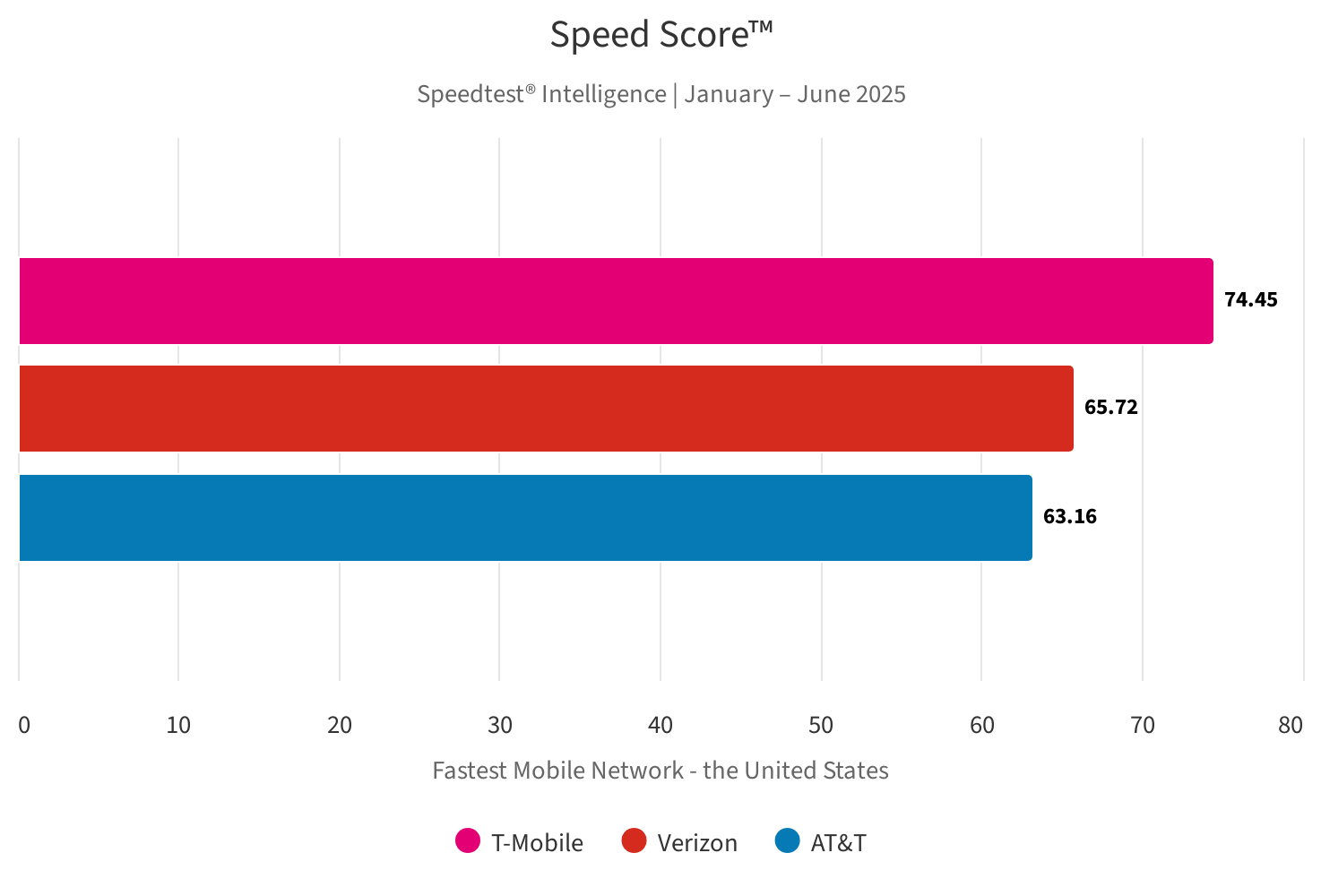
T-Mobile offers the fastest network in the US, according to Ookla. | Image credit – Ookla
So if you are streaming a lot, gaming on the go, or just need consistently fast data throughout the day, Verizon is still the more reliable choice.
Phone selection
Verizon, like other major US carriers, carries a massive range of devices. If it’s officially sold in the US, Verizon probably supports it. That covers the newest releases from Apple, Samsung, Motorola, Google, OnePlus, and more.
So whether it’s the iPhone 17 series, Galaxy S25 series, or Google Pixel 10 series, you can grab them all through Verizon. The carrier also throws in plenty of perks – bigger discounts, trade-in bonuses, and sometimes even free phones – mostly for Plus and Ultimate plan users. Sure, “free” deals can end up costing more over time, but Verizon’s in-house financing options make it easier if you don’t want to pay a big chunk upfront.
With Verizon, you can get the latest iPhone 17, Galaxy S25 Ultra, Pixel 10 and more. | Image credit – PhoneArena
Google Fi also has a solid lineup, though the best deals naturally focus on Google’s own Pixel phones. You can also get the latest Samsung and Motorola devices, but Fi doesn’t run promotions for iPhones. That said, Google Fi makes it easy to bring your own phone, so using an iPhone isn’t a problem.
Overall, Verizon still wins in sheer variety, offering phones from more brands and more options across the board.
Features and perks
Looking at coverage and pricing only gives part of the picture – you also want to factor in extras. Both Verizon and Google Fi throw in some perks, but they play very different games.
Verizon leans heavily on streaming and travel. For an extra $10 a month, you can bundle Disney+, Hulu, and ESPN+, or pick Netflix, Apple TV+, or HBO Max. On top of that, high-speed mobile hotspot access and TravelPass for international data make it easy to stay connected when you’re on the go. If bonus features and streaming access are a priority, Verizon’s offerings really stand out.
Google Fi’s sweet spots show up mostly in its highest-tier plan. You score six months of YouTube Premium at no cost and get 100 GB of Google One storage. For international travelers, Fi’s Premium Unlimited plan covers free calls and texts in over 200 countries. Even the entry-level plans give limited international calling, so you’re not left stranded when reaching friends or family abroad.
Customer service
Verizon’s support shines mainly because you can eventually reach a real person – though you usually start with automated prompts. Some users have had complaints, especially since Verizon started incorporating AI into its support system.
On the bright side, Verizon has physical stores, which is a huge advantage if your problem is tricky or can’t be fixed over the phone or online. Plus, the Verizon app lets you handle all the basics of managing your plan without hassle.
Google Fi takes a different route. Most support happens through the app, chat, or over the phone. Responses are usually fast, but without any physical stores, fixing more complicated device issues can take a bit longer.
Which carrier should you choose?
And now, the big question: which one should you pick? Honestly, I don't think there is no one-size-fits-all answer – it really comes down to what you need. Google Fi usually wins for simplicity and cost, with predictable bills and even AI-generated summaries to make things easier. It also shines for travelers, making it a smart pick if you’re often abroad.
Verizon, on the other hand, starts off pricier but can be cheaper if you are managing multiple lines, making it ideal for families. Its strong 4G coverage also means better reliability in rural areas, so if consistent performance at home is a priority, Verizon takes the lead. Plus, if you are after a wide phone selection, streaming extras, and frequent promos, Verizon delivers more bang for your buck.
What is the main difference between Verizon and Google Fi?
Verizon operates like a classic carrier, owning and maintaining its own cellular network across the US. Google Fi works differently as a Mobile Virtual Network Operator (MVNO), meaning it doesn’t have its own towers – it rents network access, mostly from T‑Mobile, to provide service. On top of that, Verizon’s plans are postpaid, while Google Fi runs on a prepaid system.
How good is Google Fi vs Verizon?
Google Fi is a great option, if you spend most of your time in cities or suburbs where the network performs well. It handles daily browsing, streaming, hotspot use within its limits, and international travel without major issues.
Verizon, however, usually pulls ahead in reliability. Its own network infrastructure means fewer coverage gaps, stronger signal along highways, and steadier performance during peak usage. That makes it a better choice for heavy data users, people who rely on their phone for work, or anyone living outside major urban centers.
Basically, it comes down to what you need and where you are. For typical day-to-day use, Google Fi is great. If you need consistent, dependable service no matter where you go, Verizon is usually the safer bet.
Is Google Fi cheaper than Verizon?
Usually – yes. Google Fi tends to be more affordable, especially for single users or small households, and often stays cheaper as you add multiple lines.
Does Google Fi use Verizon network?
No – Google Fi does not use Verizon’s network. Its service is built on other carriers, most notably T‑Mobile.
Does Verizon work better with iPhones than Google Fi?
Verizon tends to deliver smoother, more reliable support for iPhones, whereas Google Fi shines with Android phones. Fi does work on iPhones, but you might miss out on features like seamless network switching and Apple Watch integration.
Who should choose Google Fi vs Verizon?
If you rely heavily on hotspot or tethering, or spend time in rural areas, on long drives, or working remotely, Verizon is likely the more reliable choice. On the other hand, if you move between cities, travel internationally, or just want an affordable, flexible plan for casual use or family lines, Google Fi stands out as a strong option.
Six-month unlimited plan is now 57% off
$90
$210
$120 off (57%)
Mint Mobile is now allowing you to get whichever plan you like for either three, six, or 12 months for just $15/mo. If you go for the six-month unlimited service, for instance, you'll now have to pay just $90 upfront instead of $210.
Tsveta, a passionate technology enthusiast and accomplished playwright, combines her love for mobile technologies and writing to explore and reveal the transformative power of tech. From being an early follower of PhoneArena to relying exclusively on her smartphone for photography, she embraces the immense capabilities of compact devices in our daily lives. With a Journalism degree and an explorative spirit, Tsveta not only provides expert insights into the world of gadgets and smartphones but also shares a unique perspective shaped by her diverse interests in travel, culture, and visual storytelling.
A discussion is a place, where people can voice their opinion, no matter if it
is positive, neutral or negative. However, when posting, one must stay true to the topic, and not just share some
random thoughts, which are not directly related to the matter.
Things that are NOT allowed:
Off-topic talk - you must stick to the subject of discussion
Offensive, hate speech - if you want to say something, say it politely
Spam/Advertisements - these posts are deleted
Multiple accounts - one person can have only one account
Impersonations and offensive nicknames - these accounts get banned
To help keep our community safe and free from spam, we apply temporary limits to newly created accounts:
New accounts created within the last 24 hours may experience restrictions on how frequently they can
post or comment.
These limits are in place as a precaution and will automatically lift.
Moderation is done by humans. We try to be as objective as possible and moderate with zero bias. If you think a
post should be moderated - please, report it.
Have a question about the rules or why you have been moderated/limited/banned? Please,
contact us.











Things that are NOT allowed:
To help keep our community safe and free from spam, we apply temporary limits to newly created accounts: