Do you remember that when the iPhone first was launched in the summer of 2007, it was an AT&T exclusive. If you were signed up with another carrier and wanted the latest and greatest technology, you had to become an AT&T subscriber. What many of you might not know is that the late Steve Jobs, Apple's CEO at the time (and of course, a co-founder of the tech giant) first approached Verizon about taking on the iPhone as an exclusive.
The untold story of how the iPhone launched as an AT&T exclusive
Jobs met with then Verizon CEO Ivan Seidenberg in 2005. With the carrier considered to have the best network at the time, Jobs felt that his game changing phone should be available for customers with the best mobile connectivity. But the "asks" made of Verizon by Jobs were too much and Verizon simply walked away from the talks. Always the optimistic forward thinker, Jobs knew what he had in the iPhone while Verizon wasn't sure.
You can't blame Verizon for passing up on the iPhone once you hear that Jobs wanted Apple to get paid a percentage of every Verizon customer's monthly bill. Reportedly, it would have resulted in Verizon paying Apple $10 per customer per month. Jobs also wanted control over iPhone customer service and wanted to limit iPhone sales to Verizon stores and Apple Stores, which would have frozen out Verizon partners like Best Buy and Walmart.
Apple iPhone users: which carrier are you subscribed to?
5735 Votes
T-Mobile.
37.37%
Verizon.
26.5%
AT&T
17.26%
MVNO/Wi-Fi only.
8.27%
I don't have an iPhone.
10.6%
Jobs also did not want Verizon's logo plastered all over the iPhone's hardware and software. Verizon rejected the approach and Apple ended up giving AT&T an exclusive on the iPhone for three years and eight months.
Most new iPhone buyers prefer Verizon
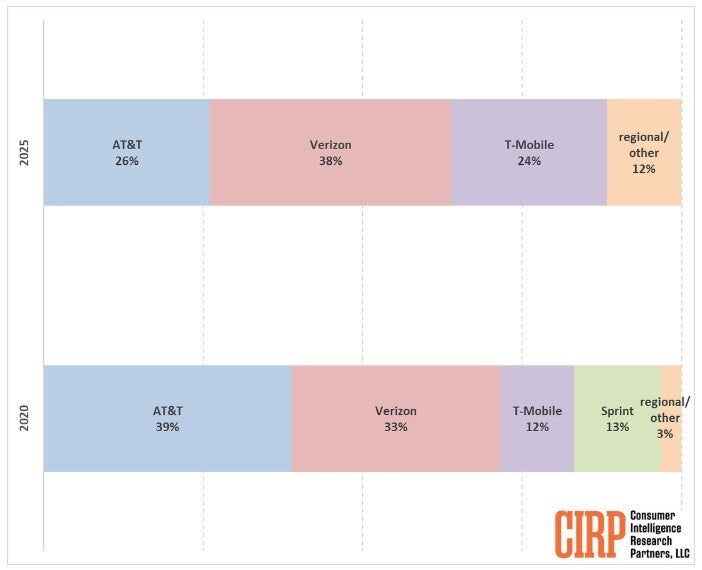
An interesting study has been completed by Consumer Intelligence Research Partners, LLC (CIRP). The latter surveyed mobile phone users in the U.S. each September and asked them who had purchased an iPhone during the previous 12 months, and which wireless carrier they were using. Looking at the results from 2025, it turns out that those buying a new iPhone model prefer Verizon.
Recommended For You
In September 2025, 38% of those who had purchased an iPhone over the previous 12 months were Verizon customers. That was up from the 33% of iPhone buyers that Verizon had in 2020. AT&T was the big loser as it had 26% of consumers who had purchased a new iPhone over the past 12 months this past September. In September 2020, AT&T had captured a leading 39% of those who purchased a new iPhone within the previous 12 months.
Apple iPhone buyers prefer Verizon according to a CIRP survey. | Image credit-CIRP
Looking at the numbers for T-Mobile in September 2025, it would appear that the survey showed that the Un-carrier's percentage of iPhone purchasers over the previous 12 months had doubled from 12% in September 2020 to 24% in 2025. However, in September 2020 Sprint had 13% of consumers who had purchased an iPhone over the previous 12 months. T-Mobile acquired Sprint in April 2020 so it seems that the 2025 number of 24% for T-Mobile pretty much shows the absorption of former Sprint customers in T-Mobile's numbers.
Lastly, 12% of consumers who said they purchased a new iPhone between September 2024 and September 2025 use a regional or other kind of carrier. That percentage has quadrupled from the 3% of new iPhone buyers between September 2019 and September 2020 who said the same thing.
The most important data point in the survey is this one
Does this mean that Verizon offers better deals for the iPhone? As a Verizon customer, I got a great deal when trading in my iPhone 11 Pro Max for the iPhone 15 Pro Max in 2023. Last year, I got a similar sweet deal when I traded in my wife's iPhone 11 Pro Max for an iPhone 16 Pro Max. On the other hand, it could mean that iPhone users simply prefer the Verizon experience including the network.
The 4X increase in the regional/other category might be the most important thing we can take from this data. It means that substantially more people who can afford buying a new iPhone are using lower priced wireless providers. This could be the start of a new trend as consumers discover that they can use the same networks that Verizon, T-Mobile, and AT&T subscribers use at a fraction of the cost.
Trade in your old phone for cash at ecoATM!
Recycle your used phone and get instant cash. Find out how at ecoATM!
Alan, an ardent smartphone enthusiast and a veteran writer at PhoneArena since 2009, has witnessed and chronicled the transformative years of mobile technology. Owning iconic phones from the original iPhone to the iPhone 15 Pro Max, he has seen smartphones evolve into a global phenomenon. Beyond smartphones, Alan has covered the emergence of tablets, smartwatches, and smart speakers.
A discussion is a place, where people can voice their opinion, no matter if it
is positive, neutral or negative. However, when posting, one must stay true to the topic, and not just share some
random thoughts, which are not directly related to the matter.
Things that are NOT allowed:
Off-topic talk - you must stick to the subject of discussion
Offensive, hate speech - if you want to say something, say it politely
Spam/Advertisements - these posts are deleted
Multiple accounts - one person can have only one account
Impersonations and offensive nicknames - these accounts get banned
To help keep our community safe and free from spam, we apply temporary limits to newly created accounts:
New accounts created within the last 24 hours may experience restrictions on how frequently they can
post or comment.
These limits are in place as a precaution and will automatically lift.
Moderation is done by humans. We try to be as objective as possible and moderate with zero bias. If you think a
post should be moderated - please, report it.
Have a question about the rules or why you have been moderated/limited/banned? Please,
contact us.




Things that are NOT allowed:
To help keep our community safe and free from spam, we apply temporary limits to newly created accounts: