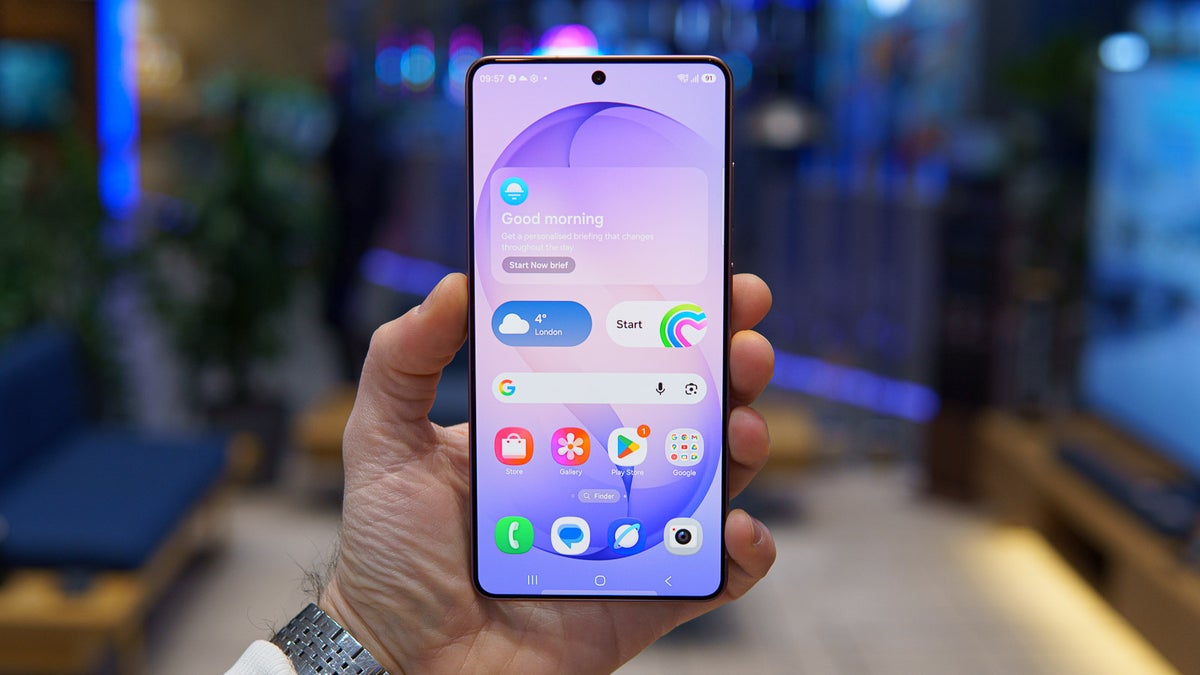
If you were to ask me, I would give you plenty of reasons to appreciate the recently released Samsung Galaxy smartphone. But at the same time, there's one major drawback with Samsung phones that stops me from calling them the best Android phones on the market. Most of you might have already guessed it.
Yes, I'm talking about the battery capacity of Galaxy phones. But have you ever wondered exactly what's stopping Samsung from shipping its phones with massive batteries, like its Chinese rivals? I think there are a few reasons behind it.
How are Chinese brands making phones with batteries as large as 10,000 mAh?
If you regularly follow the smartphone industry, you're probably aware that nearly all major Chinese brands surpassed 5,000 mAh batteries years ago. For instance, the OnePlus 15 packs a 7,300 mAh battery, the Xiaomi 17 Ultra has a 6,800 mAh cell, and the Realme P4 Power and Honor Power 2 both exceed 10,000 mAh.
These brands are able to offer such massive batteries because they use silicon-carbon technology instead of the lithium-ion batteries found in Samsung smartphones. One of its biggest benefits is that it allows manufacturers to pack huge capacities into almost the same physical space as a lithium-ion battery.
Why isn't Samsung switching to silicon-carbon batteries?
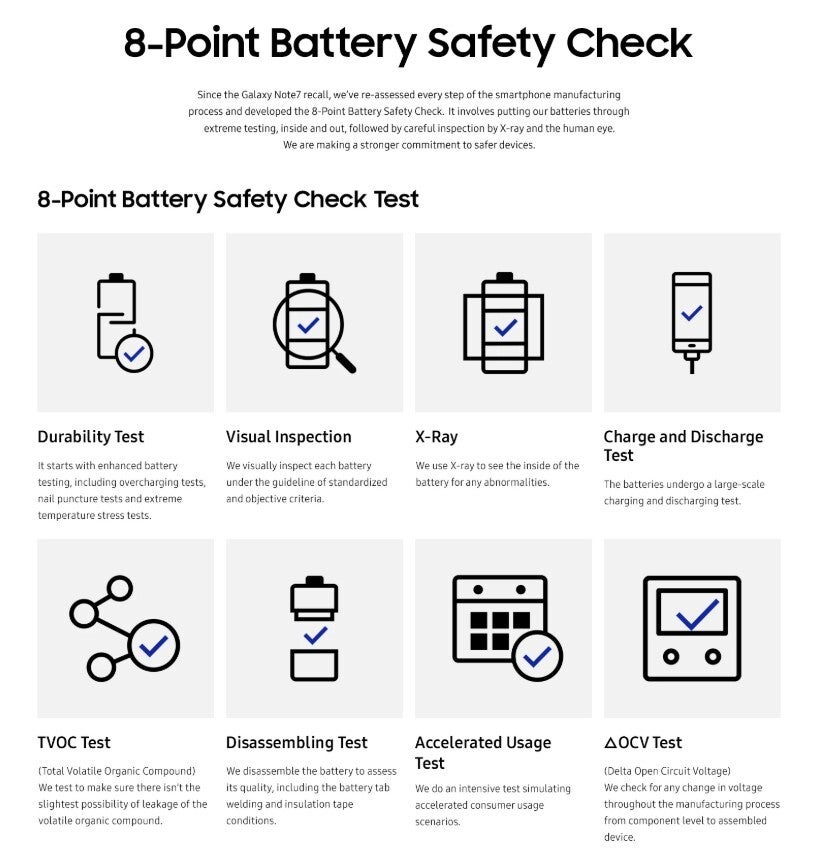
8 battery safety measures by Samsung. | Image by Samsung
The incident that happened with the Galaxy Note 7 in 2016 is why I think Samsung hasn't adopted silicon-carbon technology yet. For those unaware, that Galaxy smartphone had a serious battery issue that ultimately posed a risk to users. There were also numerous reports of fires caused by its battery.
Recommended For You
The liquid that surrounded the lithium-ion battery in the Galaxy Note 7 was highly flammable. If any external pressure caused a tear in the battery, it ultimately created a path for the electricity to flow. Because of this, the flammable liquid would heat up, resulting in explosions in some cases.
The news of this phone catching fire became so frequent that many airlines banned it from their flights. All of this resulted in the tech giant apologizing to its customers through ads in print media. The company also introduced a dedicated checklist containing 8 safety measures that every battery must pass before it can be installed in a Samsung phone.
I believe this checklist is probably the main thing that has stopped the South Korean giant from introducing 10,000 mAh batteries in its smartphones. Other than this, another small but important reason is stopping the company from instantly switching to larger batteries.
Will the Galaxy S27 Ultra become the best Android smartphone of 2027 if it comes with a massive battery?
38 Votes
Yes, a big battery is all it takes.
52.63%
Samsung needs to offer a camera like the Xiaomi 17 Ultra's.
13.16%
Samsung's S-line phones are already the best Android phones.
7.89%
It's too early to say.
26.32%
Rules of different regions
The mystery behind why Samsung, Apple, and Google don’t significantly increase battery sizes has been solved, with the primary reason being U.S. federal regulations on lithium battery transportation, 49 CFR 173.185: For lithium-ion battery cells, the limit is 20 Wh.
A reliable tipster, Ice Universe, explained in detail why not only Samsung but also a few other brands like Google and Apple are stuck with the same 5,000 mAh battery. As it turns out, in the US, regulation 49 CFR § 173.185 states that lithium-ion batteries in a smartphone should not exceed 20 Wh (watt-hour). The watt-hour can be calculated by multiplying the voltage of your smartphone battery by its capacity and then dividing the result by 1,000.
According to this, the watt-hour of the Galaxy S26 Ultra, which comes with a 5000 mAh cell that's typically 3.88 volts, will be 19.4 Wh. This is under the limit allowed as per US regulations. As a result, the phone can be easily shipped in the US market.
But what about devices like the OnePlus 15 that come with a 7300 mAh battery and are available in the US? Is the US government giving some kind of relief to OnePlus? Definitely not.
The catch here is that the 20 Wh rule applies to single-cell batteries. The OnePlus 15, on the other hand, comes with a dual-cell battery (3650 + 3650) that operates at a maximum voltage of 4.4 V. So if you do the calculation, you will find that each cell is producing 16.06 Wh, which is less than the allowed limit.
That's the reason you will find some Chinese smartphones offering slightly lower battery capacities in the EU than in their home market. For instance, the recently released Xiaomi 17 Ultra is available with a 6800 mAh battery in China, whereas in global markets it ships with only a 6000 mAh cell.
Galaxy S27 Ultra could offer a massive battery
The good news is that Samsung is not going to stick with the same old battery capacity forever on its smartphones. A latest finding suggests that the company is running trials on 12,000 mAh, 18,000 mAh, and 20,000 mAh silicon-carbon batteries. All of them reportedly have a dual-cell design.
The 12,000 mAh cell, for instance, consists of a 6,800 mAh and a 5,200 mAh cell. Even if the South Korean giant decides to pull the 6,800 mAh cell from the stack and offer it in its upcoming device, it would be a great addition.
A trusted leaker, Schrödinger, believes that the Galaxy S27 Ultra could be the first Samsung device to carry a massive battery. The only speed breaker the company is currently facing is that these batteries only last until 960 charge cycles, which is far less than the company's target of 1,500 cycles.
If this longevity problem is somehow addressed, then I would definitely consider purchasing next year's Ultra phone from Samsung. I was actually thinking of getting the S26 Ultra this year but did not go ahead because the phone doesn't feature any noticeable updates over its predecessor. A battery bigger than we have ever seen on an S-line device, along with some other important updates, would make the S27 Ultra one of the best flagship devices for me in the upcoming year.
Six-month unlimited plan is now 57% off
$90
$210
$120 off (57%)
Mint Mobile is now allowing you to get whichever plan you like for either three, six, or 12 months for just $15/mo. If you go for the six-month unlimited service, for instance, you'll now have to pay just $90 upfront instead of $210.
Aman Kumar is a news writer at PhoneArena covering Google Pixel phones, Android features, AI-powered smartphone tools, and mobile tech news. Before joining PhoneArena, he spent over five years writing about consumer technology for publications like MakeUseOf, How-To Geek, and Guiding Tech. His current daily drivers are the Pixel 10 and Samsung Galaxy S26 Plus, while his red iPhone SE (2nd gen) remains a personal favorite. Aman also appreciates bold smartphone experiments and still considers the Nokia N-Gage one of the industry’s most iconic designs.
A discussion is a place, where people can voice their opinion, no matter if it
is positive, neutral or negative. However, when posting, one must stay true to the topic, and not just share some
random thoughts, which are not directly related to the matter.
Things that are NOT allowed:
Off-topic talk - you must stick to the subject of discussion
Offensive, hate speech - if you want to say something, say it politely
Spam/Advertisements - these posts are deleted
Multiple accounts - one person can have only one account
Impersonations and offensive nicknames - these accounts get banned
To help keep our community safe and free from spam, we apply temporary limits to newly created accounts:
New accounts created within the last 24 hours may experience restrictions on how frequently they can
post or comment.
These limits are in place as a precaution and will automatically lift.
Moderation is done by humans. We try to be as objective as possible and moderate with zero bias. If you think a
post should be moderated - please, report it.
Have a question about the rules or why you have been moderated/limited/banned? Please,
contact us.







Things that are NOT allowed:
To help keep our community safe and free from spam, we apply temporary limits to newly created accounts: