Meet the Motorola Razr (2026) family: Subtle upgrades, gorgeous designs, increased prices
The Razr (2026), Razr Plus (2026), and Razr Ultra (2026) are official with familiar designs, largely familiar specs, and sadly, unfamiliar prices.

The Razr Ultra (2026) looks absolutely stunning in Pantone Orient Blue and Cocoa colorways. | Image by Motorola
If you've been waiting for an Android handset vendor to completely reimagine foldable devices as we've come to know (and occasionally love) them these last few years, your wait is... not over today.
But sometimes, reinventing the wheel is not the best idea, and that's especially true when the mobile industry as a whole is going through a tough period due to the rising costs of key components and when... you've already hit the mark as far as both designs and value propositions are concerned.
No, the freshly unveiled Razr (2026), Razr Plus (2026), and Razr Ultra (2026) don't look radically different from their 2025 predecessors (either at first glance or if you examine them more closely), but that absolutely does not mean these refined new products are to be ignored. Let's take them one by one and quickly analyze their strengths and weaknesses.
The new "vanilla" Razr packs a hefty battery into a surprisingly robust body
- 6.9-inch primary LTPO Extreme AMOLED display with 2640 x 1080 pixel resolution, 120Hz refresh rate technology, and up to 3,000 nits brightness;
- 3.6-inch secondary LTPS Extreme AMOLED screen with 1066 x 1056 pixel resolution, 90Hz refresh rate support, and up to 1,700 nits brightness;
- Corning Gorilla Glass Victus protection;
- MediaTek Dimensity 7450X processor;
- Android 16;
- 8GB LPDDR5X memory;
- 256GB UFS 3.1 storage;
- microSD card slot for up to 1TB storage expansion;
- 50MP main rear-facing camera with OIS and f/1.7 aperture;
- 50MP secondary ultra-wide-angle lens with f/2.0 aperture;
- 32MP front-facing camera with f/2.4 aperture;
- 4,800mAh battery;
- 30W wired and 15W wireless charging support;
- IP48 water and dust resistance;
- MIL-STD 810H durability;
- Stereo speakers with Dolby Atmos;
- USB 2.0 Type-C port;
- Wi-Fi 6E, NFC;
- 171.3 x 73.99 x 7.25mm dimensions (open);
- 88.08 x 73.99 x 15.85mm dimensions (closed);
- 188 grams weight;
- Pantone Hematite, Violet Ice, Bright White, and Sporting Green color options.
Would you believe me if I told you that the cheapest member of the Razr (2026) lineup holds a key advantage over its costliest brothers? How about more than one?
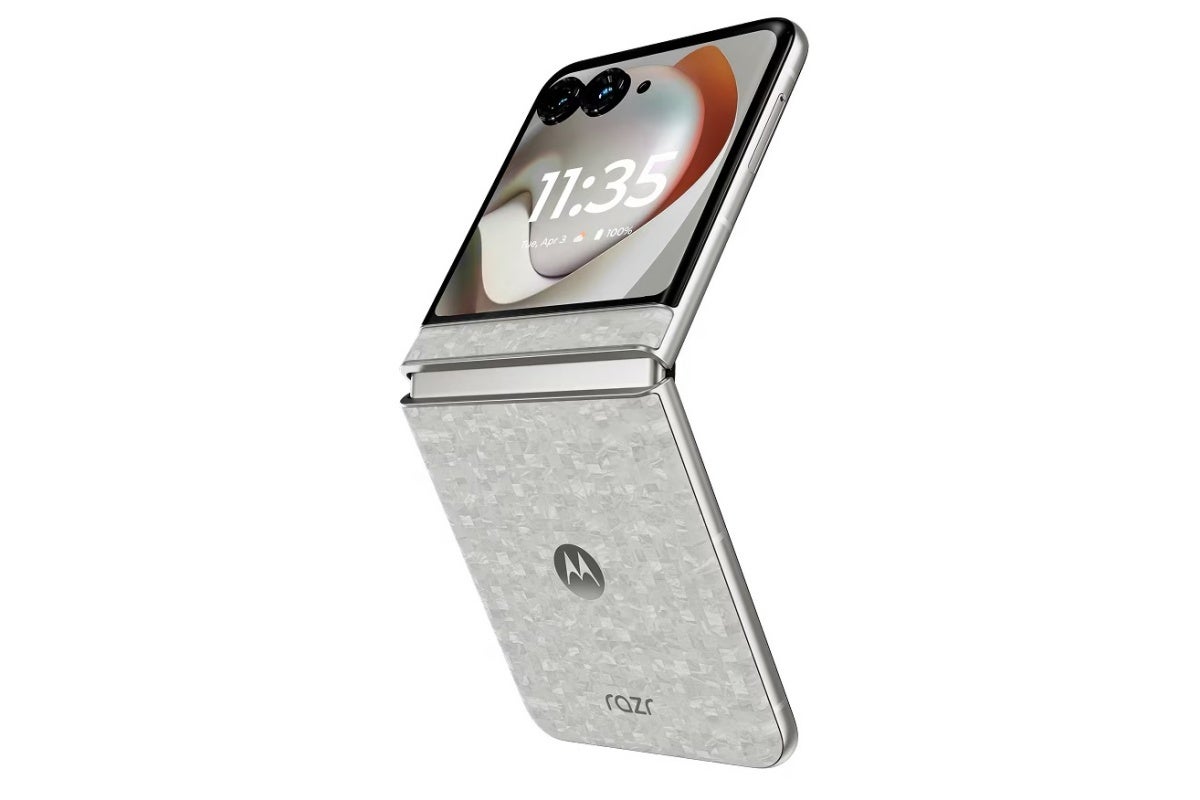
How could you not love the affordable Razr (2026) in this breathtaking Pantone Bright White colorway? | Image by Motorola
That may sound highly unlikely, but it's actually true, as the base Motorola Razr (2026) is the first flip phone that meets "military standards" for durability, which means that at least in theory, this thing should be able to handle things like extreme temperatures, humidity, and even the occasional drop on a hard surface better than the Razr Plus (2026) and Razr Ultra (2026). And all that while rocking some of the most eye-catching colorways and textures I've ever seen on a modern phone.
The other advantage is likely to be real-world endurance between charges, as the Razr (2026) amazingly packs a bigger battery than the Razr Plus (2026) and an only slightly smaller one than the Razr Ultra (2026), which sports larger, sharper, brighter, and thus more power-hungry screens.
What makes a good foldable great?
135 Votes
A special, ultra-lightweight design
10.37%
An extremely powerful chip
1.48%
Proper tablet-like features
8.89%
An asking price that's actually decent
13.33%
Superb camera capabilities
13.33%
A long software support and super-optimized UI
5.19%
Battery life that puts all competitors to shame
13.33%
It's all in the hinge and durability!
29.63%
Nothing. No foldable is great
4.44%
Compared to the Razr (2025), the budget-friendly Galaxy Z Flip 7 alternative also comes with a much better (at least in theory) secondary rear-facing camera, as well as a slightly faster chipset.
The Razr Plus (2026) is basically the Galaxy S26 Plus of this family
- 6.9-inch primary LTPO Extreme AMOLED display with 2640 x 1084 pixel resolution, 165Hz refresh rate technology, and up to 3,000 nits brightness;
- 4-inch secondary LTPS Extreme AMOLED screen with 1272 x 1080 pixel resolution, 165Hz refresh rate support, and up to 2,400 nits brightness;
- Corning Gorilla Glass Victus protection;
- Ultra Thin Glass (UTG);
- Qualcomm Snapdragon 8s Gen 3 processor;
- Android 16;
- 12GB LPDDR5X memory;
- 256GB internal storage space;
- 50MP main rear-facing camera with OIS and f/1.8 aperture;
- 50MP secondary ultra-wide-angle lens with f/2.0 aperture;
- 32MP front-facing camera with f/2.4 aperture;
- 4,500mAh battery;
- 45W wired, 15W wireless, and 5W reverse charging capabilities;
- IP48 water and dust resistance;
- Stereo speakers with Dolby Atmos;
- USB 2.0 Type-C port;
- Wi-Fi 7, NFC;
- 171.42 x 73.99 x 7.09mm dimensions (open);
- 88.09 x 73.99 x 15.32mm dimensions (closed);
- 189 grams weight;
- Pantone Mountain View color.
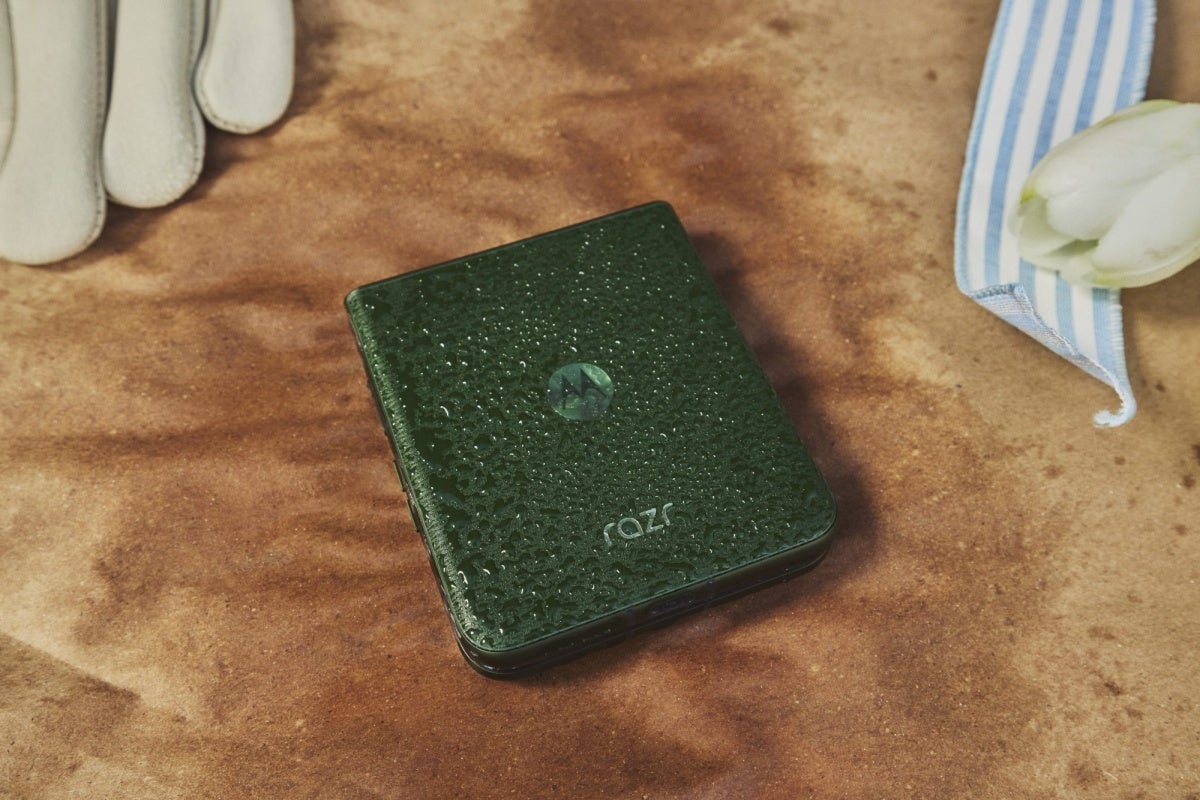
The Razr Plus (2026) doesn't look half bad in a Pantone Mountain View hue. | Image by Motorola
Did someone ask for an awkward and overpriced middle brother with an unclear target audience and almost no notable upgrades over its predecessor? That's the Razr Plus (2026) in a nutshell, and although its cover screen is much larger than that of the non-Plus Razr (2026), the processor most likely faster, and the charging speeds undeniably superior, the smaller battery squeezed into an only slightly thinner body (and with no weight benefit) makes choosing this model feel... pretty unwise.
The Razr Ultra (2026) looks objectively great, but is it good enough?
- 7-inch primary Extreme AMOLED display with 2992 x 1224 pixel resolution, 165Hz refresh rate technology, and up to 5,000 nits brightness;
- 4-inch secondary Extreme AMOLED screen with 1272 x 1080 pixel resolution, 165Hz refresh rate support, and up to 3,000 nits brightness;
- Corning Gorilla Glass Ceramic 3 protection;
- Ultra Thin Glass (UTG);
- Qualcomm Snapdragon 8 Elite processor;
- Android 16;
- 16GB LPDDR5X memory;
- 512GB internal storage space;
- 50MP main rear-facing camera with OIS and f/1.8 aperture;
- 50MP secondary ultra-wide-angle lens with f/2.0 aperture;
- 50MP front-facing camera with f/2.0 aperture;
- 5,000mAh battery;
- 68W wired, 30W wireless, and 5W reverse charging capabilities;
- IP48 water and dust resistance;
- Stereo speakers with Dolby Atmos;
- USB 2.0 Type-C port;
- Wi-Fi 7, NFC;
- 171.48 x 73.99 x 7.19mm dimensions (open);
- 88.12 x 73.99 x 15.69mm dimensions (closed);
- 199 grams weight;
- Pantone Cocoa and Orient Blue color options.
As expected for a little while now, the biggest problem with the new and upgraded Razr Ultra and the component that's by far the hardest to explain is an unchanged Snapdragon 8 Elite SoC.
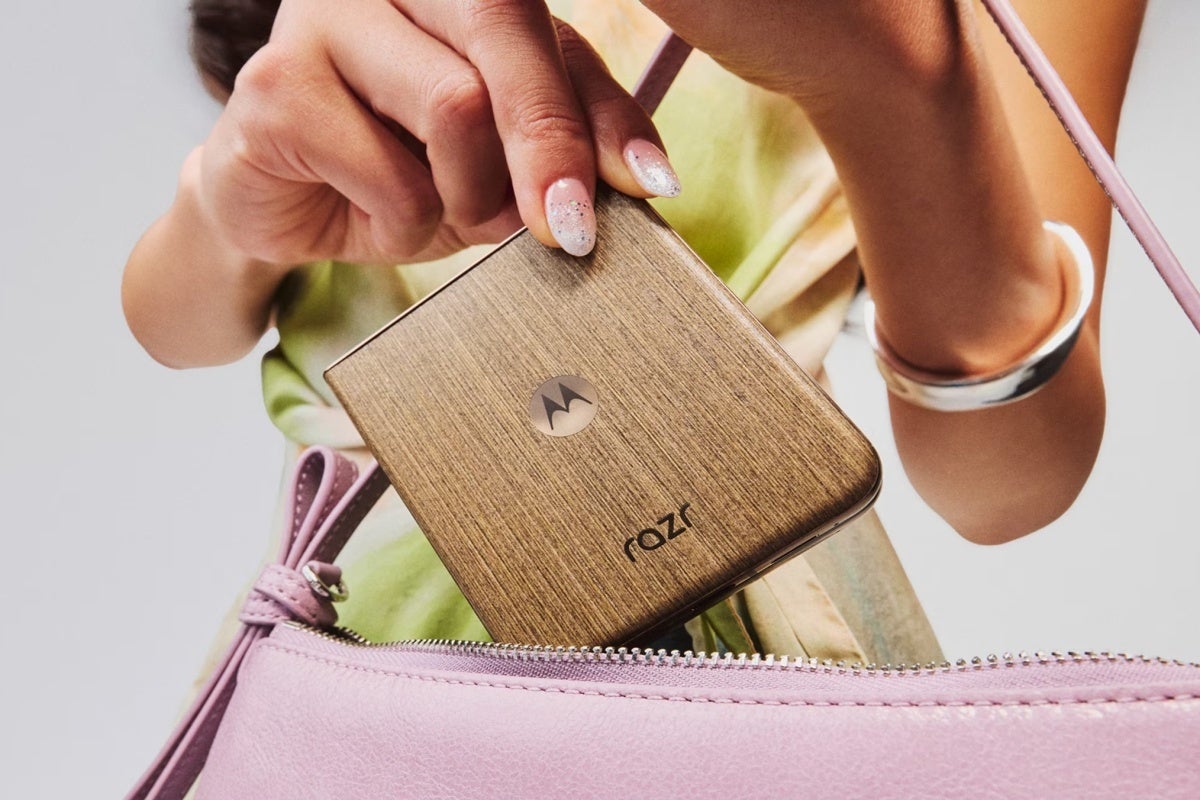
If there's one thing that can separate the Razr Ultra (2026) from today's foldable pack, that might be this insanely attractive Pantone Cocoa colorway. | Image by Motorola
That does still give the Razr Ultra (2026) the (small) edge over the Exynos 2500-powered Galaxy Z Flip 7 in overall performance, but the Galaxy Z Flip 8 could jump out in front in just a few months.
Compared to its more affordable brothers, the new ultra-high-end foldable is likely to shine across departments as diverse as both rear and front camera performance, wired and wireless charging speeds, memory and storage, overall screen quality and brightness, and last but not least, cover display durability with the help of Corning Gorilla Glass Ceramic 3 technology. Oh, and the Alcantara finish of the Orient Blue model and the "natural wood veneer" texture of the Pantone Cocoa flavor are simply breathtaking.
Motorola Razr (2026) family prices and release dates
- $799.99 - base Razr (2026);
- $1,099.99 - Razr Plus (2026);
- $1,499.99 - Razr Ultra (2026).
May 14 is when the entire Razr (2026) trio is scheduled to go up for pre-order in the US at Best Buy, Amazon, and Motorola's official regional e-store, with "universally" unlocked sales then set to kick off on May 21.
That's not such a long wait as some of you may have expected, but unfortunately, the price points are... just as bad as recently rumored, adding $100 to the original tags of the Razr (2025) and Razr Plus (2025) and a whopping (and entirely unjustified) $200 to the Razr Ultra (2025).
Clearly, the "vanilla" Motorola Razr (2026) is the best foldable phone for most (wise) buyers, while the Razr Ultra (2025) remains an unmissable bargain (likely, for a limited time only) at a massively reduced price of $799.99... in a 1TB storage variant... with free wireless earbuds also included.


Popular stories



Latest News



Things that are NOT allowed:
To help keep our community safe and free from spam, we apply temporary limits to newly created accounts: