T-Mobile reserves its fastest 5G spectrum for special events
As it has since it started to build its 5G network, T-Mobile favors the use of its 2.5GHz mid-band spectrum.
T-Mobile continues to keep mmWave spectrum on the bench. | Image by PhoneArena
T-Mobile became the 5G leader in the U.S. because of some smart spectrum management. When Verizon and AT&T first started to build out their 5G networks in the U.S., they decided to use the fastest spectrum, high-band millimeter wave (mmWave) airwaves. The problem with this is that high-band mmWave signals do not travel long distances.
T-Mobile outsmarted AT&T and Verizon when the trio started to build out their 5G networks
T-Mobile had another plan. It purchased Sprint for $26.5 billion mostly for the latter's 2.5GHz mid-band spectrum. It was a Goldilocks solution as the airwaves were not as fast as mmWave, but they were faster than low-band. While mid-band signals don't cover the ground that low-band spectrum can, it covers much more ground than mmWave.
Mid-band spectrum was hard to find when T-Mobile bought Sprint and at first, AT&T and Verizon had no way to purchase large holdings of mid-band spectrum. What the pair did was spend a ton of money at C-band auctions in order to obtain C-band licenses that included mid-band frequencies.
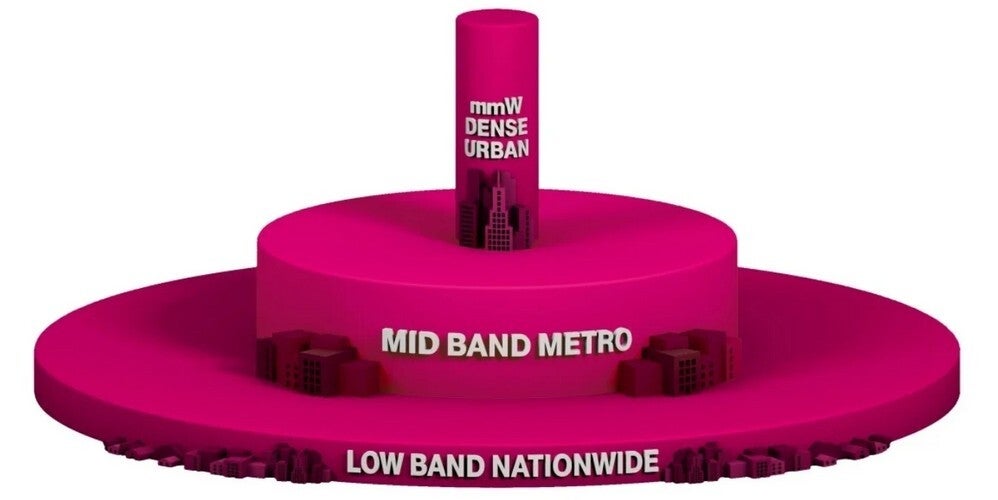
T-Mobile compared its 5G spectrum strategy to a multi-layered cake. | Image by T-Mobile
T-Mobile compared its 5G build out to a multi-layered cake
While T-Mobile really showed up AT&T and Verizon by building out its 5G network with mid-band spectrum, it does have some mmWave holdings. The carrier compared its spectrum to a layer cake with 600MHz low band on the bottom for nationwide 5G.
If you were to leave T-Mobile, what type of wireless firm would you switch to?
88 Votes
Another Mobile Network Operator like Verizon or AT&T.
22.73%
An MVNO like Google Fi or Cricket.
43.18%
Digital MVNO like Visible.
34.09%
The middle layer of the cake consists of the 2.5GHz mid-band spectrum for Metro use with mmWave at the top for dense urban areas. T-Mobile even gave away free boxes of Betty Crocker "5G cake mix" in 2020 to promote its 5G build out.
Verizon still used high-band mmWave spectrum in 91 markets during 2H 2025 compared to only 1 for T-Mobile
T-Mobile does not use mmWave often for its consumer wireless service. According to an Ookla report, RootMetrics measured only one market where T-Mobile deployed mmWave during the second half of 2025, a decline from the two markets it offered mmWave airwaves to during the first half of 2024.
On the other hand, Verizon used mmWave in 91 markets during the second half of 2025 according to RootMetrics, up from 75 during the first half of 2024.
While it is not well known, T-Mobile does use mmWave spectrum for some private networks. For example, the carrier used the speedy short distance signals last weekend for NBC's broadcast of the Kentucky Derby. The airwaves were used to help broadcast the reaction of family members in the Churchill Downs grandstand, with the cameras being used coming from eight iPhone 17 Pro units.
Millimeter wave has pros and cons. The pro is really high throughput. When we do Las Vegas Grand Prix, we bring millimeter wave. It gives you fantastic speeds, like 2 gigabits per second. One of the cons is you have to get the line of sight just right.
We’ve not taken the approach of trying to densely deploy millimeter wave because it doesn’t necessarily make sense. Stadiums are a good place for it. We'll use it where it makes sense. We're actually much more invested in mid-band. We also have low band for extended reach.
We’ve not taken the approach of trying to densely deploy millimeter wave because it doesn’t necessarily make sense. Stadiums are a good place for it. We'll use it where it makes sense. We're actually much more invested in mid-band. We also have low band for extended reach.
Scott Jacka, senior director of Technology Development Strategy, T-Mobile
NBC also used technology from T-Mobile's 5G standalone network for NBC's broadcast of a couple of golf tournaments last year. T-Mobile's 5G On Demand uses New Radio Dual Connectivity, or NR-DC, to connect its mmWave airwaves to its mid-band airwaves to deliver super-fast speeds at the Kentucky Derby by aggregating sub-6 GHz spectrum and mmWave spectrum simultaneously.
Sprint was sitting on a goldmine with its holdings of very rare 2.5GHz mid-band spectrum
We should see this technology employed by CBS next week at the 2026 PGA Championship at the Aronimink Golf Club in Newtown Square, Pennsylvania.
When T-Mobile uses mmWave, for private networks mostly, it employs the high 24GHz band. These signals usually travel not much longer than a half-mile compared to miles for spectrum in the lower bands.
At the time of the Sprint deal, many couldn't understand why T-Mobile would want to buy Sprint. T-Mobile had already started to show signs of its amazing turnaround under charismatic CEO John Legere and customers were confused as to why it would want the lagging operations of a poorly performing rival.
The truth was easy to understand for those who knew that Sprint was sitting on a goldmine with its holdings of 150MHz to 175MHz of the 2.5GHz mid-band spectrum. Perhaps things would have been much different if AT&T and Verizon not decided to use their high-band mmWave spectrum to build out their 5G networks from the start.
Had AT&T and Verizon decided to go another way and follow T-Mobile's use of mid-band, perhaps we would have seen a spirited three-way takeover battle for Sprint. But this never happened and T-Mobile remains the 5G King in the U.S.


Popular stories

Latest News
Things that are NOT allowed:
To help keep our community safe and free from spam, we apply temporary limits to newly created accounts: