If you receive this text that says it is from T-Mobile, delete it immediately
Some T-Mobile subscribers are receiving fake texts as part of a smishing scheme designed to steal their cash.

Some T-Mobile subscribers are getting fake texts. | Image by PhoneArena
A scammer is trying to get T-Mobile subscribers to tap on a link embedded in a text designed to steal personal information from them. The text says that the recipient's T-Mobile Reward Points are about to expire and lists the expiration date as being May 3, which is the day the text was sent.
Don't let your emotions get you caught in a smishing attack
This smishing attack tries to get you to tap a link on the text by stating that the link must be pressed in order for you to redeem your points. This is a typical tactic as the scammers try to get the recipient to get emotional and click on the link even though everyone knows not to open any link inside an unsolicited text.
Tapping the link will most likely reveal a list of questions that will, if you're not careful, give the scammers your credentials allowing them to access your financial apps and wipe you out. Luckily for the person who received the text (and took a screenshot of it), he knew not to tap the link and to question whether the text was real.
Call a verified phone number for the alleged sender of the text
Instead, the recipient of the text got a verified phone number for T-Mobile, called the company and found out that the rewards points program listed on the text is not part of any legitimate T-Mobile rewards program. I also checked with Gemini AI, and it also said that T-Mobile did not offer reward points. Gemini's response also warned about the smishing attack.
Do you think you can spot a fake text?
67 Votes
After reading this article, I believe I can.
17.91%
I already could spot a fake.
58.21%
No, I really wouldn't be able to tell.
4.48%
I don't know.
19.4%
If you're not sure about whether a text you receive is real, you can check with an AI chatbot. Having said that, the best thing to do is call the company that allegedly sent the text, using a phone number that you were able to obtain through a legitimate source. Do not call any phone number that is included with the text.
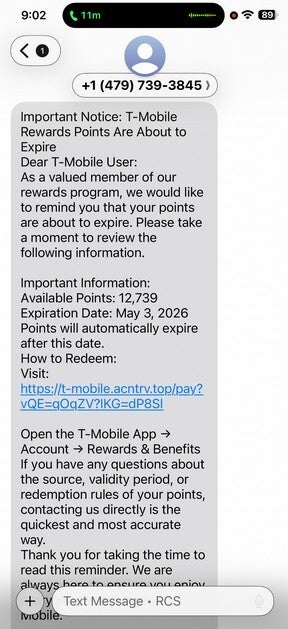
If you get a text like this, do not tap any links as you should report and delete it immediately. | Image by Nextdoor
If you look closely at the link on the text, you'll notice that it does not take you to T-Mobile.com. Instead, it takes you to T-Mobile.acntrv.top. The "acntrv.top" domain was just registered on May 2, a huge clue that tells you in no uncertain terms that you are being scammed.
Check the domain belonging to the link
Just because this particular example came from a T-Mobile subscriber in Swampscott, Massachusetts, it doesn't mean that all smishing attacks are aimed at T-Mobile subscribers. The same rules apply to shady texts that Verizon and AT&T customers also receive that purportedly come from the two wireless providers.
The most important rule you need to follow: Do not tap on any links seen on a text you receive from your carrier until you do some digging. Most texts from your carrier will come via a short code (a 5- or 6-digit number) rather than a standard 10-digit phone number. If the text you receive is from a phone number or email address, it probably is a scam.
Carriers will never ask you for personal data via a text message
As we previously noted, the links should come from a legitimate domain such as https://www.t-mobile.com, https://www.att.com, or https://www.verizon.com. Be alert for domain names that look correct but have a number inserted where a letter should be, or show a hyphen where there is none.
Make sure domain names use https instead of just http. That "s" indicates a secure, encrypted connection. Also, if the text makes it sound as though immediate action is required on your part, the more "scammy" it is.
Carriers will never ask you for your social security number, account passwords, or credit card details through the link on a text message. If you receive a suspicious text, forward it to 7726 (which spells "SPAM"). This is a free service offered by the carriers to investigate and block spam numbers.


Popular stories




Latest News




Things that are NOT allowed:
To help keep our community safe and free from spam, we apply temporary limits to newly created accounts: