The Galaxy S26 Ultra is ahead of the competition in our outdoor visibility test
Samsung's latest flagship, the Galaxy S26 Ultra, has one feature that no one talks about, and yet, it's one of the most useful quality-of-life improvements that you're going to use every day.
Samsung's latest flagship, the Galaxy S26 Ultra, has one feature that no one talks about, and yet, it's one of the most useful quality-of-life improvements that you're going to use every day. Outdoor brightness! Smartphone screens have come a long way, and Samsung is on the forefront of AMOLED display technology. The Galaxy S26 Ultra is a prime example.
Its 6.9-inch Dynamic AMOLED 2X panel is packed with features, including the built-in Privacy Display — the first of its kind on a smartphone. Along with the crisp QHD+ resolution of 3120 x 1440 pixels, the smooth 1–120Hz adaptive refresh rate, and Samsung’s great anti-glare coating, this display doesn’t just look good on paper — it also shines in real-world conditions, even under bright spring sunlight.
Galaxy S26 Ultra 12/512GB: Get it now over at Samsung!
$1299
$1499
$200 off (13%)
Samsung is letting you save up on the Galaxy S26 Ultra with an eligible trade-in. Get up to $720 instant trade-in credit or $200 off without trade-in. This is Samsung's latest and greatest phone, and the first phone in the world with Privacy Display, so don't miss out!
Before moving on to the outdoor test, we measured the Galaxy S26 Ultra’s brightness in our lab. There were some concerns that the new Privacy Display[1] might impact brightness even when turned off, so we decided to investigate.
We measured the screen brightness at 100% APL (Average Picture Level), which corresponds to all the pixels inside the display firing up at full power, and also at 20% APL, a scenario that's much closer to real-life usage.
Recommended For You
The Galaxy S26 Ultra managed to output 2420 nits at 20% APL, which is an excellent result and also a tad higher than its predecessor. This goes to show that the new Privacy Display feature does not affect the screen brightness of the S26 Ultra in a negative way. But the max brightness measurements alone can’t do justice to the way the Galaxy S26 Ultra looks under the sun. Time to head outdoors.
Galaxy S26 Ultra visibility on a sunny day (real-life conditions)
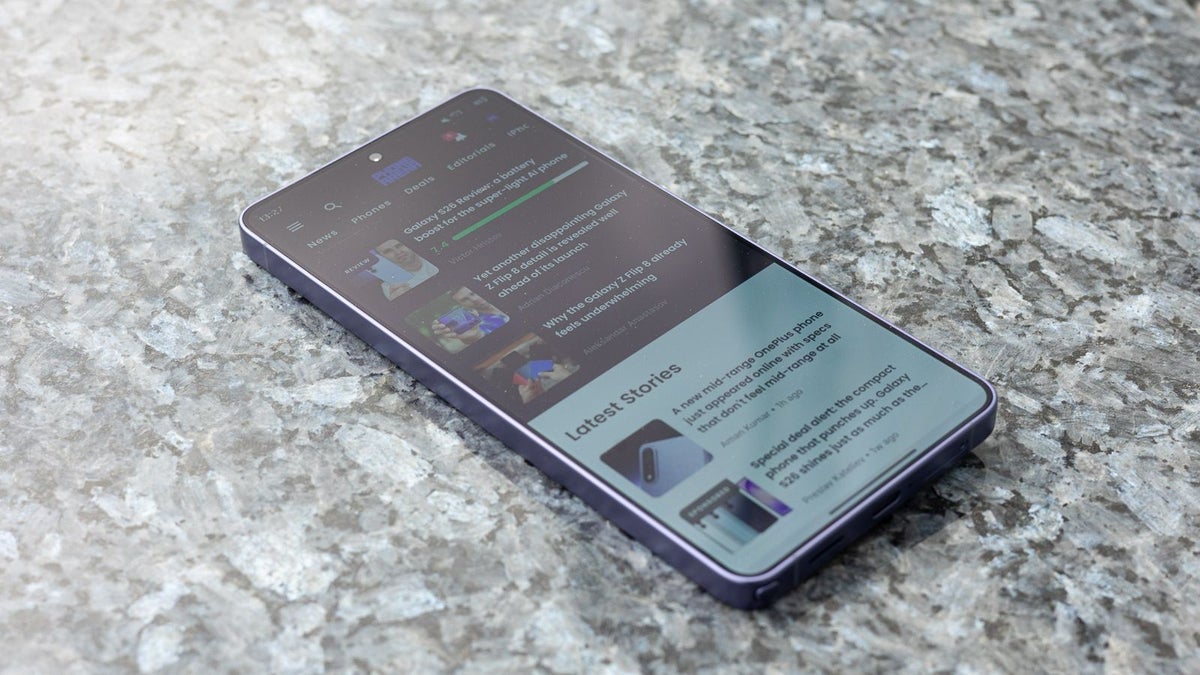
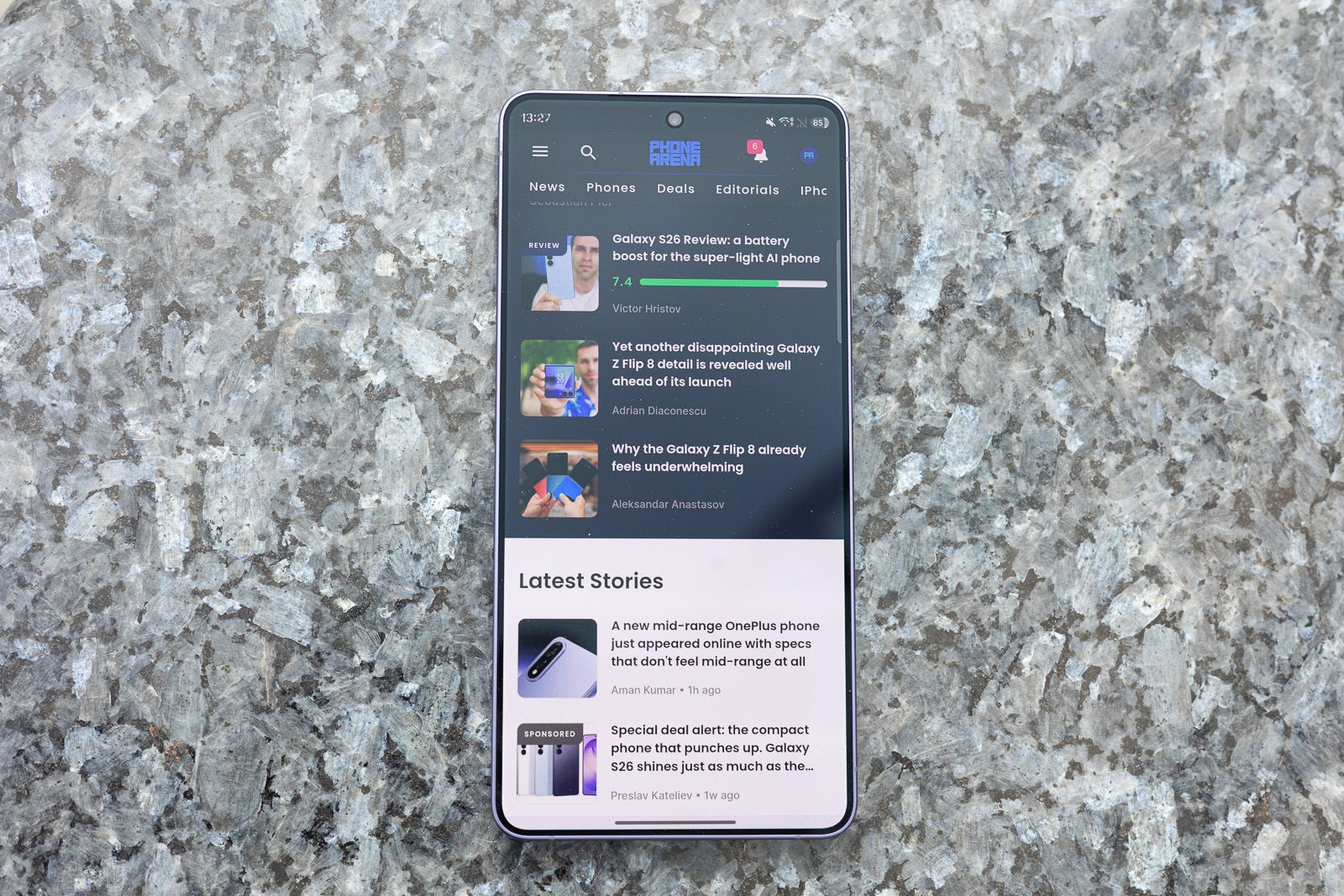
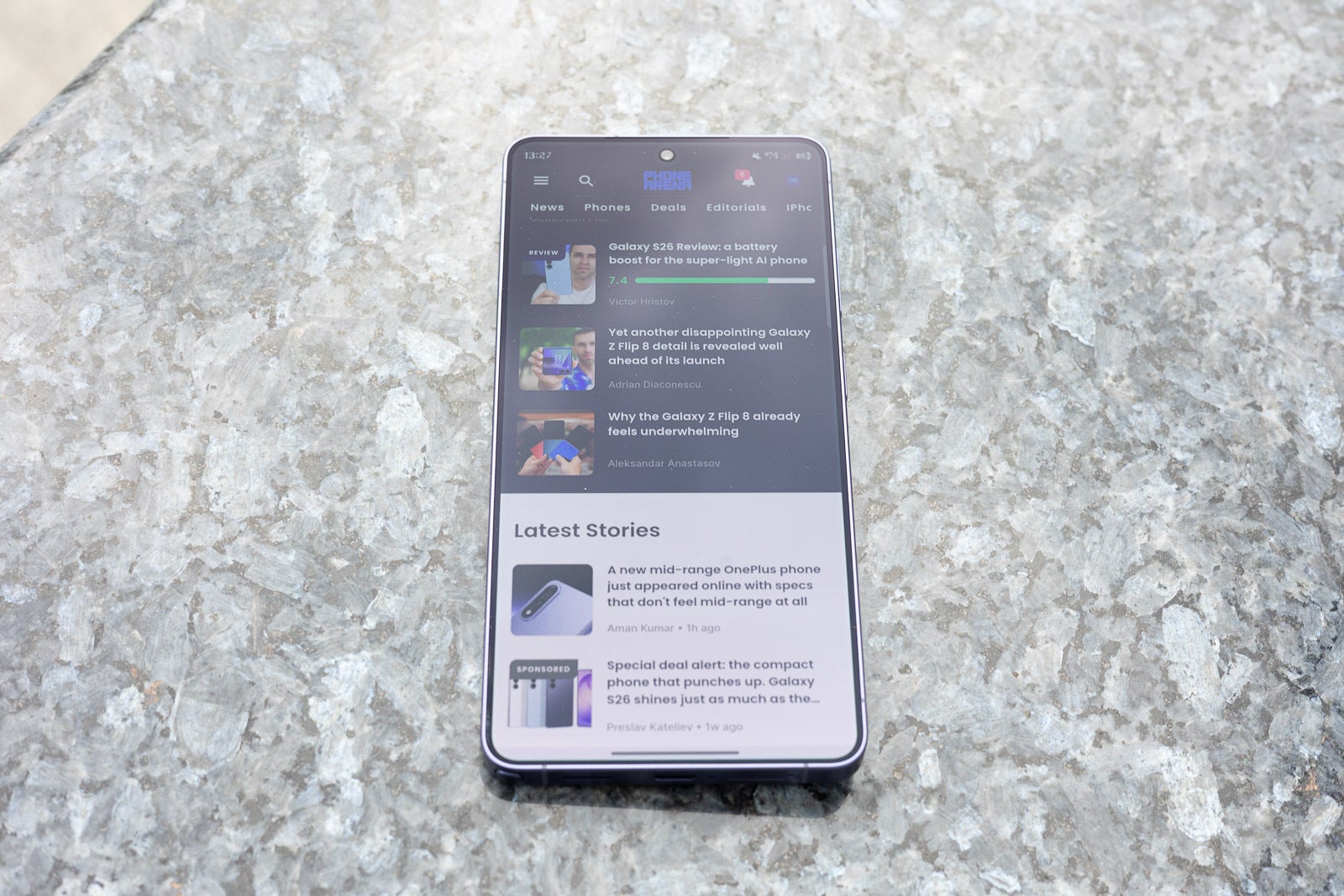
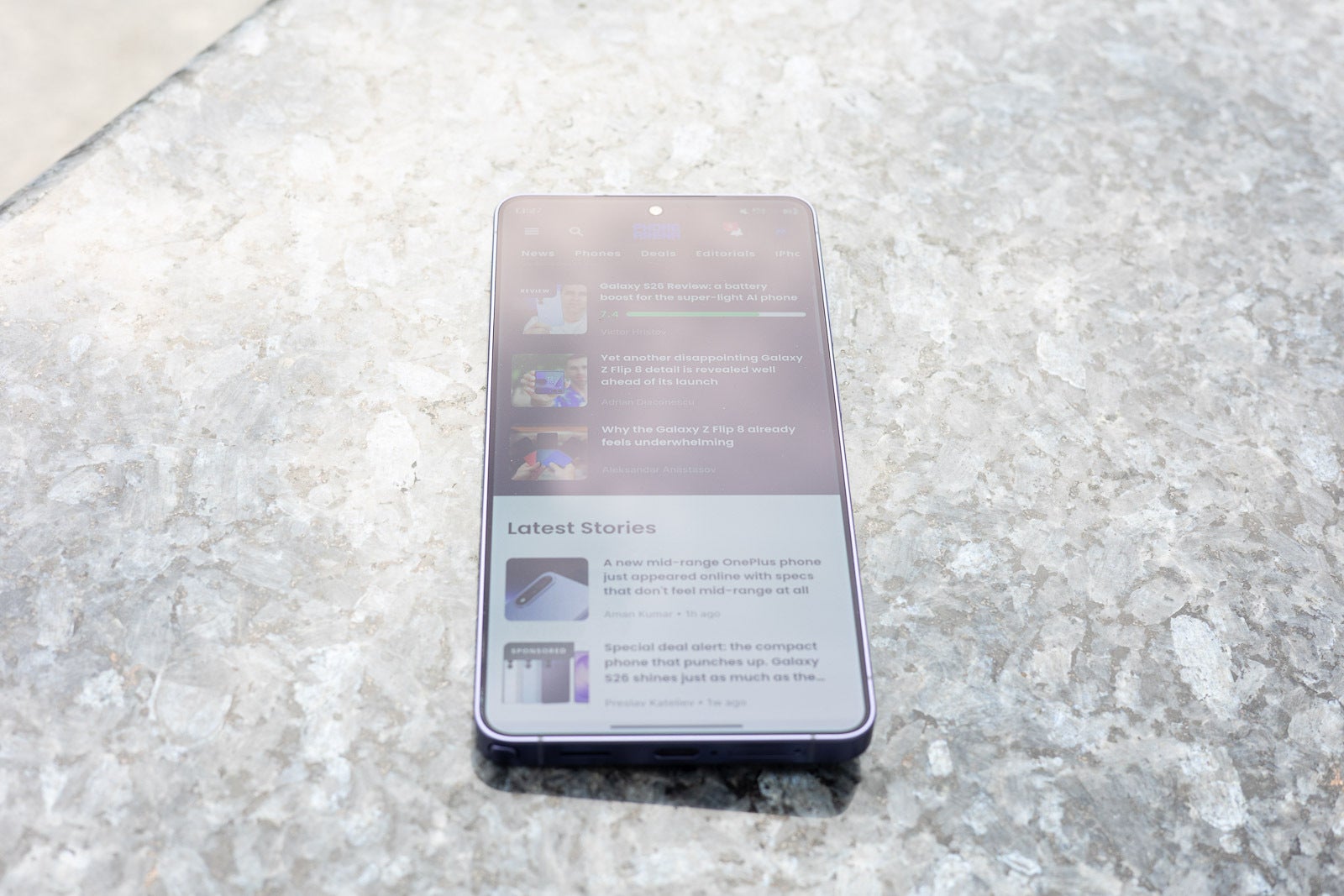
We placed the Galaxy S26 Ultra in an open, sunlit area outside our office and adjusted our camera to capture images as close as possible to what our eyes saw. We then ran three separate tests — viewing the display head-on, from a slight angle, and finally from a more extreme, steep angle.
The Galaxy S26 Ultra outdoor visibility head-on. | Image by PhoneArena
The “Adaptive brightness” feature was turned on, and we kept the Privacy Display toggle off for this test. As you can see from the first image, the display looks very bright and perfectly legible when viewed straight on.
At approximately 15 degrees, the S26 Ultra remains perfectly legible. | Image by PhoneArena
Tilting the camera reveals only minor reflections, but the display remains perfectly legible. Even when pushed to a more extreme angle, the screen holds its clarity. In these real-world conditions you can clearly see Samsung’s anti-glare coating in action, effectively diffusing light to minimize reflections and keep the on-screen content visible.
At approximately 45 degrees some reflections start to appear, but on-screen content is still readable. | Image by PhoneArena
Galaxy S26 Ultra manages to outshine the competition
Finally, we decided to pit the Galaxy S26 Ultra against two rivals in the same setting because comparisons are always fun, and tests in isolation don't paint the full picture. We chose the iPhone 17 Pro Max and the Pixel 10 Pro XL for this comparison, as they're the best the competition has to offer. Both phones were set to their respective auto brightness settings and placed next to the S26 Ultra.
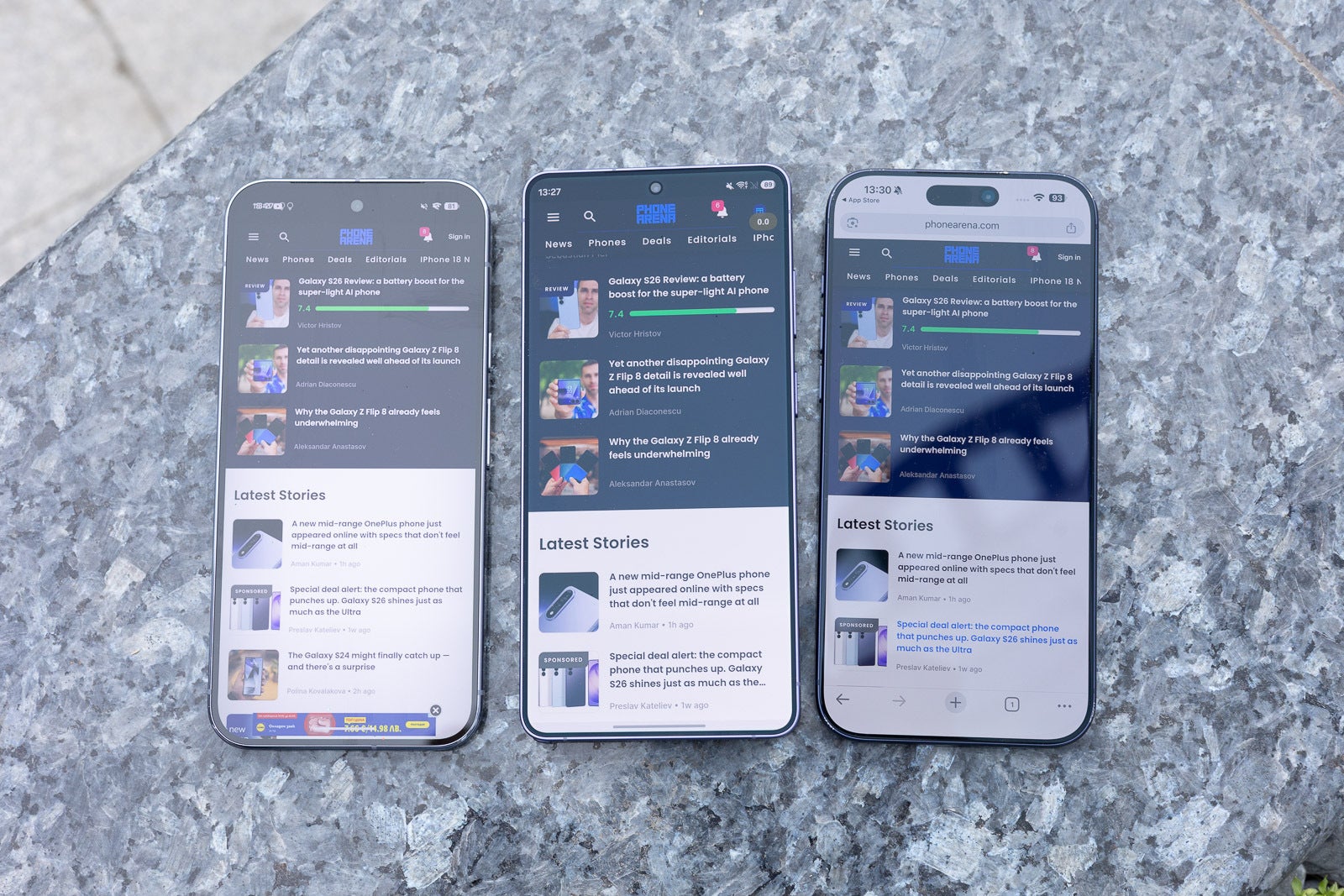
The Galaxy S26 Ultra (center) next to the Pixel 10 Pro XL (left) and the iPhone 17 Pro Max (right) | Image by PhoneArena
Viewed head-on, brightness levels across all three devices are remarkably similar, though the S26 Ultra holds a slight edge over the iPhone 17 Pro Max and is on par with the Pixel 10 Pro XL. It’s worth noting that the Pixel scored a very high result in our lab tests, yet in real-world conditions, the Galaxy S26 Ultra looked as bright. Which goes to show that lab tests don't always tell the full story.
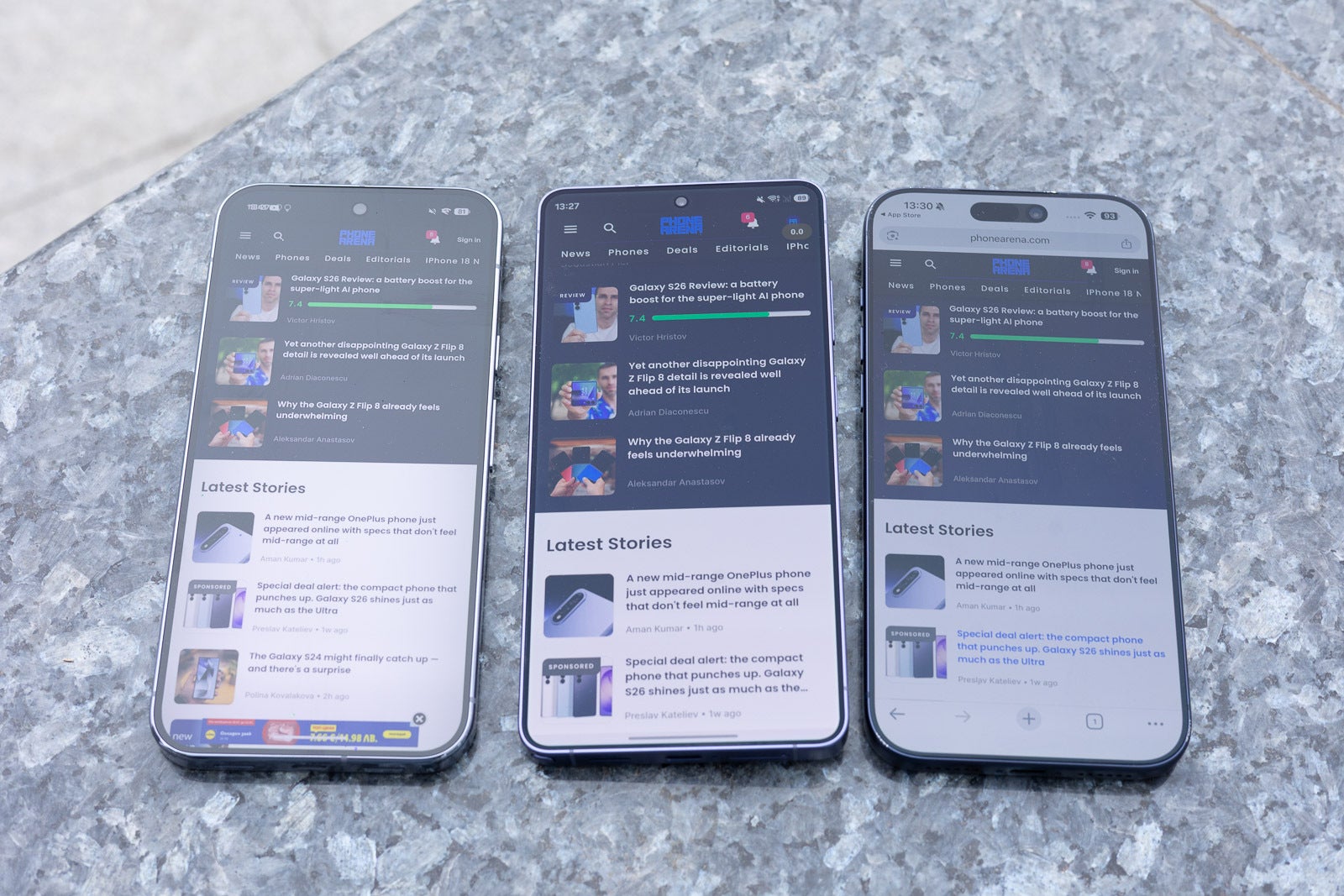
The difference in brightness becomes clearly visible at approximately 15 degrees. | Image by PhoneArena
The brightness gap between the S26 Ultra and its rivals became more noticeable when viewed at an angle. In the second test, with a moderate tilt, all three phones remained legible, but the content on the Galaxy S26 Ultra appeared more readable.
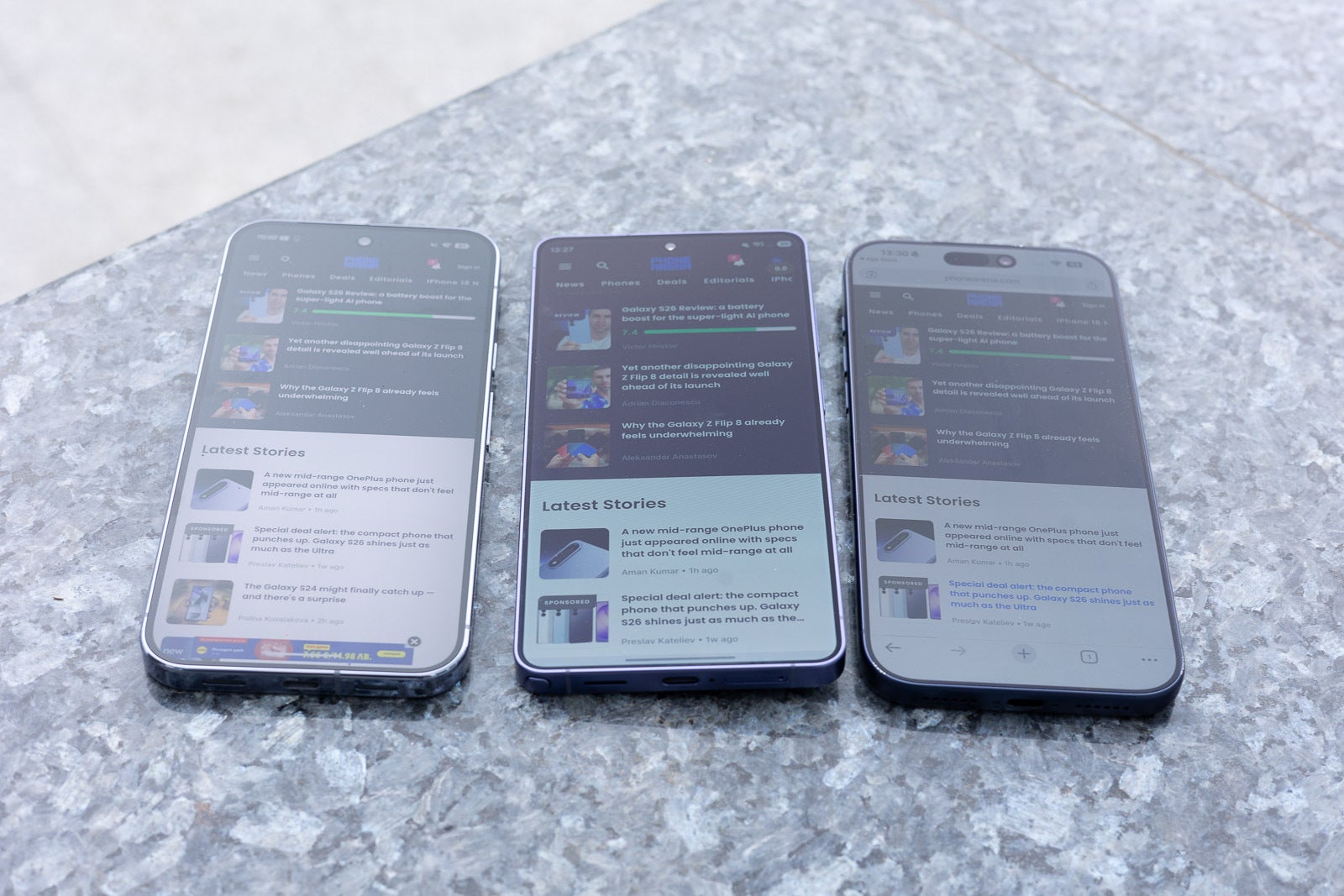
At the most extreme angle, the differences were even clearer. The Pixel 10 Pro XL began to lose legibility in the upper portion of the screen, while the iPhone 17 Pro Max also became difficult to read. The S26 Ultra, on the other hand, stayed perfectly legible, the anti-glare coating helping a lot in this extreme setting.
At approximately 45 degrees, the Pixel 10 Pro XL and the iPhone 17 Pro Max become quite hard to read too. | Image by PhoneArena
Overall, the Galaxy S26 Ultra performs impressively under direct sunlight, and its outdoor visibility is better than both its predecessor's and also the competition's. Samsung has managed to bake in the Privacy Display feature without sacrificing brightness and the anti-reflective coating also helps a lot outdoors. It's a feature that shouldn't be overlooked and one that your eyes will thank you for.
[1] Privacy Display - Requires manual activation in settings to function. Privacy Display feature is not AI-powered.
Mariyan, a tech enthusiast with a background in Nuclear Physics and Journalism, brings a unique perspective to PhoneArena. His childhood curiosity for gadgets evolved into a professional passion for technology, leading him to the role of Editor-in-Chief at PCWorld Bulgaria before joining PhoneArena. Mariyan's interests range from mainstream Android and iPhone debates to fringe technologies like graphene batteries and nanotechnology. Off-duty, he enjoys playing his electric guitar, practicing Japanese, and revisiting his love for video games and Haruki Murakami's works.
A discussion is a place, where people can voice their opinion, no matter if it
is positive, neutral or negative. However, when posting, one must stay true to the topic, and not just share some
random thoughts, which are not directly related to the matter.
Things that are NOT allowed:
Off-topic talk - you must stick to the subject of discussion
Offensive, hate speech - if you want to say something, say it politely
Spam/Advertisements - these posts are deleted
Multiple accounts - one person can have only one account
Impersonations and offensive nicknames - these accounts get banned
To help keep our community safe and free from spam, we apply temporary limits to newly created accounts:
New accounts created within the last 24 hours may experience restrictions on how frequently they can
post or comment.
These limits are in place as a precaution and will automatically lift.
Moderation is done by humans. We try to be as objective as possible and moderate with zero bias. If you think a
post should be moderated - please, report it.
Have a question about the rules or why you have been moderated/limited/banned? Please,
contact us.




Things that are NOT allowed:
To help keep our community safe and free from spam, we apply temporary limits to newly created accounts: