As smartphone SoCs head toward a 5GHz clock speed, one chip designer is lagging badly
One lagging chip designer still uses one of the world's top three chip foundries.
Smartphone chip designer fails to follow the trend toward a 5GHz clock speed. | Image by TSMC
TSMC is considered to be the best of the contract chip foundries, which explains why the top chip designers like Apple, MediaTek, Nvidia, AMD, and Qualcomm (to name a few) have their chips built by TSMC. Clock speeds of some new flagship chips for smartphones produced by the Taiwan-based foundry are about to hit the 5GHz level for the first time in history.
One chip designer isn't following the trend toward faster clock speeds
Thanks to a chart shared on X by Kurnal, who traces the increase in peak clock speeds from 2015-2025, we can see how close Qualcomm, Apple, and MediaTek are to 5GHz. The red hot rumor is that the Snapdragon 8 Elite Gen 6 Pro, expected later this year, will sport a clock speed of 5GHz or higher.
Are you surprised which chip designer is lagging?
54 Votes
No. It's so obvious.
81.48%
Yes. I thought it was another company!
18.52%
If you look at Kurnal's graph, you'll notice a chip designer that is really lagging behind the rest. This chip designer can't get a foundry to build its smartphone processor with a clock speed faster than 2.75GHz. The name of this chip designer, HiSilicon, might not be familiar to you, but you'll absolutely know the name of the company that owns HiSilicon.
China is blocked from obtaining the important EUV Lithography machine
The designer is owned by Huawei and due to U.S. restrictions backed by the Dutch government, Huawei is unable to do business with a foundry that possesses a cutting-edge lithography machine. Additionally, all of China is banned from buying this tool, the Extreme Ultraviolet (EUV) Lithography machine.
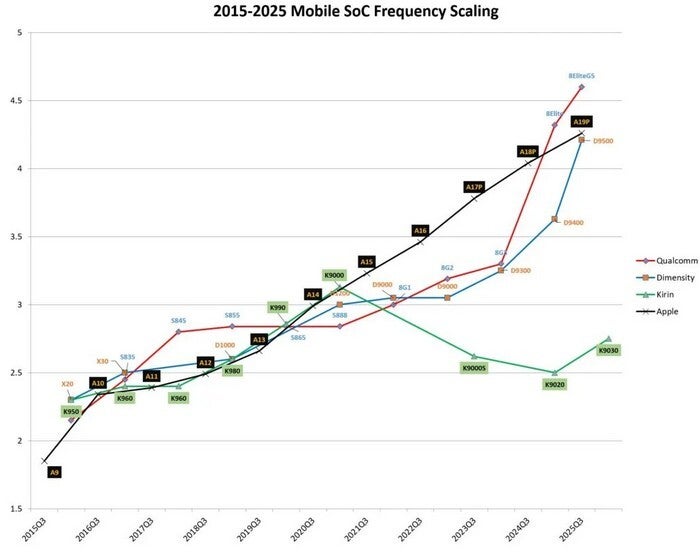
Flagship smartphone SoCs are trending toward a clock speed of 5GHz. | Image by Kurnal
The machine helps etch circuitry designs onto the silicon wafers that are the foundation in the chip building process. Because they have much shorter wavelengths than the previous generation lithography machines, EUV lithography allows foundries to build chips with a higher chip density and lower process nodes.
The bottom line is that Huawei doesn't have the ability to access EUV machines, and thus its Kirin chips are not as powerful or as energy efficient as chips made by TSMC or even Samsung Foundry. TSMC and Samsung can build chips using their 2nm process nodes while SMIC builds Huawei's chips using a 7nm process node.
That difference is why the latest smartphone chip designed by Huawei's HiSilicon and built by SMIC for Huawei, the Kirin 9030, has yet to run with a clock speed as fast as 3GHz. Reportedly, China has been testing a prototype of its own EUV machine, but this is a story we've heard many times before.
The market share numbers for the top three foundries
Some actually believe that SMIC has been able to produce SoCs for Huawei with a process node close to the 5nm class for Huawei by using a technique that calls for multi-patterning called SAQP (Self-Aligned Quadruple Patterning). That is when a foundry etches a complex pattern onto a wafer multiple times (as many as four times) because of the lack of an EUV machine.
Over the years I've written about rumored Huawei patents, including one that would supposedly allow Huawei to manufacture 2nm smartphone processors using older DUV machines. But none of these have actually panned out.
.
SMIC, China's largest foundry, is the third largest in the world by revenue and market share. TSMC has approximately 71% of the market, followed by Samsung Foundry's 7% and SMIC's 5.3% share.
A jury orders Huawei to pay millions to T-Mobile
Can you imagine what kind of phone Huawei would be able to put out if it didn't have the restrictions placed on it by the U.S.? Frankly, it's hard to conceive of a situation in which the U.S. government drops the sanctions on Huawei and allows the company to compete freely in the U.S.
You might have been able to understand my feelings about Huawei from articles I've written about the company in the past. It is impressive how Huawei continues to churn out nicely designed phones despite the supply chain restrictions it has to deal with.
But we also have to consider that in 2017, Huawei was ordered by a jury to pay $4.8 million to T-Mobile for stealing parts from the carrier's Tappy the Robot. Huawei was accused of taking pictures of and parts from the smartphone testing robot.


Popular stories



Latest News


Things that are NOT allowed:
To help keep our community safe and free from spam, we apply temporary limits to newly created accounts: