Selling defective edge-die chips pays off for Intel
Intel reported stronger than expected Q1 revenue and earnings thanks to sales of binned chips.

Intel makes good use of defective chips. | Image by PhoneArena
According to Ben Bajarin, the CEO and Principal Analyst with Creative Strategies, Intel's latest earnings report featured better than expected profit margins thanks to its plan to sell scrap chips for a profit. Chips cut from the edge of a silicon wafer often have flaws that might make them run hot, fail to reach top clock speeds, or have one dead core leaving it with seven working ones.
Intel was able to generate better than expected revenue by selling edge-die chips that were defective
When these edge-dies were tested, those that could not pass the A+ quality control test were placed in an appropriate bin, a process known as binning. If two cores are broken, the foundry uses a laser to cut them from the chip, which is now sold as a mid-range 6-core "B-Grade" processor instead of an 8-core flagship chip.
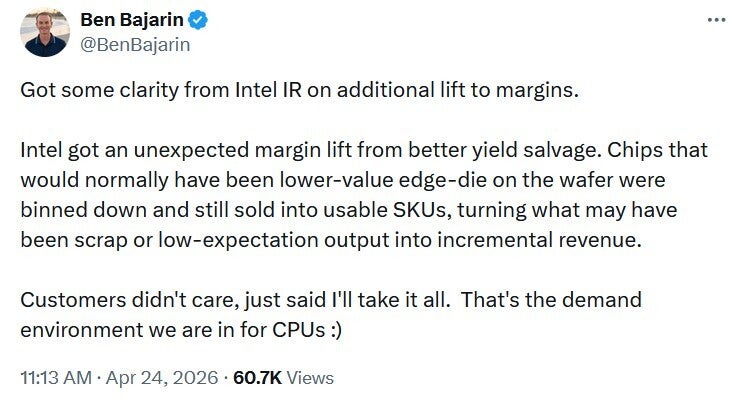
Tweet by analyst explains how Intel beat Q1 expectations. | Image by X
Intel's customers are grabbing whatever CPUs they can get, even ones that have been binned
Bajarin wrote in his tweet that he was told by Intel's Investor relations team that its customers were buying "what may have been scrap or low-expectation output" CPUs, bringing Intel some tangible revenue. Intel's first quarter earnings, reported last week, showed $1.4 billion more in revenue than expectations of $12.2 billion.
Which chip foundry do you think is the best?
6 Votes
TSMC.
83.33%
Samsung Foundry.
0%
SMIC.
0%
Intel.
16.67%
Other.
0%
The company's gross profit margins for Q1 were a whopping 650 basis points above Intel's own estimates
Gross margins were 41.5%, a whopping 650 basis points above Intel's own guidance of 34.5%. Q1 earnings came in 3000% above expectations and all of these better than forecast figures were ironically the result of defective chips.
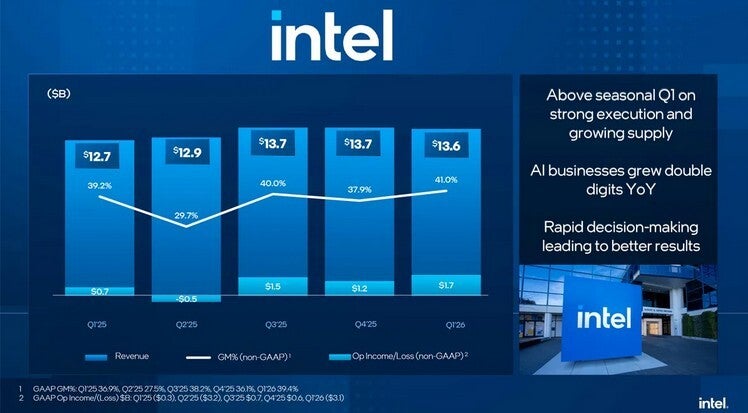
Intel's Q1 results were better than expected thanks to chip-binning. | Image by Intel, Tom's Hardware
Intel was able to take what would have been garbage thrown away and turn it into a lower-tier SKU that it sells at a lower price. Bajarin says that Intel is experiencing strong demand for CPUs and its customers are buying anything that they can get their hands on, even the low-expectation edge-chips.
Other foundries, including TSMC, use binned chips
Intel was able to beat expectations for the first quarter because it could sell low quality scrap at a decent price. Intel's AI related businesses grew by a double digit percentage in the first quarter.
Intel might not design chips for smartphones or tablets, but binning is a process that is used by other foundries including TSMC. For example, the A17 Pro application processor (AP) powering the iPad mini (A17 Pro), released in 2024, has a five-core GPU instead of the six-core GPU on the version of the A17 Pro AP powering the iPhone 15 Pro and iPhone 15 Pro Max.


Popular stories






Latest News






Things that are NOT allowed:
To help keep our community safe and free from spam, we apply temporary limits to newly created accounts: