Samsung Galaxy S6 edge vs LG G3
Introduction
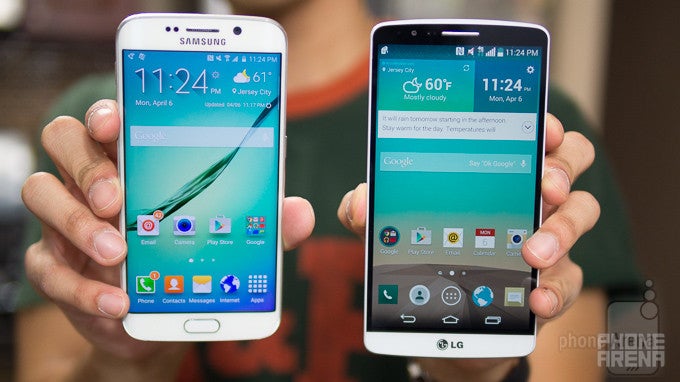
Just a year ago, the LG G3 was a new smartphone that seemed mighty impressive with its hardware parameters and attractive design. And while the G3 is still a great phone, the new Samsung Galaxy S6 edge is far ahead of what LG could come up with in 2014. Samsung's dual curved screen smartphone catches the eye with a unique look, and attracts with powerful performance. If you are interested in upgrading your LG G3 to the Galaxy S6 edge, or have to choose between an expensive new GS6 edge and a discounted LG G3, look no further than this review, where we'll compare the two in the important departments of design, display, user experience, hardware, connectivity, camera, call quality, and battery life. With this knowledge, you'll be able to make the right decision for you.
Design
The Samsung Galaxy S6 edge is an innovative device which disrupts the traditional Galaxy smartphone look with its curved screen and premium build. The LG G3 has just a simple plastic build that's of admirable quality, but certainly doesn't look and feel as impressive. The Galaxy S6 edge is a design showcase with its side-sloping screen and aluminum frame, both being hard to miss. It's a reasonably sturdy smartphone, too, thanks to those Gorilla Glass 4 layers covering its front and back. Save for its semi-faux metallic sheen, the LG G3 doesn't have anything to show in the way of luxury, but its strong card is ergonomics. The big phone is easy to hold, thanks to its carefully chiseled back and sides.
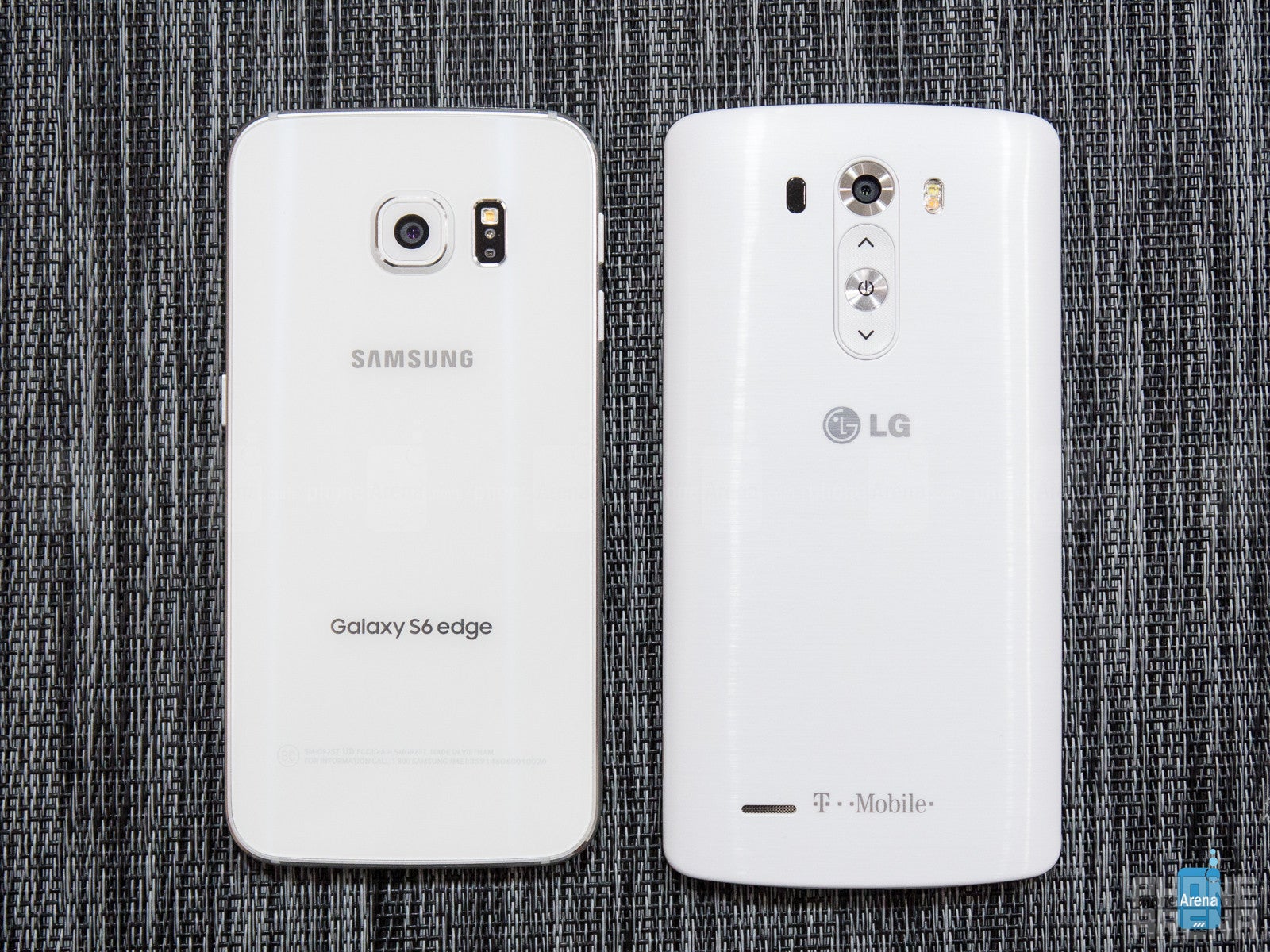
Talking about ergonomics and sizes, the Samsung Galaxy S6 edge measures 5.59 x 2.76 x 0.28 inches (142.1 x 70.1 x 7 mm) at a weight of 4.66 oz (132 g), while the LG G3 is a bulkier 5.76 x 2.94 x 0.35 inches (146.3 x 74.6 x 8.9 mm) and a heftier 5.26 oz (149 g). The Galaxy S6 edge is more compact because its display has a lesser diagonal - 5.1 inches versus the LG G3's 5.5 inches, and it is lighter, although made of stronger materials. And for those of you wondering - the curved display is not a boon for comfortable one-handed usage.
Among the S6 and G3's most notable differences are the power and volume key placements. The GS6 edge's hardware buttons are conventionally placed on the sides, while the latter's occupy its back panel. While there's nothing overly curious about the GS6 edge's button placement - you most likely know it from other smartphones, getting used to the one on the LG G3 takes a while. And although it's comfortable for the most part, it's not always practical. Other important differences are the missing microSD slot and interchangeable battery on the Galaxy GS6 edge.
To sum up, the Galaxy S6 edge is more compact, lighter, and of somewhat better design and build quality than the LG G3, but the latter has a larger 5.5-inch display, a microSD slot, and removable battery.

5.59 x 2.76 x 0.28 inches
142.1 x 70.1 x 7 mm
4.66 oz (132 g)

5.76 x 2.94 x 0.35 inches
146.3 x 74.6 x 8.9 mm
5.26 oz (149 g)

5.59 x 2.76 x 0.28 inches
142.1 x 70.1 x 7 mm
4.66 oz (132 g)

5.76 x 2.94 x 0.35 inches
146.3 x 74.6 x 8.9 mm
5.26 oz (149 g)
See the full Samsung Galaxy S6 edge vs LG G3 size comparison or compare them to other phones using our Size Comparison tool.
Display
If Quad-HD resolution and gazing at over three million pixels simultaneously tickle your fancy, you are correct for looking up the Samsung Galaxy S6 edge and LG G3, as they both have these great, extra high-resolution panels. The Galaxy GS6 edge has a 5.1-inch Super AMOLED 1440x2560 screen with an extremely high pixel density of 577, making individual pixels nearly impossible to discern. The LG G3 has a 5.5-inch IPS LCD display with the same resolution, but a lesser pixel density of 538ppi due to the increased diagonal.
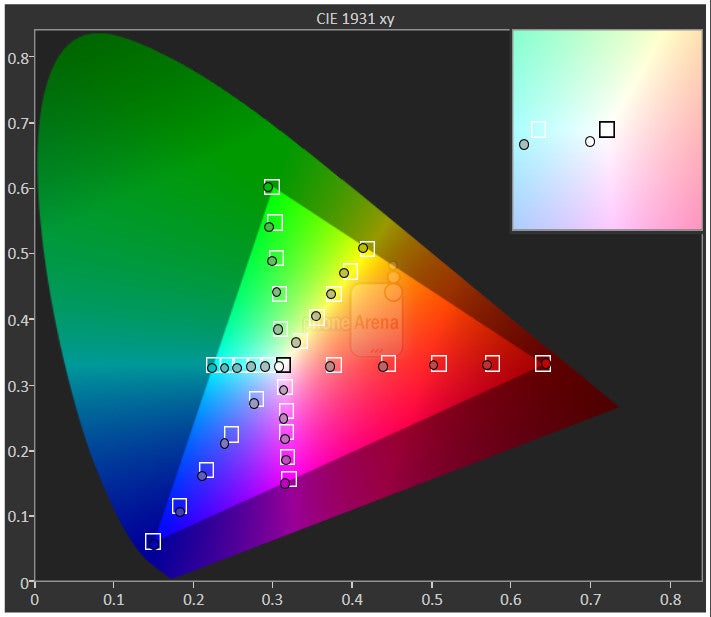
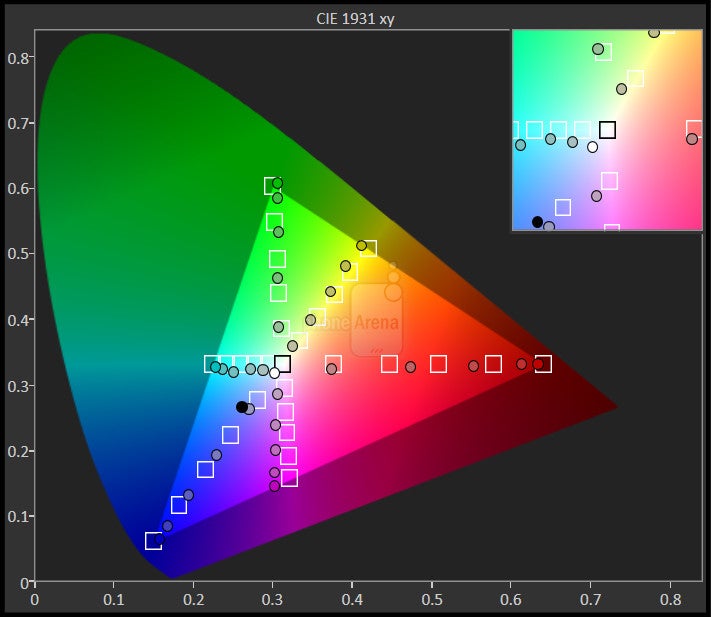
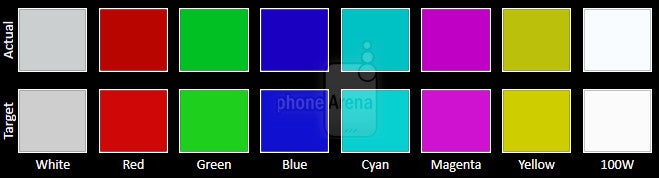
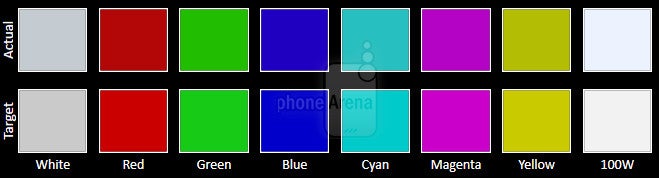
With a color temperature of 6800 Kelvins, the Galaxy S6 edge's display is rather close to the most neutral color temperature of 6500 K, which is an achievement. It's also not over or under-saturated, which is particularly pleasing... that is, as long as you have it set to the Basic screen profile.. Meanwhile, the LG G3's color temperature of 7099 Kelvins is not too far off the reference value either, but this color temperature makes its LCD display look colder than the GS6 edge's, and the colors are more saturated – LG didn't go overboard or anything, but it's obvious that perfect color accuracy wasn't the prime objective.
In terms of brightness, the GS6 edge's display can hit well above 500nits (about 553, to be more specific), which is an excellent achievement for an AMOLED display. It means you can reliably use this screen outdoors or in bright light. On the other side of the scale, the GS6 edge accomplishes an excellent minimum brightness value of 1 nit, which makes for easy bedtime reading. How does the LG G3 fare here? Well, it has a tolerable maximum brightness level of about 455 nits, which means you can use it under direct sunlight or bright lighting conditions with a little effort. And, its acceptable minimum brightness level of 9 nits means you can use it in dark rooms without retina-searing experiences, although admittedly, the screen should have been a bit darker.
Next, we'll talk gamma values. At a value of 2.2, the Galaxy S6 edge's gamma response hits the reference value, which means we have adequate brightness response across the spectrum. We can say the same for the LG G3's display, which reports a gamma value of 2.26 and is, therefore, very close to the reference value.
Overall, the Galaxy S6 edge clearly has a superior display, thanks to its better color reproduction, brightness levels, and more efficient power consumption.


Interface and Functionality
Running Android 5 Lollipop right off the bat, the Galaxy GS6 edge continues Samsung's 'less is more' approach to streamlining its TouchWiz user interface. Compared to the dated looks and feature overload of its previous incarnations, the latest TouchWiz on the GS6 edge looks better and it's easier to get around, although phantom gestures launching random features and apps is still a 'fun' conversation topic. As for LG? Well, its software design used to be rather lackluster, but the company learned from its mistakes too, and did a good job with the LG G3's user interface. It streamlined it by exchanging imitations of real world objects for basic shapes colored in light, non-distracting shades.
Refined visuals aside, Samsung made one-handed usage easier, with appropriately sized icons and easy to reach user interface elements. Simple stuff like checking your email, or the weather, or calling a contact is right underneath your thumb. Meanwhile, the LG G3 tackles one-handed usage with options to tweak the navigation button layout, shrink the keyboard, and move it left or right for one-thumb typing.
The TouchWiz UI on the Galaxy S6 edge
Taking a quick look at the smartphones' unique features, we end up with Samsung Pay and LG KnockOn/KnockCode. Facilitated by the smartphone's embedded fingerprint reader and KNOX security engine, Samsung's payment system has the potential to rule its homeland of Korea, and take on Apple Pay in the USA. And let's not forget that the GS6 edge can put some meaningful notifications and alerts on its side screens - they can show information or glow in different colors upon incoming calls, depending on which favorite contact of yours is on the line. But for the most part, the edges are there for aesthetics.
As for LG's knock-knock-who's-there features, KnockOn lets you wake the phone with a double-tap on the screen, and LG Knock Code lets you unlock the device with a knock pattern or sequence. Both have proven quite useful in our experience. That aside, there's also an odd gesture inside the camera app, which lets you land a selfie by holding your arm against the front cam and clenching your fingers to make a fist. It may award you some puzzled looks on the street.
LG G3 interface
Different as they are, TouchWiz and LG UX both succeed in bringing simple, meaningful functionality to the lucky user. But although we like LG UX for being so straightforward, we find it somewhat bland and underdeveloped compared to TouchWiz, which has grown into a cohesive, aesthetically pleasing, and feature-rich platform.
Processor and Memory
Samsung famously equipped the Galaxy S6 edge with a homemade SoC, the Exynos 7420. It's a 64-bit octa-core CPU built on a 14-nm process, and so far, we've been impressed by its performance. It employs four Cortex-A57 cores running at 2.0GHz, and four Cortex-A53 cores pushed to 1.5GHz, arranged in a true octa-core configuration (all eight cores can be utilized simultaneously). This performance beast is paired with a very capable Mali-T760 graphics unit and 3 gigabytes of fast LPDDR4 RAM. This configuration has been destroying benchmarks left and right, and its records in computing and 3D performance translate to everyday usage just as well.
We certainly can't say all those niceties for the LG G3's Snapdragon 801 SoC, but that's only because it's a year-old unit at this point. In reality, Qualcomm's quad-core 32-bit chip with its in-house designed Krait cores and Adreno 330 GPU has aged well, offering decent performance even with today's demanding games and high resolution video content. On the memory side, the LG G3 is equipped with either 2GB (for the international model) or 3GB of LPDDR3 RAM (for the Korean model), and it is a solid performer overall, although the Quad-HD resolution puts the hardware under significant strain – its performance and battery life fall short of the expected from a high-end smartphone.
The Samsung Galaxy S6 edge flaunts another trump card over the LG G3 and all mobile devices up to this point. It's got UFS 2.0 flash memory that's roughly 2.7 times faster than the LG G3 and other current devices' NAND flash storage. Thanks to that, the Galaxy GS6 edge's memory performance is a marvel, and this translates to short app load times.
To conclude the hardware comparison, the one year gap between the LG G3 and Samsung Galaxy S6 edge has resulted in a tremendous performance improvement in the latter. Those switching to the GS6 edge from the LG G3 will definitely appreciate the boost in speed and responsiveness owing to the superior chipset and faster memory.
Internet and Connectivity
Both the Samsung Galaxy S6 edge and the LG G3 are Wi-Fi, Bluetooth, NFC, GPS, 3G, and LTE-connected, which means they cover all the necessary networking bases. Also, both have microUSB 2.0 connectors for data and charging. The Galaxy S6 edge supports Bluetooth 4.1 - it's 4.0 for the LG G3 - but both have Wi-Fi 802.11 a, b, g, n, n 5GHz, ac wireless internet. In addition, both offer DLNA and Miracast for smartTV streaming, along with tethering for doubling as a USB Modem/Wi-Fi hotspot.
Web browsing
Camera
Samsung has built a solid reputation around its smartphones' camera capabilities, and the Galaxy S6 edge won't be one to diminish it with sub-par performance. Its main camera resolution is 16 megapixels, and the sizeable Sony IMX240 cam sensor with 1/2.6" pixels and wide F1.9 aperture comes with goodies such as optical image stabilization, real-time HDR, infrared white balance, and tracking auto-focus for the video camera. There's also a 5-megapixel front cam to please the selfie snappers.
Camera interface of the Samsung Galaxy S6 edge
Camera UI of the LG G3
In daylight, the Galaxy S6's sharp and nicely exposed photographs coming from its main camera have plenty of detail and don't suffer from much noise, even when closely examined. The color balance is warm overall, making for slightly more eye-pleasing images overall, that not only look great, but also very natural.
Indoors, the images lose some of their details but the handset keeps a good balance between sharpness and smoothness, staying away from introducing too much noise. The colors tend to remain mostly neutral, which is a good thing. As for night images, they are quite alright, although not on the same level as those extra nice daylight photos. Thankfully, there isn't too much noise, but don't expect to be wowed by the details.
The LG G3 sounds less impressive with its 13MP main camera that comes with 1/3.06"-sized pixels and a smaller aperture (F2.4), while the front snapper is only a 2.1MP cam. But in practice, both are no-nonsense performers that don't disappoint, even if the end result is not in the same league as the GS6 edge's. Notably, the LG G3's camera is very quick and accurate with its focus duties, thanks to its laser-assisted auto-focus system. It also takes flat-out nice photos in good lighting conditions. However, we must acknowledge that the LG flagship often goes for an image that's a little too warm and vibrant.
Still, details in the images are very good – photos are certainly not as sharp as those coming from the Galaxy S6 edge's bigger 16MP camera, but the level of detail is great regardless. Results are above average in indoor and night-time shots as well, but don't even dream of cropping - the heavy-handed noise filtering gives a watercolor-like appearance to photos when zoomed in close. And the front camera, alas, lacks fidelity and resolution.
Sample images
As for video quality, both the Galaxy S6 edge and LG G3 offer up to 4K resolution video recording with frame rates of up to 30FPS and optical image stabilization, making for clear and stable sights from the main camera. Image quality is very good in both, but the Galaxy S6 edge operates much faster thanks to its UFS 2.0 flash memory - the process, from opening the app to saving the video and viewing it on that high-res display, is a breeze! Moreover, the GS6 edge can record 1080p video at 60FPS from the main cam if you are into that sort of thing. That's a feature the LG G3 lacks by default, although 3rd party apps offer a workaround for it. Anyway, it goes without saying that the GS6 edge makes more detailed and color-correct videos overall, thanks to employing larger sensors and finer algorithms. But there's something to be desired from its 60FPS video output – sharp details become soft, and the picture looks watercolor all of a sudden.
Sample Videos
Wrapping up the camera comparison, the LG G3 takes really decent daytime photos and videos, and its low-light performance is okay most of the time. But the Galaxy S6 edge does everything better – it takes larger, more detailed photos across different light situations, and videos look better, too. In addition, the smartphone is very fast to launch its camera app, and offers a much better degree of control over the final result. In comparison, the LG G3's camera app is completely automatic, and therefore very limited – it's the one aspect where LG's strive for simplicity made the end product worse.
Multimedia
When it comes to multimedia playback, the Galaxy S6 edge's hardware superiority doesn't give it much of an edge over the LG G3, as both smartphones support the latest HEVC 2.5 multimedia encoding and decoding standards. This means rich format support out of the box, and with both devices touting big, crisp displays, it goes without saying you'll be enjoying every minute of high-resolution video. As for loudspeaker performance, the G3 manages a decent 81db out of its mono speaker, which trumps the GS6 edge's 75.4dB output. With the LG G3, you can totally listen to some music in your car, for example, but the sound quality is tinny and hollow – you know, typical tiny speaker affair. The GS6 edge also sounds a bit subdued and thin, which is normal.
Music players
Overall, both smartphones are multimedia powerhouses with their high-resolution displays and nice, loud output, although the LG G3 fairs a little better as a portable boombox due to its speaker's extra 4.6dB of loudness.
Call quality
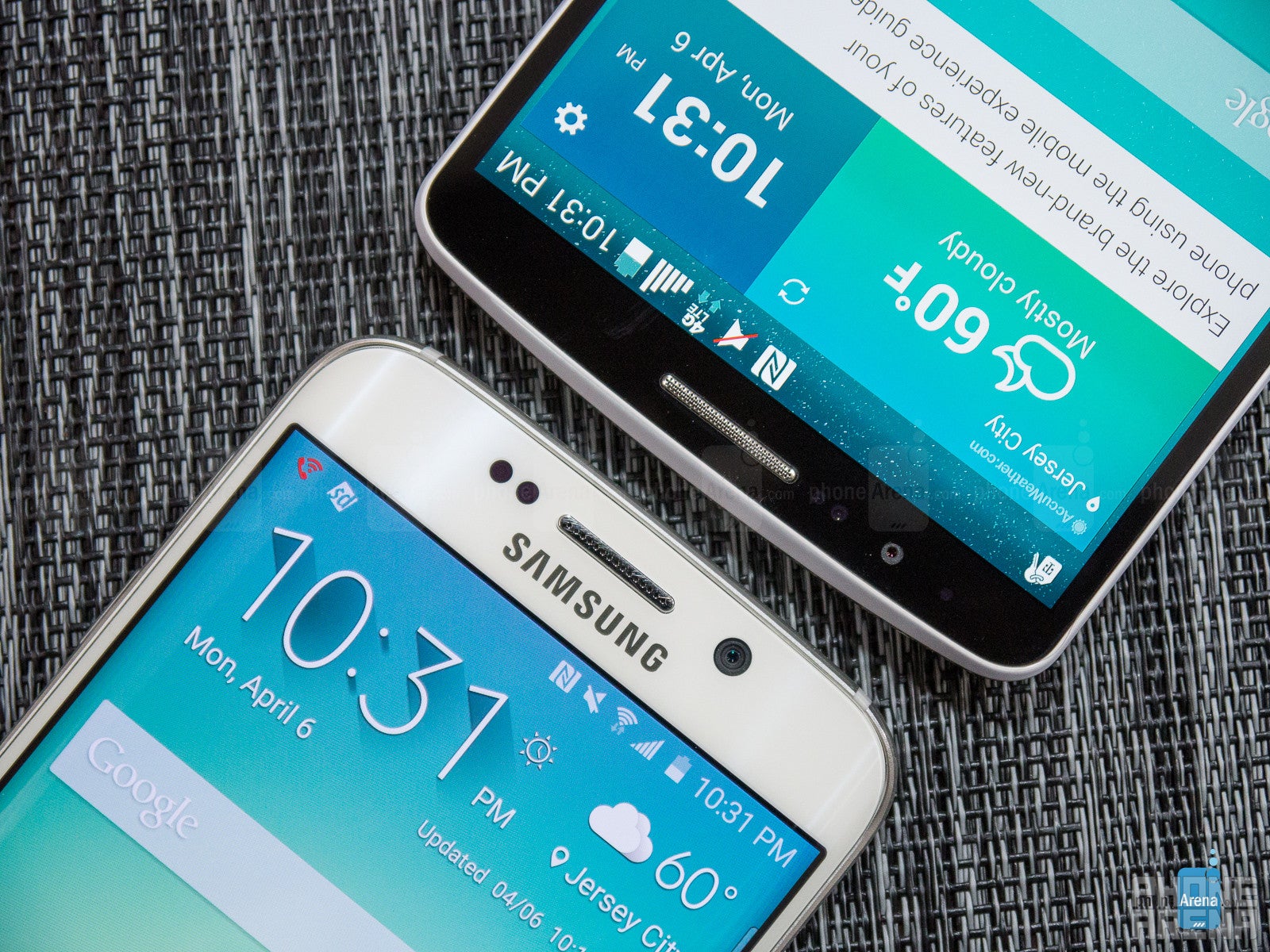
Moving over to the speakerphone, the one on the GS 6 edge is powerful enough to use in noisy environments without having us to ask our callers to repeat themselves. The same goes for the LG G3.
Battery
The Samsung Galaxy S6 edge carries only a 2600mAh battery. This may not sound very assuring on paper, but with a 14nm-made SoC in play, Sammy's hero phone manages to squeeze 8 hours and 11 minutes of on-screen usage, covering the bare minimum (a full workday of on-screen use) that we consider appropriate for a recent high-end smartphone. The LG G3 houses a sizeable 3000 mAh juice pack, but don't take that as a guarantee for endurance. LG's last year flagship delivers a mediocre battery performance, lasting 6h and 14 min of constant on-screen use in our specialized battery life test. Although it lasts two hours less, the LG G3 can pull through at least 8 hours of moderate use, so things aren't all bad here.
Reaching for a conclusion here, it's obvious the Galaxy S6 edge is more reliable when it comes to battery life and charging speed. It also helps that it comes enabled with wireless charging.
Conclusion
With a much nicer design, a smaller but superior display, faster hardware, a better camera, and added goodies such as quick charging, the Samsung Galaxy S6 edge is a genuine superphone that's a worthy upgrade over the LG G3. However, the LG G3 remains more attractive from a price-oriented perspective. Being a year old and nicely discounted, it is one of the cheapest Quad-HD resolution smartphones you can buy new and unlocked. It's also a very nice smartphone overall, and while its looks and performance, admittedly, can't hold a candle to Samsung's latest and greatest, this doesn't make it anything less than a bargain!
Samsung Galaxy S6 edge
Pros
- Premium and compact design
- Accurate and bright display
- Faster performance
- Better camera
- Greater battery life
LG G3
Pros
- Larger screen
- Removable battery
- microSD card slot


Popular stories
Latest News
Things that are NOT allowed:
To help keep our community safe and free from spam, we apply temporary limits to newly created accounts: