iPhone 18 Pro vs Pixel 11 Pro: main differences
Apple's newest, smarter iPhone is now official. Can the Pixel 11 Pro stand up to the upcoming behemoth?
We may earn a commission if you make a purchase from the links on this page.
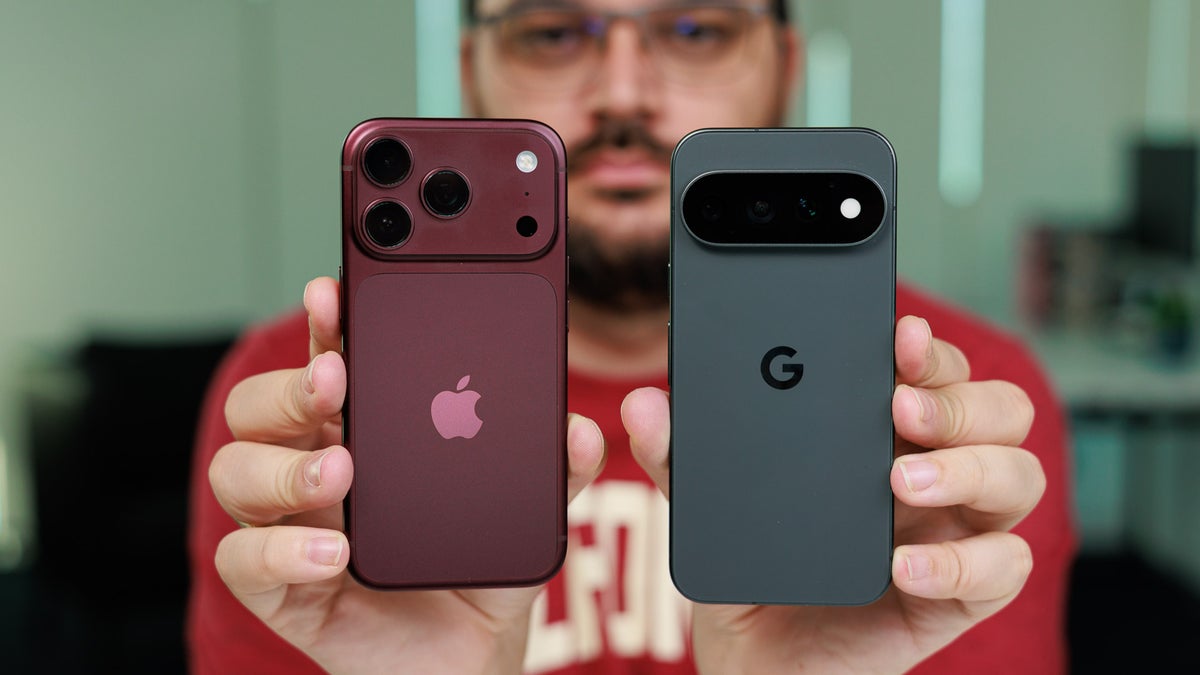
Pro vs Pro | Image by PhoneArena
Apple's new iPhone 18 Pro is out and, as always, it came out swinging. With a new 2 nm Apple A20 Pro chip, a variable aperture on its camera, and another battery size increase, it's trekking forward as one of the best smartphone options to buy when you enter the store.
But it's not the only one. Oh no, the competition may have thinned out over the past decade or so, but that only means that the ones that remain are just as resilient and important as the iPhone. For example — Google's Pixel line. The Pixel 11 Pro may not have the raw horsepower with its Tensor G6 chip, but certainly has the brains that used to put Apple's AI to shame. Plus, Google's computational photography chops are not to be underestimated. In fact, they are trend-setting.
But it's not the only one. Oh no, the competition may have thinned out over the past decade or so, but that only means that the ones that remain are just as resilient and important as the iPhone. For example — Google's Pixel line. The Pixel 11 Pro may not have the raw horsepower with its Tensor G6 chip, but certainly has the brains that used to put Apple's AI to shame. Plus, Google's computational photography chops are not to be underestimated. In fact, they are trend-setting.
So, two giants here. Which one is the better choice for you?
| iPhone 18 Pro | Pixel 11 Pro |
|---|---|
| 6.3-inch screen, smaller Dynamic Island, 120 Hz, 460 PPI, 3,000 nits peak | 6.3-inch screen, selfie camera punch-hole, 120 Hz, 497 PPI, 3,600 nits peak |
| Aluminum unibody framing a matte glass back, 211 g | Aluminum frame, matte glass back, two-tone 204 g |
| Apple A20 Pro, Apple’s first 2 nm iPhone chip | Google Tensor G6, 3 nm |
| 256 GB / 12 GB RAM 512 GB / 12 GB RAM 1 TB / 12 GB RAM 2 TB / 12 GB RAM | 256 GB / 12 GB RAM 512 GB / 16 GB RAM 1 TB / 16 GB RAM |
| Improved vapor chamber | Enlarged vapor chamber |
| New Apple-made C2 modem | MediaTek M90 modem |
| Variable aperture main lens, going from f/1.48 to f/4.0 | Fixed aperture f/1.78 on main camera |
| 48 MP 4x telephoto, 48 MP ultra-wide | 48 MP 5x telephoto, 48 MP ultra-wide |
| Camera Control button, Action button | No extra buttons |
| 18MP Center Stage square sensor | 42 MP regular selfie camera |
| Starting from $1,199 | Starting from $1,099 |
Table of Contents:
Design and Size
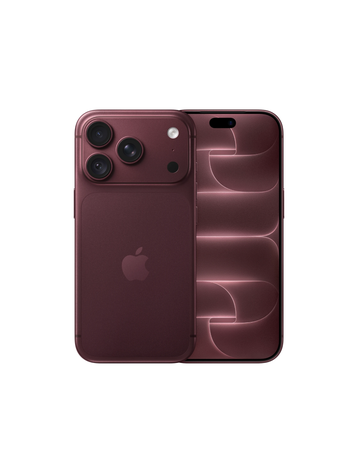
Last year's iPhones had a bit of a shakeup in design, so — as expected — we aren't getting any big redesigns this year. The iPhone 18 Pro has some facelifts — the Dynamic Island is now smaller, but it's still a wide-ish punch-hole in the top center of the screen. The Pixel 11 Pro has a more modest selfie camera punch-hole.
The back is pretty much the same design as last year, with a big rectangular camera bump running across the top half of the device, and a matte glass "window" that ensures MagSafe wireless charging will work.
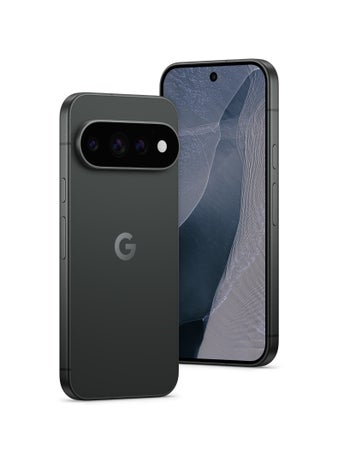
Google's Pixels also have a camera bar on the back, though slimmer. In the Pixel 11 Pro, we have a new feature here — the LED flashlight also doubles as a soft notification light. Though, it only glows for calls or when you activate "Hey, Google", and can't be customized. The Pixel's back is also fully matte glass to allow for wireless charging and magnetic Pixelsnap accessories.
Now, in 2026, most phones already have incredibly thin bezels, but it's still mandatory to point out — the iPhone 18 Pro shows a 90.09% screen-to-body ratio, while the Pixel 11 Pro has an 87.09% one. Meaning, the Pixel's bezels are ever-so-slightly thicker.
Both phones weigh about the same — 211 g for the iPhone 18 Pro and 204 g for the Pixel 11 Pro. And both come with IP68 rating for protection against water and dust.
|
|
| Apple iPhone 18 Pro | Google Pixel 11 Pro |
| Dimensions | |
|---|---|
| 150 x 71.9 x 8.75 mm (~13.49 mm with camera bump) | 152.4 x 71.1 x 8.4 mm (~12.22 mm with camera bump) |
| Weight | |
| 211.0 g | 204.0 g |
See the full
Apple iPhone 18 Pro vs Google Pixel 11 Pro specs comparison
or compare them to other phones using our
Phone Comparison tool
Display Differences
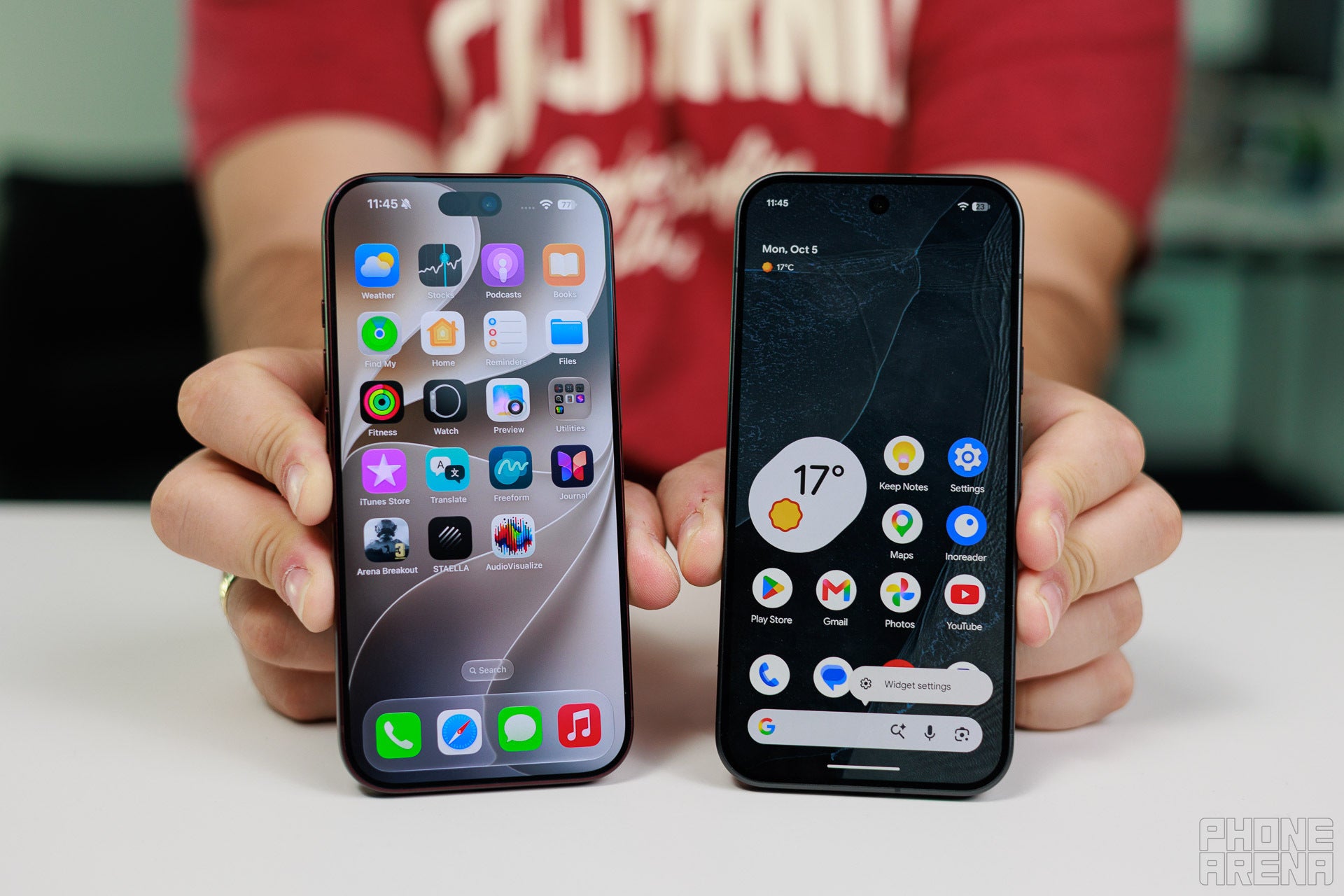
Everyone has OLED nowadays | Image by PhoneArena
It's 2026 and OLED is the name of the game for flagship phones. iPhones adopted it about 8 years ago, Android phones have had it for ages. Needless to say, OLED has been tuned to perfection nowadays, and any top-tier phone will look great. Sharp, vibrant, and with a high refresh rate.
So, the race now is on for peak brightness. This is... a weird flex, but it's what we have. The Pixel 11 Pro can reach 3,600 peak brightness, the iPhone 18 Pro can hit 3,000 nits. Now, peak brightness is only a small portion of the screen (as small as one pixel), measured for a small time window. It speaks to the potential of the screen of displaying HDR content, but doesn't represent real-life use.
That's a long-winded way of saying that we will measure 20% APL brighness when we get the iPhone 18 Pro in our lab to more accurately show top brightness for "real life" use. And we also want to see how the anti-reflection coating looks on a bright day versus the Pixel 11 Pro's glossy screen.
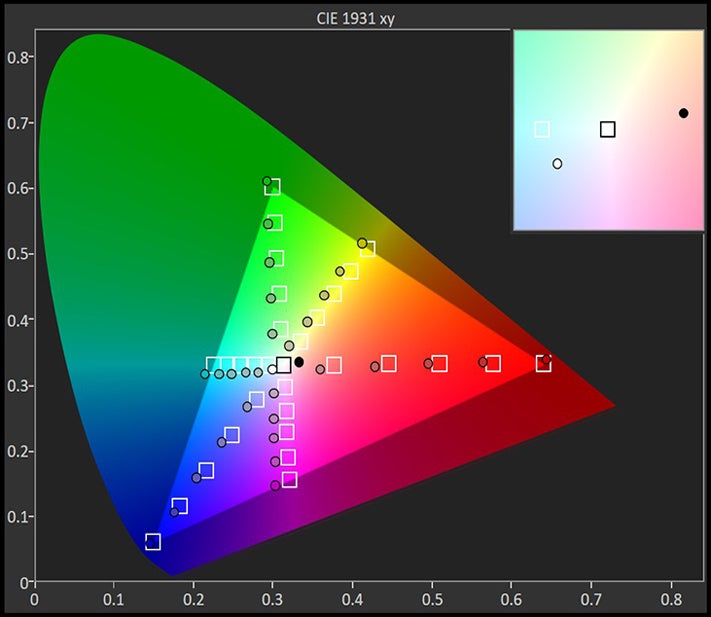
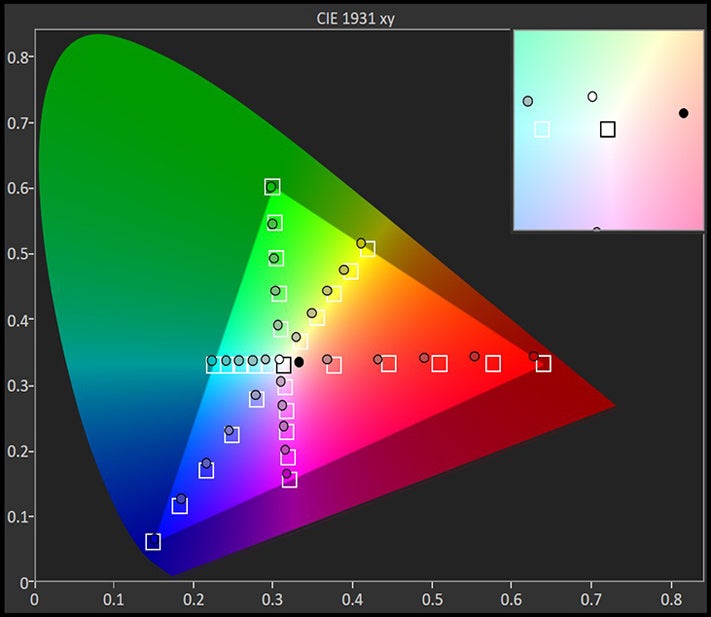
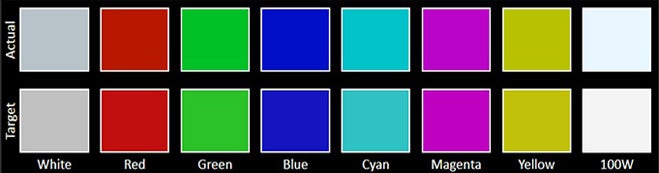
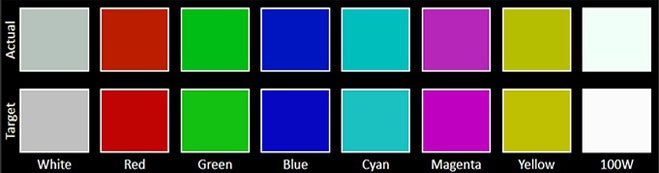


|
|
|
| Apple iPhone 18 Pro | Google Pixel 11 Pro |
| Size | |
|---|---|
| 6.3-inch | 6.3-inch |
| Type | |
| OLED, Variable 1-120Hz | OLED, 120Hz |
See the full
Apple iPhone 18 Pro vs Google Pixel 11 Pro specs comparison
or compare them to other phones using our
Phone Comparison tool
Always on display with LTPO tech that dials the refresh rate all the way down to 1 Hz is present on both phones.
Biometrics are handled differently. Google uses an ultrasonic under-screen fingerprint scanner, while Apple relies on its fine-tuned Face ID, which unlocks the iPhone with just a look. But it's worth noting that Google also offers face unlock with the selfie camera and it's been protected with AI algorithms — it's considered so secure that it's allowed to use the Pixel's face unlock for banking apps. Still, it may not work flawlessly in the dark, whereas the Face ID was build for this with its infrared tech.
Performance and Software
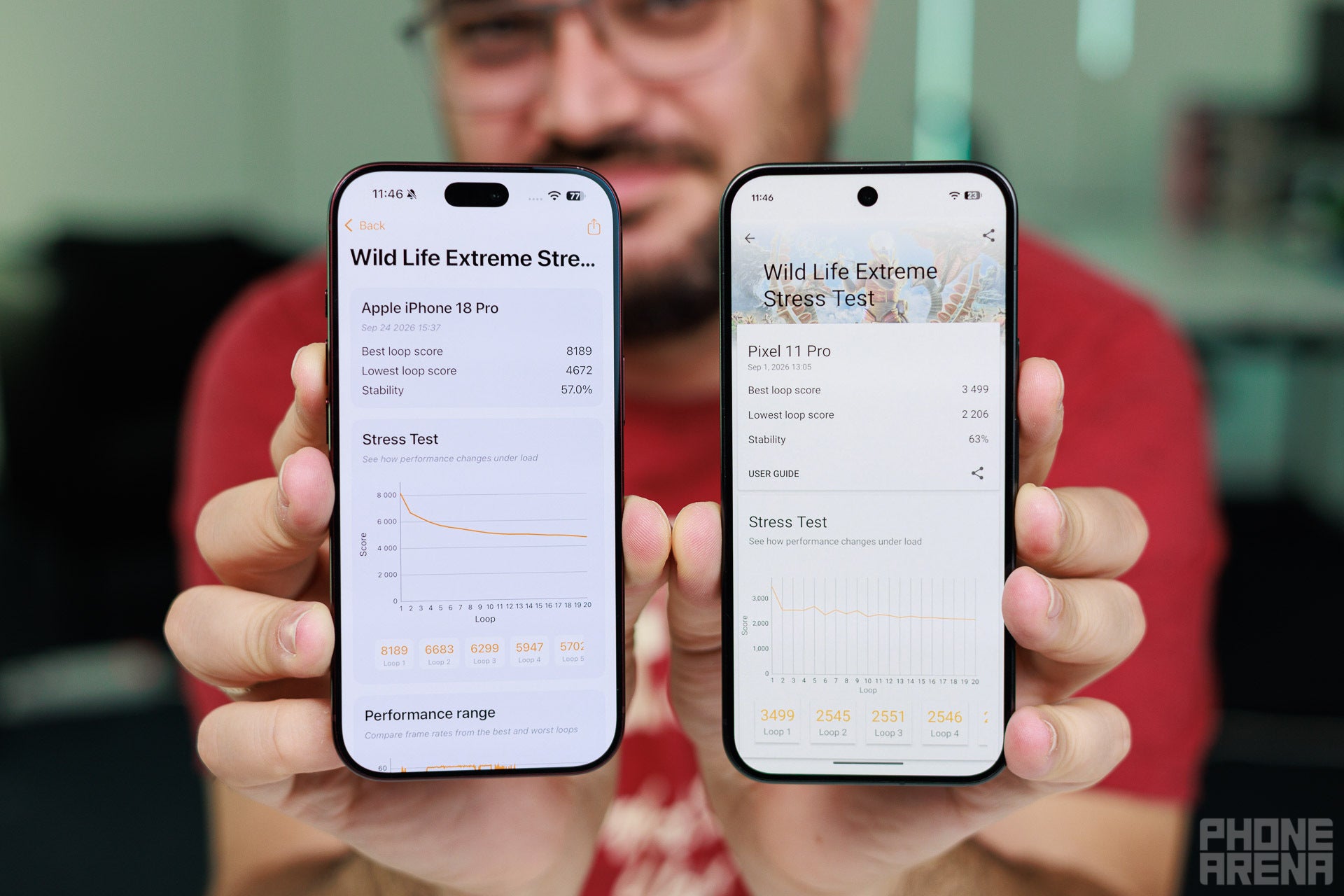
OK, the Pixel is not a front-runner here | Image by PhoneArena
The iPhone 18 Pro comes with Apple's newest A20 chip. It's another hexa-core processor, which now has 7 GPU cores, and is built on a 2 nm processor. In short — it's a fire-breathing dragon for sure. Let's hope that the improved and upgraded vapor chamber inside can keep up with it as well as the iPhone 17 Pro's could keep up with the A19 Pro last year.
Google's Tensor G6 is... not even in the race. Not saying it to be mean, it's been a fact since the OG Tensor was released. Google puts all of its know-how into the AI cores to support the enhanced Gemini features and give you fast-acting AI on the phone. Raw performance and graphics are behind on scores when compared against the industry leaders — Qualcomm's Snapdragon and Apple's A-series.
But, bragging rights and scores aside, I will say that Pixel phones feel snappy, fast, responsive, fun. I have a Pixel 10 at home, which I still use occasionally, and it has a soothing "right at home" feeling to me, for some reason.
Personal anecdotes aside, here are the actual numbers:
And yeah, the CPU benchmark just doesn't even look... fair. The iPhone has massive headroom to work with, pretty much doubling the Pixels' scores.
And yeah, considering that AAA game developers are now porting their games for the iOS ecosystem, it's no surprise that the iPhone also scores quite high on GPU benchmarks as well. The Pixel 11 Pro is definitely not a gaming phone or strictly a powerhouse. But Google may want to look into upping those numbers, even if it's just for bragging rights.
For now, if mobile gaming is a focus — it's the iPhone your eyes should be locked on to.
The RAM shortages forgive no one, not even Google. The Pixel 11 Pro starts off at 12 GB of RAM but at least the base version has 256 GB of storage. Going up to 512 GB or 1 TB is what will get you that 16 GB RAM upgrade. The iPhone 18 Pro Max comes with 12 GB of RAM across its storage tiers — 256 GB, 512 GB, 1 TB, and 2 TB.
Generally, they have fast memory chips, but the iPhone does appear to be a bit faster, allowing for snappier app loads, downloads, installs.
CPU Performance Benchmarks:
And yeah, the CPU benchmark just doesn't even look... fair. The iPhone has massive headroom to work with, pretty much doubling the Pixels' scores.
GPU Performance
And yeah, considering that AAA game developers are now porting their games for the iOS ecosystem, it's no surprise that the iPhone also scores quite high on GPU benchmarks as well. The Pixel 11 Pro is definitely not a gaming phone or strictly a powerhouse. But Google may want to look into upping those numbers, even if it's just for bragging rights.
For now, if mobile gaming is a focus — it's the iPhone your eyes should be locked on to.
Storage speed
The RAM shortages forgive no one, not even Google. The Pixel 11 Pro starts off at 12 GB of RAM but at least the base version has 256 GB of storage. Going up to 512 GB or 1 TB is what will get you that 16 GB RAM upgrade. The iPhone 18 Pro Max comes with 12 GB of RAM across its storage tiers — 256 GB, 512 GB, 1 TB, and 2 TB.
Generally, they have fast memory chips, but the iPhone does appear to be a bit faster, allowing for snappier app loads, downloads, installs.
The iPhone 18 Pro comes with iOS 27, which will finally bring many promised AI upgrades. The "smarter" Siri, with its extended conversational skills and ability to pull information from your apps, emails, and messages, is finally here. Improved Image Playground for more image generation styles (and hopefully better results). And cross-system improved dictation and an interesting new feature that will have Safari notify you if specific flagged web pages have been updated with new content.
We have a deep dive into all the new iOS 27 features here, so check that out to get the full software picture.
Of course, Apple is playing catch-up here, as Google has been on the forefront of AI developments for years now. Gemini is peak in its game, Nano Banana is an excellent image generation engine, and the Assistant on the Pixel can already do the aforementioned things, with multiple of iterations and improvements already logged for months and years prior to Apple's "Siri AI".
Camera
Variable aperture!
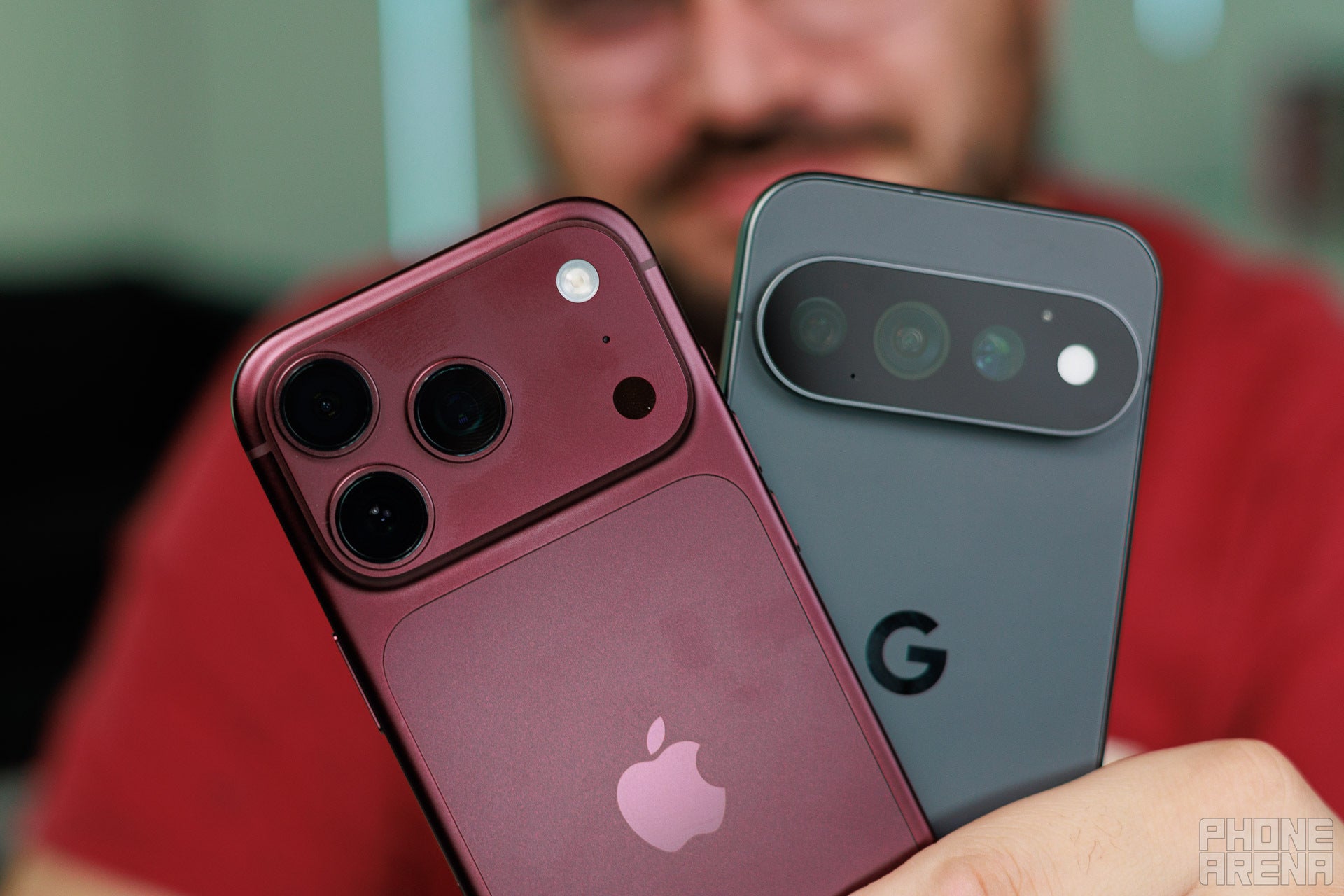
Two camera forerunners | Image by PhoneArena
The iPhone 18 Pro came with a big upgrade to the camera — variable aperture! And yeah, Apple is not first here. Samsung experimented with variable aperture back with the Galaxy S9 but dropped the concept. And Sony's PRO-I photography phone also had one.
So, when you want to get a nice landscape shot with more things in focus, you can close the aperture down to f/4.0 — provided you have enough light. If you want to let more light in, or get some nice creamy bokeh in the background, you can open it up all the way to f/1.48.




Is this a big deal or something that can easily be mimicked by software nowadays? Up to anyone to deceide for themselves really.
The Pixel 11 Pro's main camera has a fixed F1.7 aperture and it's not the end of the world. On the contrary, that seems to be a pretty good sweet spot as far as smartphone cameras are concerned.
We also have high-quality 48 MP zoom cameras and ultra-wide cameras on both flagships. Their specs are excellent, so here's how the photos look:
Main camera






As usual, in daytime photos, the Pixel leans more towards slightly colder hues and a very contrasty, dramatic look. The iPhone is known for a slightly warmer tone and it does keep the contrast more neutral, revealing more of the photo. Of course, Photographic Styles can throw a wrench in any analysis I try to make here, so for what it's worth — these were all taken at default settings.
The Pixel did a pretty impressive job with night-time photos, bringing out a lot more color and detail. Even if the photo ends up looking a bit more dream-like or too perfect, it's hard to deny that it just shows a lot more of the scene.
Zoom




At extreme zooms, the Pixels' digital sharpening does a good job at clearing up the subjects a bit more. Or maybe "re-drawing" is the better use of the word here. In reality, I am yet unsure what use we have for such extreme zooms done with small cameras and small lenses. Bragging rights? Sure... Have a cookie, Pixel.
Ultra-wide




Just as with the main camera, the Pixel's ultra-wide is slightly more contrasty and dramatic. And again, delivers more well-exposed night shots.
Selfie




The iPhone is generally the king of vanity and its selfie camera is often a strong performer. Here, we have mixed results. The skin tone from the iPhone looks a bit better, though its detail seem a little soft. On the other hand, the Pixel seems to be a bit too eager to sharpen things and impress us with striking highlights. The iPhone's selfies look a bit more tame and realistic, and I'd go with those.
Battery Life and Charging
The iPhone 18 Pro comes with an improved battery life, with Apple now promising 36 hours of video playback (up from 33 on the iPhone 17 Pro). More importantly — fast charging! Up to 50% battery in 15 minutes with a 60 W adapter.
Of course, Apple's in-house tests are different from ours, so here are our comparisons:
Both phones also support wireless charging with magnetic alignment — MagSafe on the iPhone 18 Pro and PixelSnap on the Pixel 11 Pro.
Specs Comparison
And here is a quick look at the iPhone 18 Pro vs Pixel 11 Pro specs:
|
|
|
| Apple iPhone 18 Pro | Google Pixel 11 Pro |
| Dimensions | |
|---|---|
| 150 x 71.9 x 8.75 mm (~13.49 mm with camera bump) | 152.4 x 71.1 x 8.4 mm (~12.22 mm with camera bump) |
| Weight | |
| 211.0 g | 204.0 g |
| Size | |
|---|---|
| 6.3-inch | 6.3-inch |
| Type | |
| OLED, Variable 1-120Hz | OLED, 120Hz |
| System chip | |
|---|---|
| Apple A20 Pro (2 nm) | Google Tensor G6 (3 nm) |
| Memory | |
| 12GB (LPDDR5X)/256GB 12GB/512GB 12GB/1TB 12GB/2TB |
12GB (LPDDR5X)/256GB (UFS 4.0) 16GB/512GB 16GB/1TB |
| OS | |
| iOS (27.x) | Android (17), up to 7 OS updates |
| Type | |
|---|---|
| 4288 mAh | 4850 mAh |
| Charge speed | |
| Wired: 60.0W Wireless: 25.0W | Wired: 30.0W Wireless: 25.0W |
| Main camera | |
|---|---|
| 48 MP (PDAF, ToF 3D depth sensing, Sensor-shift OIS) Sensor name: Sony IMX905 Aperture size: F1.5/F4.0 Focal length: 24 mm Sensor size: 1/1.28" Pixel size: 1.22 μm |
50 MP (OIS, PDAF) Aperture size: F1.7 Sensor size: 1/1.3" |
| Second camera | |
| 48 MP (Ultra-wide, Sensor-shift OIS) Sensor name: Sony IMX972 Aperture size: F2.2 Focal Length: 13 mm Sensor size: 1/2.55" Pixel size: 0.7 μm |
48 MP (Ultra-wide) Aperture size: F2.8 Sensor size: 1/2.51" |
| Third camera | |
| 48 MP (Telephoto, Periscope, OIS, PDAF) Sensor name: Sony IMX973 Optical zoom: 4.0x Aperture size: F2.8 Focal Length: 100 mm Sensor size: 1/2.55" Pixel size: 0.7 μm |
48 MP (Telephoto, Periscope) Optical zoom: 5.0x Aperture size: F2.8 Sensor size: 1/1.95" |
| Front | |
| 18 MP (Time-of-Flight (ToF), Autofocus, HDR) | 42 MP (PDAF) |
See the full
Apple iPhone 18 Pro vs Google Pixel 11 Pro specs comparison
or compare them to other phones using our
Phone Comparison tool
Summary
The iPhone 18 Pro is pretty much the perfect Apple upgrade. Just a little bit to keep it in the game, not too much to trigger your FOMO is you already own an iPhone 17 Pro. How does it compare to the Pixel 11 Pro? Well, on performance, pure raw power, and gaming, it runs laps around it. On camera — both are extremely competent, maybe the Pixel has the edge if you look at nighttime performance.
For the AI features? Well, that's a new field, but Google has been in the lead for a while there. While the iPhone's new Siri is now much more conversational and can generate images in more styles... Google's Pixel still has unprecedented features like Direct My Call and Hold for Me. Though Apple does now have features like live in-call translation, call notes and summaries, contextual pop-ups like Magic Cue, along with the many image editing tools.
But it does boil down to more raw power vs slightly more advanced AI features. Slightly warmer camera vs contrastier camera. And of course iOS vs Android.
What's your flavor of choice?


Related Content






Popular stories



Latest News


Things that are NOT allowed:
To help keep our community safe and free from spam, we apply temporary limits to newly created accounts: