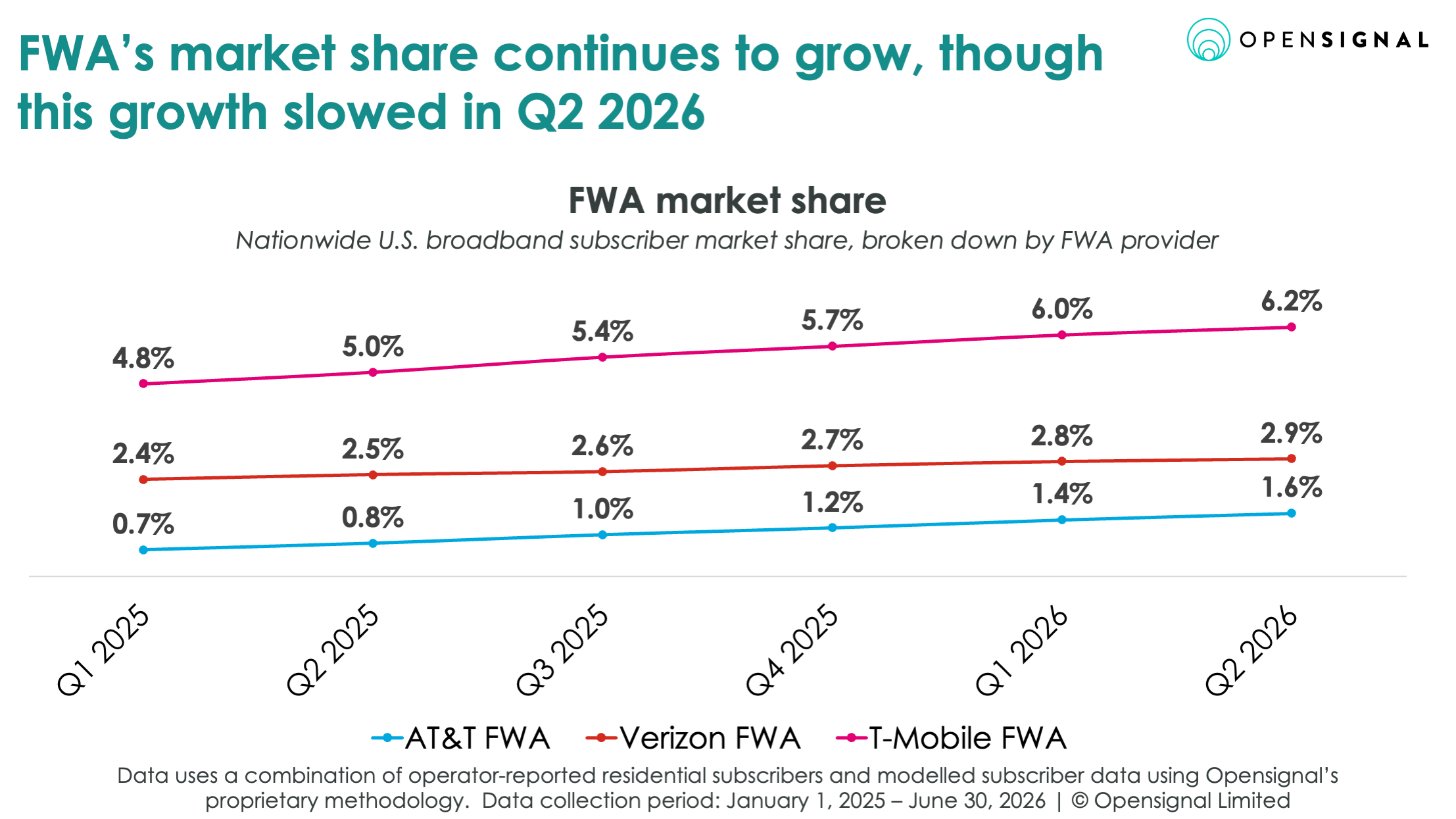
Carriers use excess capacity on their 5G networks to provide home broadband. 5G internet isn't the fastest, but it's good enough for the average user. As of the end of Q2, the Big Three accounted for 10.6% of the residential broadband market, up from 8.4% last year.
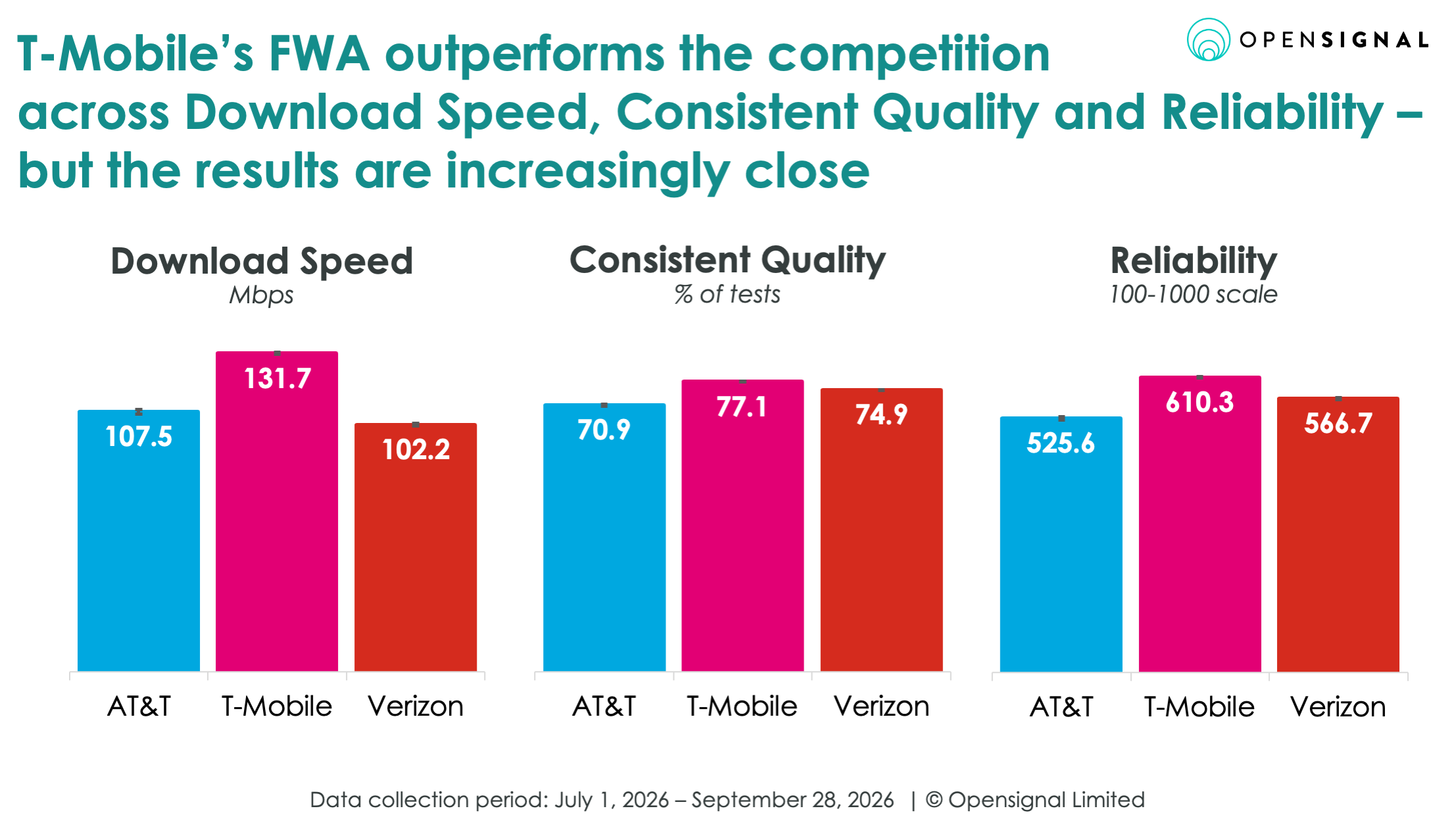
T-Mobile dominates all metrics. | Image by Opensignal
T-Mobileleads in download speed, consistent quality, and reliability, with its users experiencing download speeds 24Mbps (22%) faster than those of runner-up AT&T.
According to New Street Research, the three carriers can still add 20.6 million subscribers without needing additional spectrum, so the slowdown in growth isn't deliberate.
Cable strikes back
Cable companies Comcast and Charter have ramped up promotional efforts to protect their turf. Cable Net Promoter Score, which measures satisfaction and the likelihood of recommending a service to others, increased, while FWA's declined in Q2.
Opensignal believes that promotional pricing from cable providers has eroded FWA's price advantage, as cable connections are faster than 5G internet. In Q2, the share of FWA's new subscribers who switched from cable dropped from 67% to 64%.
Starlink threat is growing
The wins-per-loss (WPL) ratio for 5G internet, or the number of subscribers it gains for each one it loses, fell from 1.26 to 0.96 against satellite providers. This means the Big Three lost slightly more customers to satellite operators than they gained from them.
Recommended For You
Starlink offers an experience comparable to FWA in rural areas. The threat is still small, with FWA market share rising by 3 percentage points to 14%, compared with Starlink's 2-percentage-point increase to 6%. FWA accounted for around 30% of broadband provider switches among rural non-movers, while Starlink's share doubled to 7%.
Only 1% of FWA's new users came from satellite, while 2% of customers leaving FWA opted for satellite providers. Starlink captured the majority of those customers. As Starlink increases its capacity, its impact is likely to grow.
Why wouldn't you choose one of the Big Three for home broadband?
6 Votes
What should AT&T, T-Mobile, and Verizon do?
With fixed-line alternatives available at comparable prices, AT&T, T-Mobile, and Verizon would need to lower prices to keep growing and reduce churn. That should be easy. After all, 5G home internet only requires fallow network capacity. However, FWA generates a lower return on capacity than postpaid services.
The long-term solution is to expand their fiber footprint and lure customers looking for faster speeds to their own fixed-line service instead of letting them churn away to rivals.
Get a free Galaxy A17 with Straight Talk. To claim this deal, you need to pair the phone with activation on a Silver Unlimited Plan or higher. This tier costs $45 per month. Offer valid through 01/10/27 while supplies last online.
Anam Hamid is a computer scientist turned tech journalist who has a keen interest in the tech world, with a particular focus on smartphones and tablets. She has previously written for Android Headlines and has also been a ghostwriter for several tech and car publications. Anam is not a tech hoarder and believes in using her gadgets for as long as possible. She is concerned about smartphone addiction and its impact on future generations, but she also appreciates the convenience that phones have brought into our lives. Anam is excited about technological advancements like folding screens and under-display sensors, and she often wonders about the future of technology. She values the overall experience of a device more than its individual specs and admires companies that deliver durable, high-quality products. In her free time, Anam enjoys reading, scrolling through Reddit and Instagram, and occasionally refreshing her programming skills through tutorials.
A discussion is a place, where people can voice their opinion, no matter if it
is positive, neutral or negative. However, when posting, one must stay true to the topic, and not just share some
random thoughts, which are not directly related to the matter.
Things that are NOT allowed:
Off-topic talk - you must stick to the subject of discussion
Offensive, hate speech - if you want to say something, say it politely
Spam/Advertisements - these posts are deleted
Multiple accounts - one person can have only one account
Impersonations and offensive nicknames - these accounts get banned
To help keep our community safe and free from spam, we apply temporary limits to newly created accounts:
New accounts created within the last 24 hours may experience restrictions on how frequently they can
post or comment.
These limits are in place as a precaution and will automatically lift.
Moderation is done by humans. We try to be as objective as possible and moderate with zero bias. If you think a
post should be moderated - please, report it.
Have a question about the rules or why you have been moderated/limited/banned? Please,
contact us.










Things that are NOT allowed:
To help keep our community safe and free from spam, we apply temporary limits to newly created accounts: