Some of the most important changes to smartphones have been related to advances in display technology, and that may repeat in the coming years. Following the larger displays with variable refresh rates and the wide foldable smartphone trend, Apple and Samsung may be working on a holographic display.
The first “spatial” iPhone may launch by 2030
Samsung is reportedly working on a new technology that would allow phones to have holographic displays. Dubbed MH1 or H1, the display integrates a “nano-structured holographic layer,” enabling 3D-like depth effects without the need for glasses.
The new technology, reported by leaker Schrödinger on Twitter, also relies on eye-tracking and diffractive beam-steering. That last technique uses microscopic structures inside the display layer that bend and redirect light toward the user’s eyes at specific angles.
Samsung is reportedly moving its 3D Plate tech to mobile with the MH1 (H1) display. Forget 2D we’re talking glasses-free holographic depth & spatial AI avatars floating above the glass. More info will be shared on Schrödinger Intel soon... pic.twitter.com/mUysO0Wbv5
This rumor pairs with a reported “Spatial iPhone,” which is allegedly in development by Apple. The new technology is at the first R&D phase of development, but it could end up in smartphones by 2030, according to a follow-up post by the leaker.
Recommended For You
Next-generation depth effects
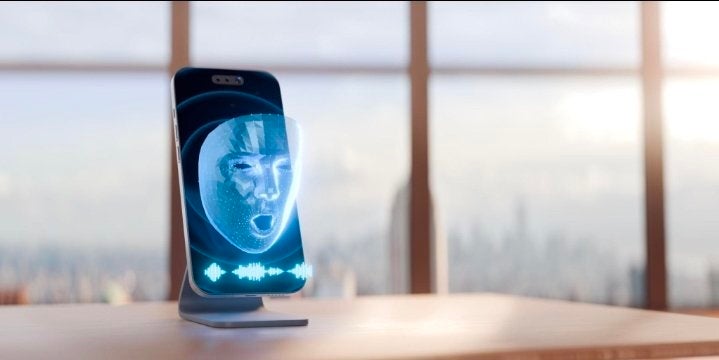
Holographic displays could be the future of the iPhone. | Image by Schrödinger Intel
With the new technology, the new display will be capable of showing images that give the perception of depth without using additional glasses. Those effects will make it feel like the image floats above the glass surface of the device.
Samsung has reportedly developed a patented algorithm that would allow users to tilt their phones and view around objects in a given video. That ability is described as “360-degree rotation.”
Despite the new abilities, the display will be capable of maintaining full 4K fidelity for standard 2D content. The new holographic depth effect will only activate for specific content.
If those claims are true, Samsung will be able to keep the clarity of the image unchanged, which would be the most impressive achievement of the technology. Current technologies that provide similar effects, like lenticular lens-based 3D screens, generally come with an image quality tradeoff.
Apple’s spatial ambitions could finally get rewarded
Through the years, Apple has shown interest in various types of 3D display and spatial technologies through patent applications. The company has also been adding spatial audio, photos, and video features to the iPhone over the last few years.
What display innovation would you like to see?
123 Votes
A holographic display sounds great
89.43%
Just make it bright and energy efficient
8.13%
A display that extends from small phone to a monitor
0.81%
None, displays are good enough, we need other innovation
1.63%
While Apple’s previous efforts were mostly connected to the Apple Vision Pro and the company’s general interest in AR and VR tech, they could give it a head start with a new display technology. If a phone like the potential iPhone 22 Pro launches in 2030 with a holographic display, users will have years of content that would pop out of their phones.
Of course, that’s an unconfirmed rumor about a technology at a very early stage of development. Even with the impressive track record of the source, many things could change before we see whether this project bears any useful fruit.
Is this the next smartphone revolution?
Apple’s future CEO John Ternus recently said in an interview that mixing the digital and physical world is an “inevitability” and the company is working on products he described as “pretty cool.” An actual “holographic” iPhone could fit both those descriptions and make everyone feel like it’s a revolutionary product.
I won’t get too excited about such a smartphone because of one very personal reason. I have a specific health condition that limits the vision of one of my eyes and renders practically every 3D technology useless for me. While many people describe things popping out of the screen when they watch 3D movies, the most I get are some blurry effects and glasses marks on my nose.
On top of the more obvious technological issues, Apple and Samsung should also figure out how to make such technology work even for people with vision limitations. If they manage to do it, that could be their chance to open a new chapter in consumer technology, once again because of displays and not stuff like AI.
Galaxy Z Fold 8: save up to $800
$1299
99
$2099
99
$800 off (38%)
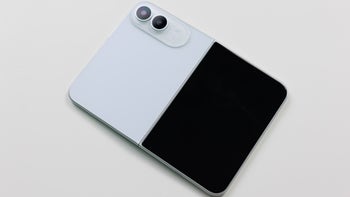
The Galaxy Z Fold 8 is Samsung's first-ever passport-style device, offering a unique approach to the foldable experience. Right now, you can get the device with a maximum trade-in discount of up to $800. Alternatively, you can get it with a $250 Samsung Instant Savings, no trade-in required.
Ilia, a tech journalist at PhoneArena, has been covering the mobile industry since 2011, with experience at outlets like Forbes Bulgaria. Passionate about smartphones, tablets, and consumer tech, he blends deep industry knowledge with a personal fascination that began with his first Nokia and Sony Ericsson devices. Originally from Bulgaria and now based in Lima, Peru, Ilia balances his tech obsessions with walking his dog, training at the gym, and slowly mastering Spanish.
A discussion is a place, where people can voice their opinion, no matter if it
is positive, neutral or negative. However, when posting, one must stay true to the topic, and not just share some
random thoughts, which are not directly related to the matter.
Things that are NOT allowed:
Off-topic talk - you must stick to the subject of discussion
Offensive, hate speech - if you want to say something, say it politely
Spam/Advertisements - these posts are deleted
Multiple accounts - one person can have only one account
Impersonations and offensive nicknames - these accounts get banned
To help keep our community safe and free from spam, we apply temporary limits to newly created accounts:
New accounts created within the last 24 hours may experience restrictions on how frequently they can
post or comment.
These limits are in place as a precaution and will automatically lift.
Moderation is done by humans. We try to be as objective as possible and moderate with zero bias. If you think a
post should be moderated - please, report it.
Have a question about the rules or why you have been moderated/limited/banned? Please,
contact us.







Things that are NOT allowed:
To help keep our community safe and free from spam, we apply temporary limits to newly created accounts: