The weather in most of the continental U.S. these past few days has been awful. Two feet of snow has been dumped on Salem, Massachusetts and "feels like" temps have been below zero. In other areas of the country, the snow is packed even higher off the ground. You might wonder how the Big 3 wireless operators in the U.S., which includes T-Mobile, Verizon, and AT&T, managed to get through the storm without any major outages.
Fierce Wireless shared what it was told from the carriers themselves how they prepared for the incoming snow, sleet, and freezing rain. For example, in Dallas, where AT&T has its headquarters, a trifecta of snow (several inches worth), sleet, and slick ice created issues.
AT&T used these mobile cell sites to deliver service during and after the storm
AT&T said that its FirstNet response operations group (ROG), led by former first responders instead of tech people, were ready and prepared for the storm. Having previously worked as police officers, fire chiefs, and emergency managers, this group knews the importance of timely communication between first responders. When a storm knocks out cell towers, other assets are deployed including:
SatCOLTs: (Satellite Cell on Light Trucks)- These are large trucks sporting massive antennas that link to satellites that will deliver a 4G/5G signal even if every ground wire in the city is cut.
CRDs: (Compact Rapid Deployables)-Suitcase-sized units that can be positioned inside buildings or hard to access areas.
FirstNet One: Flying 1,000 feet in the air, this is a 55-foot Blimp that provides coverage over an area of up to 100 square miles.
ROG the Dog: Therapy animals brought by the team to disaster zones to help first responders cope with a stressful mission.
Recommended For You
An AT&T spokesman told Fierce Wireless, "We're hanging in there in Texas, other parts of the country are way worse."
T-Mobile sent out a press release that included a statement from John Saw, the carrier's Chef Technology Officer (CTO). Saw said that throughout Winter Storm Fern, T-Mobile's network remained strong "thanks to the incredible preparations and response of our emergency team." T-Mobile also utilized its self-optimizing network (SON) with AI to keep subscribers connected.
Why T-Mobile adjusts the angle of some of its radio signals during and after a storm
It's actually amazing what the Big 3 carriers like T-Mobile do to keep their customers with bars during a major storm such as the one we just lived through in the Northeast U.S. With Dynamic Antenna Tilting, the angles of radio signals are remotely changed to cover dead zones caused by weather related outages. With Traffic Load Balancing, traffic from a congested cell tower is transferred to a tower that is under-utilized. This adjustment almost makes too much sense.
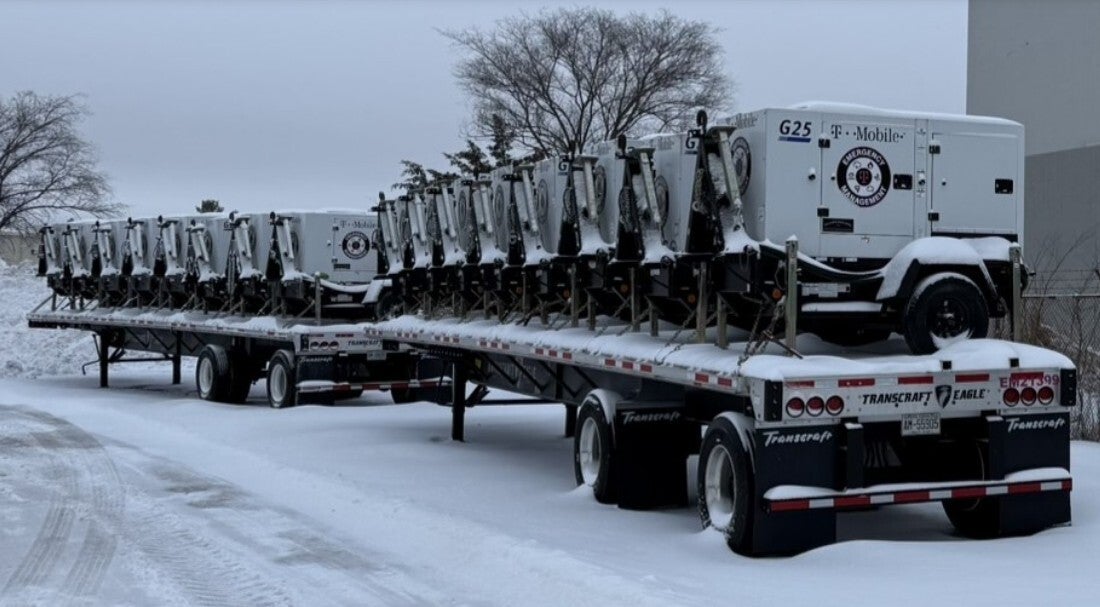
Portable T-Mobile generators get ready to be deployed during Winter Storm Fern. | Image credit-T-Mobile
To extend the life of back up batteries and generators, spectrum use is shifted to low-power bands. With Interference Mitigation, signal timing from two different bands (for example, mid-band 2.5GHz and low band 600MHz) are adjusted to prevent interference between the two. T-Mobile also states that it has crews and technicians on the ground using portable generators. Where necessary, and in areas where safe road conditions prevail, the wireless provider is refueling or recharging on-site backup power.
Verizon milks its COWs during bad weather in order to provide uninterrupted service
Verizon told Fierce Wireless, "Our engineers prepare year-round for these events and are ready to deploy immediately if needed." Verizon also noted that before the storm it hardened its cell sites and backup generators. This process includes making sure that backup generators and batteries are operational across all Macro cell sites. Fuel deliveries were arranged and tankers at the ready to refill generators if power went down.
Verizon also had its mobile cell sites such as COWs and COLTs ready. The former, Cell on Wheels, is a mobile tower and base station mounted on a flatbed trailer and towed by a truck. The latter is a Cell on Light Truck. This is a self-contained website built onto a light truck or a van. For COWs and COLTs to work, they are plugged into a Fiber network for maximum speed or connect to the Verizon network using a Microwave tower, or via satellite.
Everything seemed to work well this past week as I experienced no issues in Salem. But hold on folks, a blizzard is expected to hit the area next weekend.
Get iPhone 18 Pro with Visible, get $480 off!
$719
/mo
$1199
$480 off (40%)
On the Visible+ Pro plan, you get access to 5G Ultra Wideband data on Verizon's fastest network. Along with unlimited roaming across Mexico and Canada, 2 days of Global Pass per month, 3x hotspot speeds, 4K streaming, and Smartwatch service.
Alan, an ardent smartphone enthusiast and a veteran writer at PhoneArena since 2009, has witnessed and chronicled the transformative years of mobile technology. Owning iconic phones from the original iPhone to the iPhone 15 Pro Max, he has seen smartphones evolve into a global phenomenon. Beyond smartphones, Alan has covered the emergence of tablets, smartwatches, and smart speakers.
A discussion is a place, where people can voice their opinion, no matter if it
is positive, neutral or negative. However, when posting, one must stay true to the topic, and not just share some
random thoughts, which are not directly related to the matter.
Things that are NOT allowed:
Off-topic talk - you must stick to the subject of discussion
Offensive, hate speech - if you want to say something, say it politely
Spam/Advertisements - these posts are deleted
Multiple accounts - one person can have only one account
Impersonations and offensive nicknames - these accounts get banned
To help keep our community safe and free from spam, we apply temporary limits to newly created accounts:
New accounts created within the last 24 hours may experience restrictions on how frequently they can
post or comment.
These limits are in place as a precaution and will automatically lift.
Moderation is done by humans. We try to be as objective as possible and moderate with zero bias. If you think a
post should be moderated - please, report it.
Have a question about the rules or why you have been moderated/limited/banned? Please,
contact us.



Things that are NOT allowed:
To help keep our community safe and free from spam, we apply temporary limits to newly created accounts: