My experience with the Pixel 10 has been pretty smooth ever since I moved to it from the iPhone 15 last year. There was surely a rough patch of a couple of months this year when I noticed that its performance had degraded a lot, but Google was kind enough to resolve all my concerns through its monthly update.
However, there is still one thing Pixel phones are not better at than the iPhone. I am talking about the working of facial recognition systems in dark environments. Compared to the iPhone, Google smartphones often struggle to recognize a face when there isn't enough light available.
Fortunately, the latest finding suggests that the Big G is finally taking the necessary steps to improve its mobiles' performance in this particular area.
How come the iPhone's Face ID is better than the Pixel facial recognition system?
Both the iPhone and the Pixel are quick enough to recognize the face when there is enough surrounding light. However, the latter is often seen struggling in low lighting conditions, and the reason behind this is the engineering approach the devices use for facial recognition. Apple installs a dedicated TrueDepth camera system inside its iPhones that basically does the job of projecting thousands of invisible infrared dots on your face.
Recommended For You
The projected dots help in creating an accurate 3D model of your face. Since the infrared illumination is not at all dependent on the surrounding light, the iPhone can recognize the face even in a completely dark environment. The latest Pixel phones, on the other hand, rely on the front camera for 2D facial-based recognition. While it works flawlessly in a bright environment, it struggles a lot in dark conditions since there isn't enough light for the selfie camera to see the face.
What kind of facial recognition system do you want in Pixel phones?
6 Votes
The Pixel face authentication system was once as good as Apple's Face ID
You would be surprised to know that there was a time when Pixel used to perform really well in low-lighting conditions as well. The Pixel 4, which was released in 2019, used infrared cameras and dot projectors, which allowed it to easily scan the face even in dark environments.
However, the company removed it in the Pixel 5, citing the reason that fingerprint unlock is more secure than face unlock. The technology was later added in the Pixel 7, but this time it doesn't feature the infrared cameras and dot projectors. It relied on the front camera, and the Big G has used the same approach on all the devices released since then, even the latest Pixel 11 lineup.
Pixel users are apparently frustrated with the device performance in low light
It's not only me. Most users who have used both iPhone and Pixel appear to appreciate the former for its smoother facial authentication system in dark environments. You will find plenty of frustrated Pixel users online calling out Google for working on this department of its smartphones.
One user commented under a relevant Reddit post that "The Pixel 4 was the last Android phone with IR face scanning. Everything since has been a step backwards." Another user replied to this comment that the face unlock was really great on the Pixel 4.
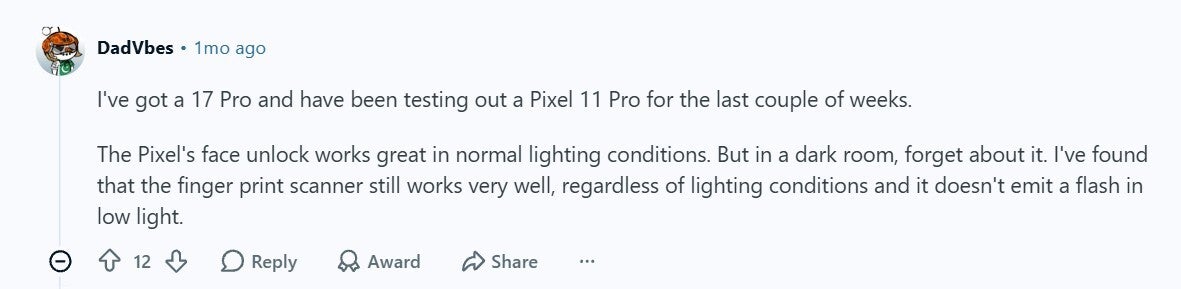
Facial recognition system of iPhone 17 Pro and Pixel 11 Pro. | Image by Reddit
A Redditor who claims to have both the iPhone 17 Pro and the Pixel 11 Promentions that the latter really struggles with face unlock in dark rooms.
Google is reportedly working on a fix
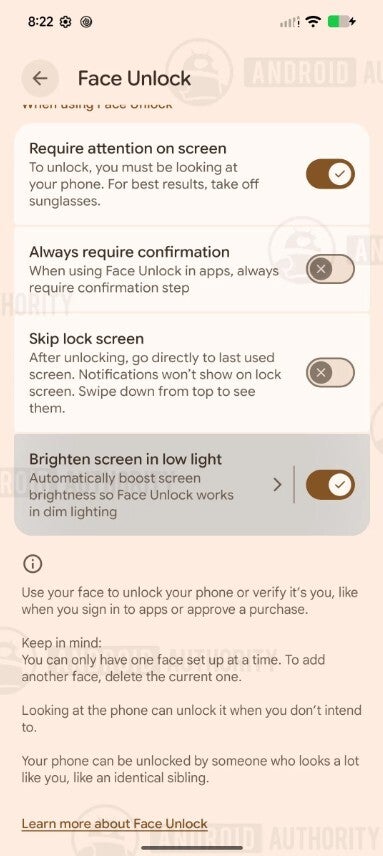
Brighten screen in low light option. | Image by Android Authority
The good news is that the Big G is apparently aware that the face unlock mechanism of its smartphones doesn't work the best in dark rooms. To fix this, a software-based solution is reportedly being prepared. A new "Brighten screen in low light" toggle has been spotted in the Android 17 QPR3 Beta 2, whose function is to boost the screen brightness so that face unlock works in dim lighting.
Basically, when a dark environment is detected or when the user's face is not properly visible, the phone will brighten the screen so that the front camera can easily scan and recognize the face. The feature is still in the early stages of its development, so not many details are out about it yet. However, the available clues suggest that there could be a slider that could allow the user to adjust the intensity of the brightness.
Something is better than nothing
Although the available details suggest that there will be a toggle to control the brightness intensity, I would still not prefer to get my face flashed with a bright light in a dark room. That's why I still believe Apple's approach is better. Interestingly, Google was earlier reported to be working on a new technology called Project Toscana, with the intention to come up with an under-display infrared camera.
There were reports that the tech giant would introduce this technology with the Pixel 11 lineup, but unfortunately that didn't happen. And now the appearance of the software-based solution suggests that Project Toscana might have been put on hold. Or, it could also be possible that the upcoming Pixel 12 family would feature an under-display infrared camera, and all the previous Pixel phones would rely on the software-based solution to properly recognize faces in dark conditions.
We will surely get more details in the future. Until then, let's be happy that at least Google is aware and working on fixing its Pixel phones' poor facial recognition performance in dim lighting.
Aman Kumar is a news writer at PhoneArena covering Google Pixel phones, Android features, AI-powered smartphone tools, and mobile tech news. Before joining PhoneArena, he spent over five years writing about consumer technology for publications like MakeUseOf, How-To Geek, and Guiding Tech. His current daily drivers are the Pixel 10 and Samsung Galaxy S26 Plus, while his red iPhone SE (2nd gen) remains a personal favorite. Aman also appreciates bold smartphone experiments and still considers the Nokia N-Gage one of the industry’s most iconic designs.
A discussion is a place, where people can voice their opinion, no matter if it
is positive, neutral or negative. However, when posting, one must stay true to the topic, and not just share some
random thoughts, which are not directly related to the matter.
Things that are NOT allowed:
Off-topic talk - you must stick to the subject of discussion
Offensive, hate speech - if you want to say something, say it politely
Spam/Advertisements - these posts are deleted
Multiple accounts - one person can have only one account
Impersonations and offensive nicknames - these accounts get banned
To help keep our community safe and free from spam, we apply temporary limits to newly created accounts:
New accounts created within the last 24 hours may experience restrictions on how frequently they can
post or comment.
These limits are in place as a precaution and will automatically lift.
Moderation is done by humans. We try to be as objective as possible and moderate with zero bias. If you think a
post should be moderated - please, report it.
Have a question about the rules or why you have been moderated/limited/banned? Please,
contact us.





Things that are NOT allowed:
To help keep our community safe and free from spam, we apply temporary limits to newly created accounts: