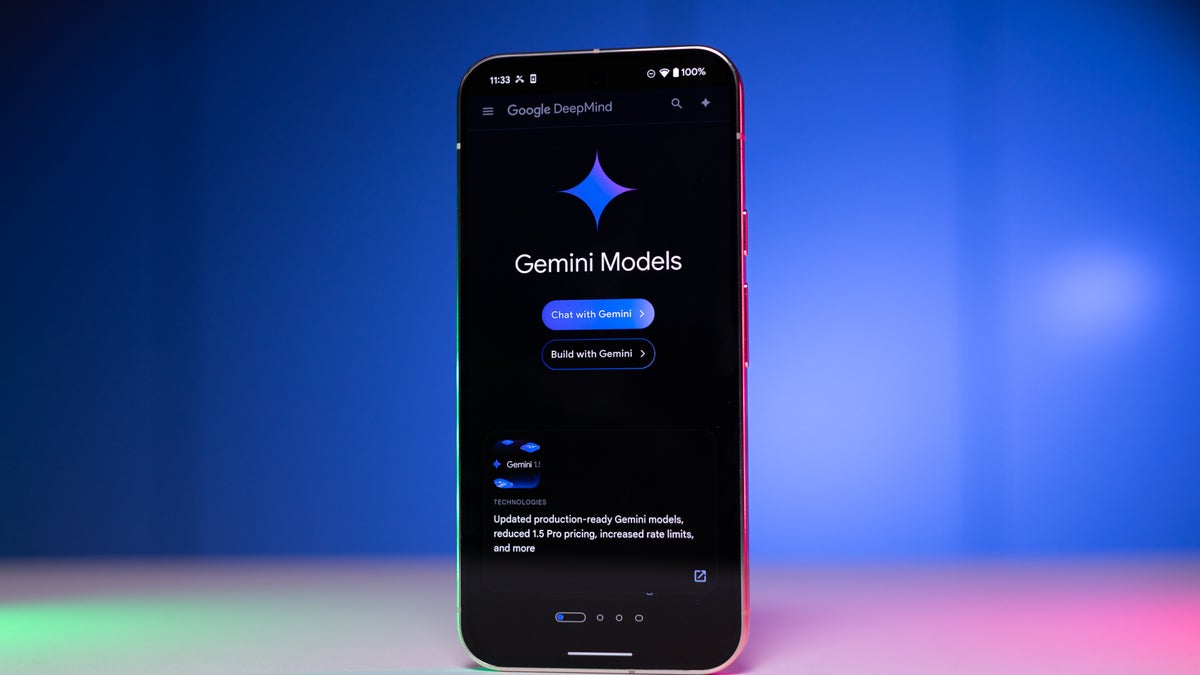
Google's AI chatbot, Gemini is getting the ability to spot whether a video is real or generated using AI.
Easily flag AI-generated content
In November this year, Gemini AI gained the power to check whether an image was produced using AI. The chatbot can now also detect AI-generated videos.
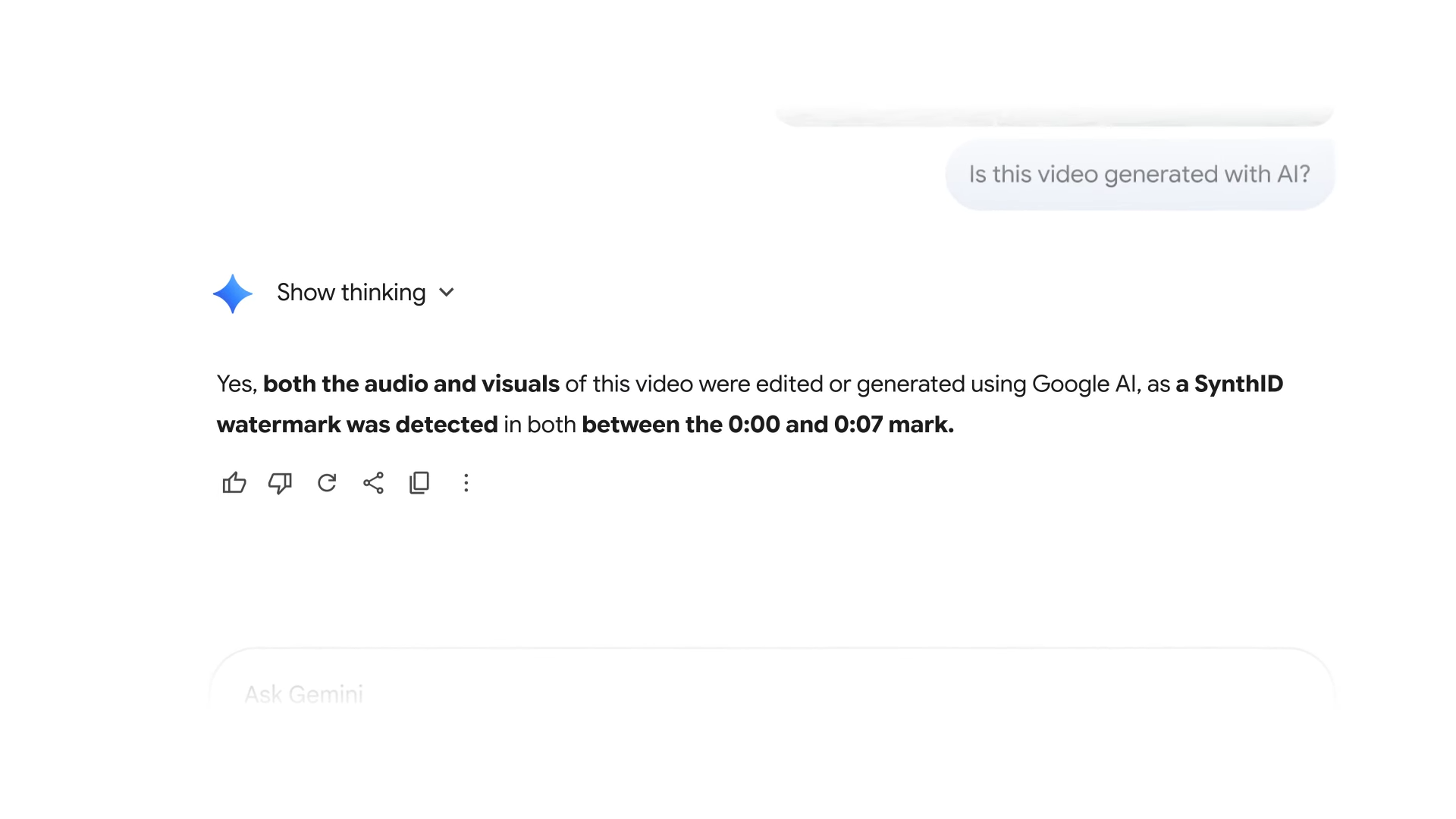
It's a cakewalk to use Gemini AI video detector capability. In fact, the process is quite similar to how you use its AI image detector tool. Simply open the Gemini app on your smartphone or visit its website on your computer. Then, upload the video that you think was produced using AI, and give a prompt like, "Is this video generated with AI."
However, the catch is that Gemini can currently detect only videos created using Google's own tools. This is the same limitation you face when using its AI image detection tool. Additionally, you can currently upload only videos with a maximum size of 100 MB and a length of no more than 90 seconds.
That said, the chatbot takes a few seconds to analyze both the visuals and audio of the uploaded video and then informs you whether either or both were generated using AI. You'll also notice a mention of the SynthID watermark in the results, which is essentially what helps Google identify AI content created with its own tools.
How does SynthID help Gemini detect AI-generated content?
Google Gemini AI video detector. | Image by Google
You can use generative AI to produce images, videos, and text content. However, to make sure it's easy to identify whether content is made by AI or by humans, Google uses SynthID technology, which watermarks all content generated using Google AI tools. This digital watermark is imperceptible to humans but can be easily detected by the Google SynthID Detector.
Recommended For You
Basically, when you ask Gemini whether the uploaded image or video is AI-generated, it uses the Synth Detector to check for signs of SynthID watermarks. If any are found, the chatbot responds that AI was detected in the uploaded content. Otherwise, you'll get a response like "No SynthID detected," indicating that the content doesn't contain any traces of AI.
The SynthID watermark is currently embedded only in content that is produced or altered by Google's AI tools. That's why, when you upload content created using any other AI tools like ChatGPT, Gemini cannot detect whether it was generated or edited with AI.
To make sure AI detectors can identify content created with any AI tool, companies are working to establish the Coalition for Content Provenance and Authenticity (C2PA) as a universal standard. As part of this effort, most AI-generated content will contain C2PA metadata. However, this is still a work in progress, and many AI tools have yet to adopt the standard. Google recently announced that images created using Nano Banana Pro will be embedded with C2PA metadata.
How do you identify if an image or video is AI-generated?
11 Votes
I look for anatomical oddities in the figures.
36.36%
I check for inconsistencies in physics and logic.
36.36%
I rely on online AI detection tools.
27.27%
AI detectors have never been this important
With the advancement of AI tools, it's becoming increasingly difficult to distinguish between real and AI-produced content. As someone like me whose life revolves around technology and who has worked with AI tools since the days when models like ModelScope struggled with even simple prompts, I can still tell when content is AI-generated. But things aren't as easy for older people like my parents.
Just a few days ago, my 55-year-old father believed an online image of the broken Carlisle Bridge in Lancaster was real until it was later found to be AI-generated. AI video and image detectors will make it easier for anyone to spot more of such generative media. I also hope that C2PA metadata is quickly implemented as a universal standard so that it becomes possible to flag AI-generated content with any detection tool.
Aman Kumar is a news writer at PhoneArena covering Google Pixel phones, Android features, AI-powered smartphone tools, and mobile tech news. Before joining PhoneArena, he spent over five years writing about consumer technology for publications like MakeUseOf, How-To Geek, and Guiding Tech. His current daily drivers are the Pixel 10 and Samsung Galaxy S26 Plus, while his red iPhone SE (2nd gen) remains a personal favorite. Aman also appreciates bold smartphone experiments and still considers the Nokia N-Gage one of the industry’s most iconic designs.
A discussion is a place, where people can voice their opinion, no matter if it
is positive, neutral or negative. However, when posting, one must stay true to the topic, and not just share some
random thoughts, which are not directly related to the matter.
Things that are NOT allowed:
Off-topic talk - you must stick to the subject of discussion
Offensive, hate speech - if you want to say something, say it politely
Spam/Advertisements - these posts are deleted
Multiple accounts - one person can have only one account
Impersonations and offensive nicknames - these accounts get banned
To help keep our community safe and free from spam, we apply temporary limits to newly created accounts:
New accounts created within the last 24 hours may experience restrictions on how frequently they can
post or comment.
These limits are in place as a precaution and will automatically lift.
Moderation is done by humans. We try to be as objective as possible and moderate with zero bias. If you think a
post should be moderated - please, report it.
Have a question about the rules or why you have been moderated/limited/banned? Please,
contact us.








![Another batch of Galaxy S26 series users in the US are getting a nice surprise today [UPDATED]](https://m-cdn.phonearena.com/images/article/183643-wide-two_350/Another-batch-of-Galaxy-S26-series-users-in-the-US-are-getting-a-nice-surprise-today-UPDATED.webp)
Things that are NOT allowed:
To help keep our community safe and free from spam, we apply temporary limits to newly created accounts: