Cable companies are no longer just renting wireless networks. They are quietly taking control of the busiest parts and letting Verizon carry the expensive, low-traffic coverage.
Focusing on the busiest parts
Image by PhoneArena
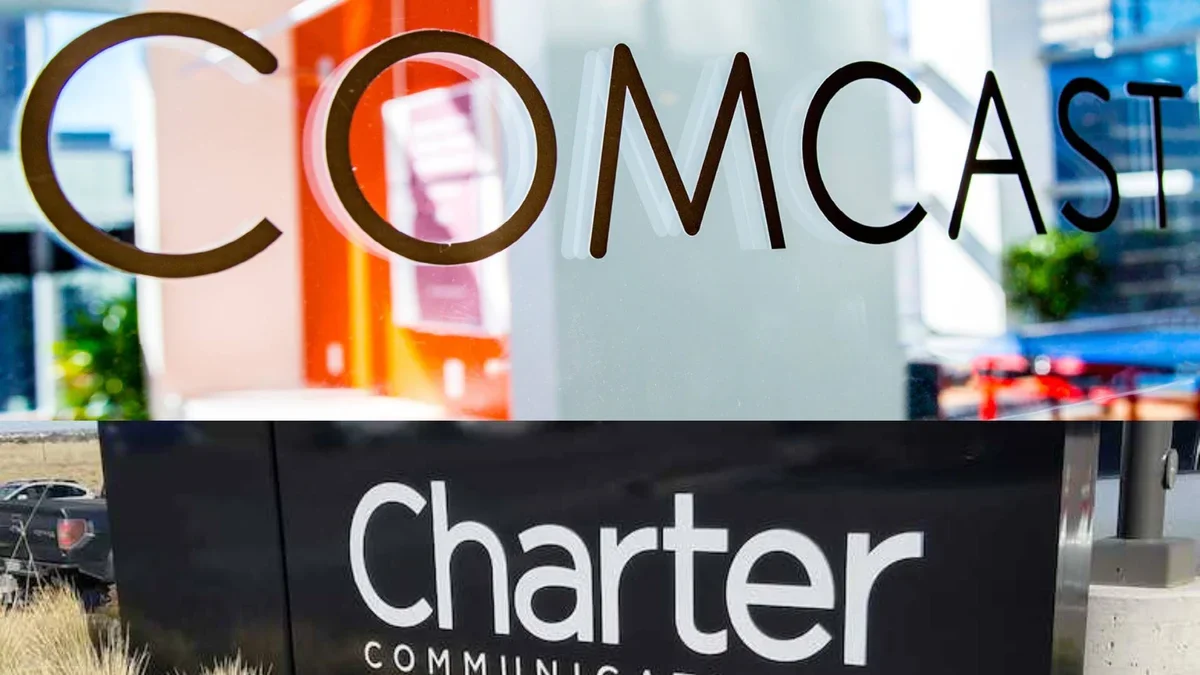
Charter and Comcast have spent a combined $922 million on CBRS spectrum. CBRS (Citizens Broadband Radio Service) is a band of mid-range wireless spectrum in the 3.5 GHz range that the FCC allows for shared use, letting companies deploy private or local 4G and 5G networks without buying expensive nationwide licenses.
Now, they're using it to build small wireless cells directly onto their existing cable lines. These strand-mounted cells sit where people actually use their phones: dense neighborhoods, apartment blocks, and city streets. Instead of trying to cover everything, the cable companies focus only on high-traffic areas and rely on Verizon to handle the wide, expensive coverage elsewhere.
Comcast leadership has explained that a very small share of geography produces most mobile traffic. I guess that's the Pareto principle in action once again!
Traditional carriers must build networks that reach almost everyone. Cable operators only need to build where usage is concentrated, then fall back on their Verizon MVNO agreements for the rest.
Recommended For You
Charter has already shown how far this model can go. By late 2025, about 88% of Spectrum Mobile traffic was running on Charter-controlled networks, including WiFi, CBRS, and partner cable systems. Over the past three years, Charter has reduced its dependence on Verizon macro towers by roughly 20%, with further reductions expected as more CBRS markets come online.
Charter works with Nokia, using lightweight strand-mounted radios that draw power and backhaul directly from the cable network. Comcast chose Samsung for a similar setup and started its rollout in Philadelphia, where it owns the maximum allowed CBRS spectrum. These deployments are far cheaper than traditional small cells, costing only a few thousand dollars each instead of tens of thousands.
Who does the hard work in US wireless?
20 Votes
Verizon (and the big carriers overall).
85%
Charter and Comcast (and similar services).
0%
Both.
5%
Not sure.
10%
Big carriers still do the heavy lifting
So, instead of paying wholesale rates for nearly all traffic, cable operators now pay Verizon mainly for low-density areas that are costly to serve. Verizon still does the hardest part of wireless: broad coverage with lower returns.
The FCC also plays a role. CBRS licenses must be actively used by 2030 or they are lost. Because the rules focus on population coverage rather than land area, cable companies can meet requirements by building in cities where their cable networks already exist.
Charter and Comcast are not moving at the same speed. Charter is pushing fast, targeting 23 CBRS markets by the end of 2025 to drive down wholesale costs. Comcast is moving more carefully, prioritizing profitability and treating wireless as a broadband add-on rather than a core growth engine.
Anyway, this is not a short-term experiment. Cable operators have decided to become infrastructure owners where it matters most, while letting Verizon absorb the cost and complexity of nationwide coverage.
Get iPhone 18 Pro with Visible, get $480 off!
$719
/mo
$1199
$480 off (40%)
On the Visible+ Pro plan, you get access to 5G Ultra Wideband data on Verizon's fastest network. Along with unlimited roaming across Mexico and Canada, 2 days of Global Pass per month, 3x hotspot speeds, 4K streaming, and Smartwatch service.
Sebastian is one of PhoneArena’s senior opinionators. A veteran news writer with almost 20 years of experience in media and technology, he not only covers all the hot news about Galaxies and iPhones, but often provides hot takes on industry trends. He’s fascinated with camera-focused flagships from the likes of Oppo and Vivo, as well as foldable phones.
A discussion is a place, where people can voice their opinion, no matter if it
is positive, neutral or negative. However, when posting, one must stay true to the topic, and not just share some
random thoughts, which are not directly related to the matter.
Things that are NOT allowed:
Off-topic talk - you must stick to the subject of discussion
Offensive, hate speech - if you want to say something, say it politely
Spam/Advertisements - these posts are deleted
Multiple accounts - one person can have only one account
Impersonations and offensive nicknames - these accounts get banned
To help keep our community safe and free from spam, we apply temporary limits to newly created accounts:
New accounts created within the last 24 hours may experience restrictions on how frequently they can
post or comment.
These limits are in place as a precaution and will automatically lift.
Moderation is done by humans. We try to be as objective as possible and moderate with zero bias. If you think a
post should be moderated - please, report it.
Have a question about the rules or why you have been moderated/limited/banned? Please,
contact us.













Things that are NOT allowed:
To help keep our community safe and free from spam, we apply temporary limits to newly created accounts: