Every product we review or recommend is thoroughly tested by our in-house experts in real-world conditions, following our
review methodology
and
ethics statement
to ensure honest, independent, and data-driven results.
When the Moto X was coming to light, it was rumored that it would’ve been given a low price point to contend with Google’s line of Nexus devices. In reality, that wasn’t the case. Fear not though, because Motorola recently introduced the world to its Moto G – a close sibling to the Moto X that’s aiming to shake things up with its outright cost of $179. Sure, it’s not expected to be a cutting-edge thing or high spec’d, but then again, some people out there will more than likely be pacified by a humble offering that gets things done.
The package contains:
microUSB cable
User Manual
Warranty Information
Design
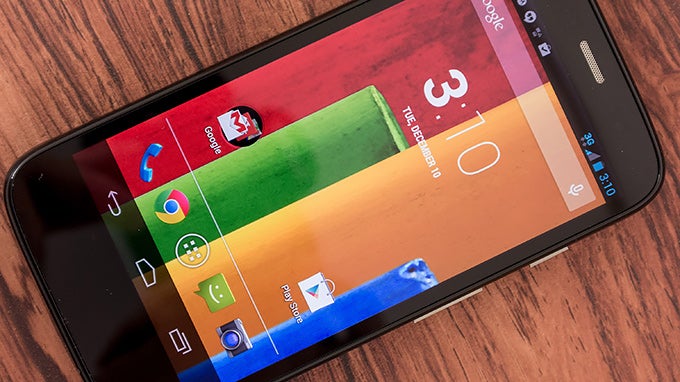
This thing is nearly identical to the Moto X! From its subtle curved rear casing, to its overall size, the Moto G doesn’t tread too far from the design formula in play with its higher powered sibling. Unlike many of today’s prized possessions, the Moto G is extremely form-fitting, which makes it super easy to handle – more so when its curved rear casing gives it an ergonomic and comfortable feel in the hand. We’re not too surprised that it’s comprised out of polycarbonate plastic, but we fancy the idea of it having a removable rear covers, which lends to giving people some color variety.
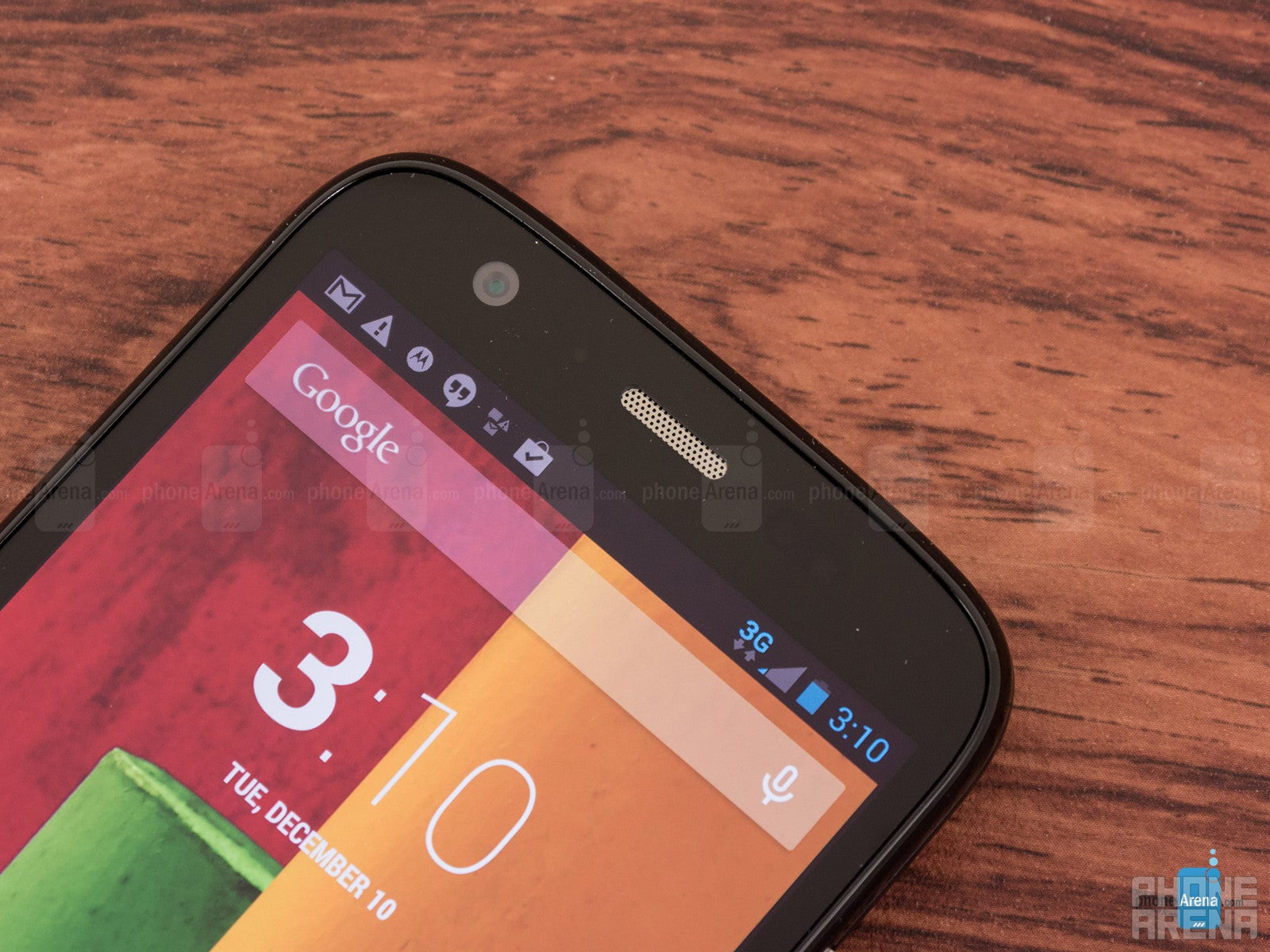
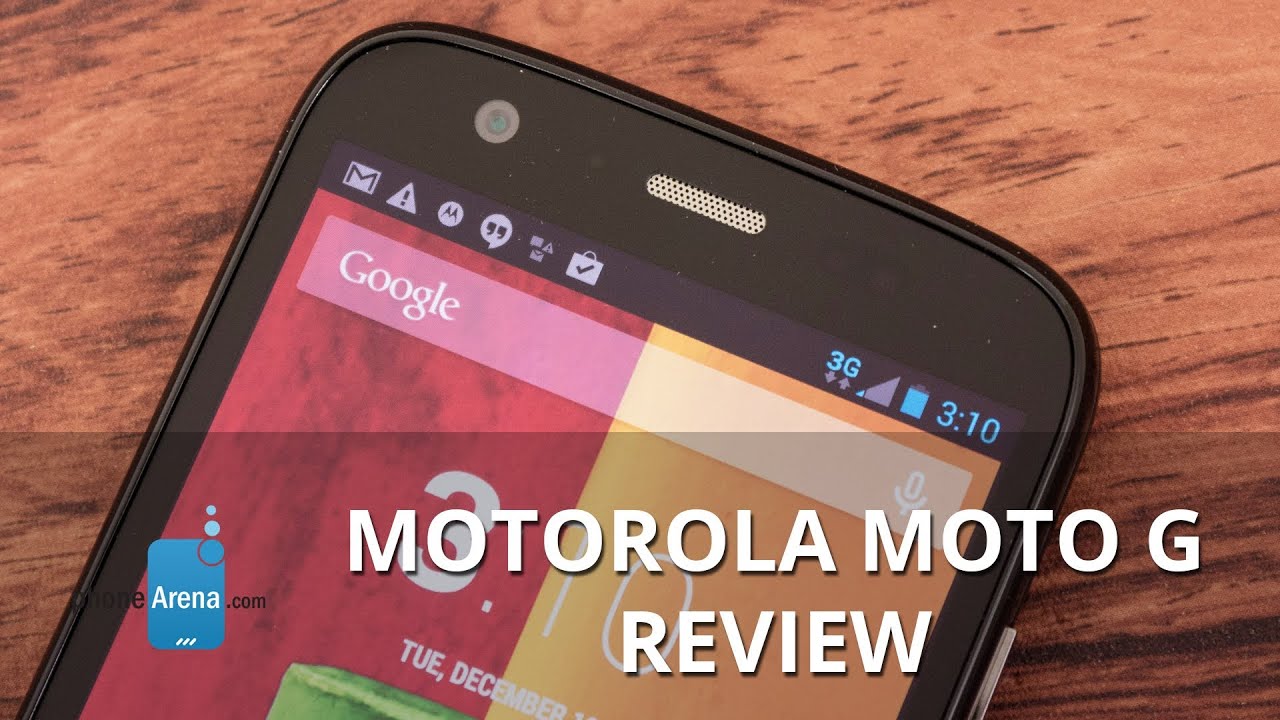
The façade of the phone is pretty clean looking, save for the earpiece, LED notification light, proximity/light sensors, and front-facing 1.3-megapixel camera that are all lined up along the top edge.
Again showing us its close ties to the Moto X, the Moto G employs all the same ports and buttons around its trim – and they’re even positioned in the same places too! Specifically, they include the microUSB port for charging/data connectivity, power button, volume control, standard microphone, 3.5mm headset jack, and noise cancelling mic.
Finally, the rear hosts its 5-megpapixel camera, which features an LED flash and only 720p video recording. Nearby, we have small circular cutouts that make up its speaker grill – while the Motorola logo is tucked in the tiny indentation on the rear. Like we’ve explained, it features a removable rear casing, which then gives us access to its SIM slot. However, the 2070 mAh battery itself cannot be removed.
The Moto G has a modest 4.5-inch 720p LCD display, with pixel density of 329 ppi, it’s able to deliver a fair amount of crispness with things like fine text in the web browser. Furthermore, there’s some vibrancy splashed on that’s a result from the faint hint of saturation seen with its color reproduction. Checking it outdoors with the sun present, it proves to be challenging due to its weaker brightness output and the slight distortion at wide viewing angles. It’s not the most superb screen we’ve seen, but it doesn’t need to be either, just because it works for what it is.
Motorola Moto G 360-Degrees View
Drag the picture or use the keyboard arrows to rotate the phone. Double click or press keyboard
Space to zoom in/out.
Drag the picture in the desired orientation to rotate the phone.
The numbers below represent the amount of deviation in the respective property,observed when a display is viewed from a 45-degree angle as opposed to direct viewing.
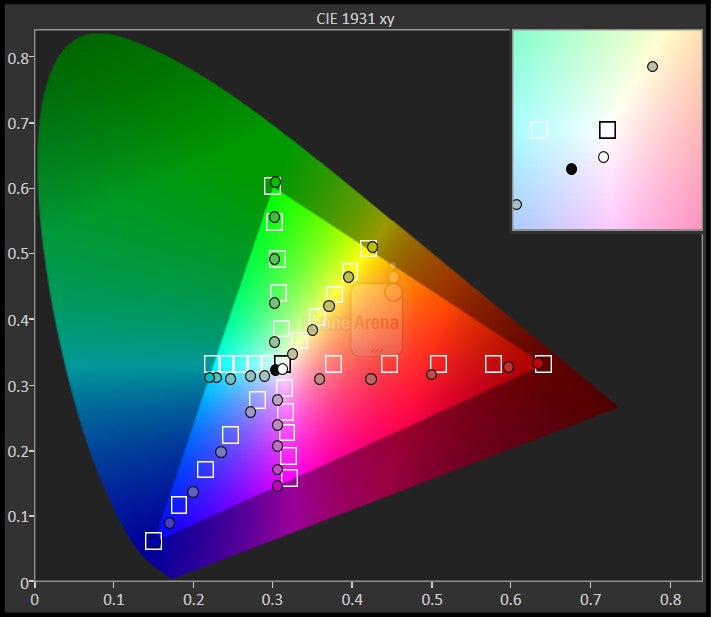
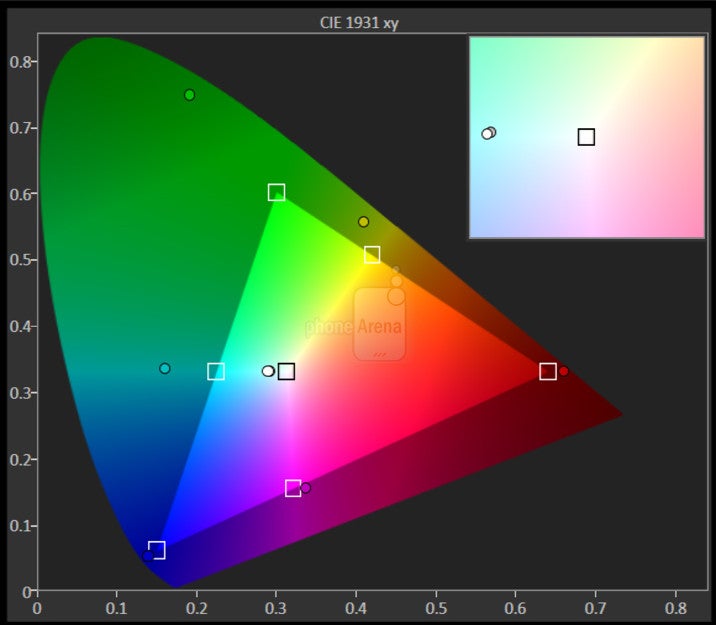
The CIE 1931 xy color gamut chart represents the set(area)of colors that a display can reproduce,with the sRGB colorspace(the highlighted triangle)serving as reference.The chart also provides a visual representation of a display's color accuracy. The small squares across the boundaries of the triangle are the reference points for the various colors, while the small dots are the actual measurements. Ideally, each dot should be positioned on top of its respective square. The 'x:CIE31' and 'y:CIE31' values in the table below the chart indicate the position of each measurement on the chart. 'Y' shows the luminance (in nits) of each measured color, while 'Target Y' is the desired luminance level for that color. Finally, 'ΔE 2000' is the Delta E value of the measured color. Delta E values of below 2 are ideal.
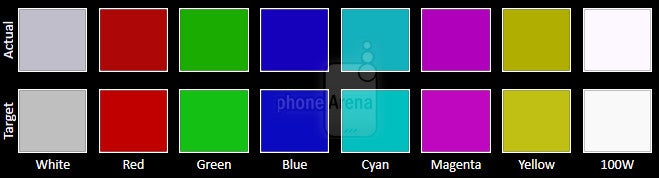
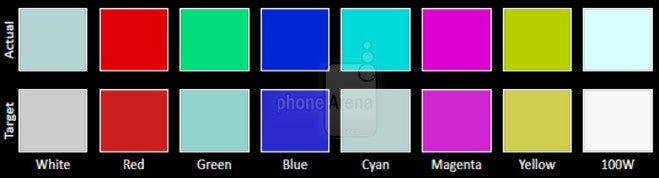
The Color accuracy chart gives an idea of how close a display's measured colors are to their referential values. The first line holds the measured (actual) colors, while the second line holds the reference (target) colors. The closer the actual colors are to the target ones, the better.
The Grayscale accuracy chart shows whether a display has a correct white balance(balance between red,green and blue)across different levels of grey(from dark to bright).The closer the Actual colors are to the Target ones,the better.
Motorola seems to take a liking to a mostly stock Android 4.3 Jelly Bean experience, seeing that’s exactly what we see here on the Moto X. Other custom Android experiences tend to throw a lot of features at us, including the kitchen sink it seems sometimes, which sometimes end up feeling more redundant than useful, but here on the Moto G, it’s kept simple and straightforward.
And with that in mind, we’re not saddened by any means of the imagination to see nothing particularly new with the experience that we haven’t been exposed to before. Although it’s not greeted with the cool Active Display and Touchless Control features that we saw with the Moto X, at its core though, it still has all the foundational features of Android that we know and love.
In the organizer side of things, it lays claim to the usual set of core apps that we find on any other Android phone out there. Additionally, the enhanced features and uncanny functions of the Google Now experience continues to show us how much more intelligent and thought out it is when it comes to tracking our schedule.
Thanks to its 4.5-inch display, the Moto G has that perfect size in giving us a very comfortable typing experience. Well, it’s the stock Jelly Bean keyboard on here, which suffices enough for most of our needs. However, its responsiveness can sometimes be a bit delayed – resulting in some mistakes along the way.
Power users won’t be wowed much by the mostly stock Android experience of the Moto G, but it’s sure to be more than ample to appease newcomers – or even those who want a simple phone without all of the bells and whistles of other experiences.
Processor and Memory
The good: it’s a reputable processor under the hood. The bad: its performance leaves us yearning for more power. Armed with a quad-core 1.2GHz Qualcomm Snapdragon 400 CPU coupled with 1GB of RAM and the Adreno 305 GPU, it’s effective to handle surface level operations, but it shows its strain and sluggishness with more intensive tasks.
Available in 8GB or 16GB of internal storage, it’s an ample tally that should suffice basic users, but content driven folks can easily fill it up. In that case, cloud storage will increasingly become something they’ll want to invest in.
QuadrantHigher is better
Motorola Moto G8512
Motorola Moto X8509
Samsung Galaxy S4 mini6783
AnTuTuHigher is better
Motorola Moto G17014
Motorola Moto X18483
Samsung Galaxy S4 mini13341
GFXBench Egypt HD 2.5 onscreen(fps)Higher is better
Spoiled by 4G LTE connectivity? If so, you might find yourself yanking your hair as you wait for complex web sites load via HSPA 21.1 Mbps connectivity – so it’s a tedious process to say the least. Although navigational controls are smooth once a page completely loads, page rendering is sometimes delayed on the fly, which results in some minor headaches as it tries to catch up with our pace.
On one hand, it’s spectacular that the Moto G is unlocked from the onset, but the downside is that it lacks 4G LTE connectivity. Even though it’s also outfitted with the usual assortment of connectivity features, like aGPS with GLONASS compatibility, Bluetooth 4.0, and 802.11 b/g/n Wi-Fi, it lacks modern conveniences like NFC or video-out functionality.
Camera
The camera app is one of the few things that’s not stock-like with the Android experience, but it’s a simple layout that takes the hassle out of snapping photos. Indeed, there are few manual controls and shooting modes with this, which means that its focus is simply to give us an effortless experience.
Frankly, the Moto G takes some decent looking photos from its 5-megapixel camera. Of course, the best results come from taking photos outdoors with plenty of lighting, seeing that we’re presented with average details combined with a neutral color reproduction. Therefore, most of these shots will translate over well to 4” x 6” printouts – though, it doesn’t get pretty when they’re blown up.
Naturally it works well with agreeable lighting conditions, but under low lighting, we’re detracted by the overall under exposed look with our shots – essentially masking details. Images fail to impress us seeing that details as a whole are softer, and photos in general are more prone to blurring.
Video recording is limited to 720p, as opposed to 1080p, since it’s not equipped with enough beefy gear to handle the higher resolution capture. Looking at our test results, they’re not particularly attractive, seeing that it’s filled with softer details, heavy artifacting when panning, and a very sensitive exposure adjustment. However, it does offer a quick continuous auto-focus feature and records very clear audio.
Sample Videos
Multimedia
Going with the usual Google Play Music app, there’s nothing particularly new here that we don’t see on other Android smartphones. Cranking up its volume to the max, its audio quality is nothing more than average, but we do notice some crackling and strained tones – making it sound a bit irritating to the ear sometimes.
High definition videos have good playback with the Moto G, which is surprising considering that its performance is challenging with other operations – plus, it has support for many of the popular video codecs out of the box. It’s not an ideal video watching solution, but we can live with what the Moto G offers.
Right away, our ears notice some evidence of noise emitted by its earpiece, which is accompanied with hollow sounding voice. Switching to the speakerphone, it produces some crackling at the loudest volume setting. Comforting at the very least, our callers mention having an easy time comprehending our voice from their end.
Battery
Working with a 2070 mAh battery, it’s a small capacity no doubt, but at least we’re pleased with what it’s able to crank out. Fully charged and ready to go, we’re able to get roughly 17 hours of normal usage out of it.
We measure battery life by running a custom web-script,designed to replicate the power consumption of typical real-life usage.All devices that go through the test have their displays set at 200-nit brightness.
People will argue that the Nexus 5 is the device to beat in order to win over that reputation for having the most bang for the buck value. Although it does offer its own set of value, the Moto G is actually able to triumph it in another way – one that targets consumers who want nothing other than a BASIC smartphone, without complications to the experience, coming at a cheap price.
Unlike those wonky and sometimes depressing entry-level smartphones, the Moto G has enough variety in its design and software experience to give consumers something to look forward to. Yes, it’s lacking several things we believe nowadays as being standard, like 4G LTE connectivity and 1080p video recording, but nevertheless, those are just some of the small compromises that Motorola needed to make in order to deliver its product.
Sporting an outstanding outright price of $179 for the base model, it’s something many people believe to be mind-boggling. Just when we thought $349 for the Nexus 5 was pretty darn good, but this obviously takes the cake. It’s unlocked, there’s variety with its color casings, and the Android experience is also easy to understand, so it’s hard not to like it. All told, Motorola is defining what it means to be an entry-level player.
Software version of reviewed unit: Android version: 4.3 Build number: 14.10.0Q3.X-84-16 Kernel version: 3.4.0-g741c020-00002-g4becdcd
A discussion is a place, where people can voice their opinion, no matter if it
is positive, neutral or negative. However, when posting, one must stay true to the topic, and not just share some
random thoughts, which are not directly related to the matter.
Things that are NOT allowed:
Off-topic talk - you must stick to the subject of discussion
Offensive, hate speech - if you want to say something, say it politely
Spam/Advertisements - these posts are deleted
Multiple accounts - one person can have only one account
Impersonations and offensive nicknames - these accounts get banned
To help keep our community safe and free from spam, we apply temporary limits to newly created accounts:
New accounts created within the last 24 hours may experience restrictions on how frequently they can
post or comment.
These limits are in place as a precaution and will automatically lift.
Moderation is done by humans. We try to be as objective as possible and moderate with zero bias. If you think a
post should be moderated - please, report it.
Have a question about the rules or why you have been moderated/limited/banned? Please,
contact us.


















Things that are NOT allowed:
To help keep our community safe and free from spam, we apply temporary limits to newly created accounts: