Huawei says a new Kirin chip, equivalent to 3nm, will power the upcoming Mate 90 series
Huawei will pack the upcoming Mate 90 flagship series with an unnamed Kirin chip that uses its new LogicFolding architecture.
Next Huawei flagship to sport cutting-edge chip. | Image by PhoneArena
A couple of days ago we told you about a big chip breakthrough for Huawei. Because U.S. sanctions prevent the company from having its own cutting-edge designs turned into powerful chips, Huawei came up with another way to increase transistor density without using an extreme ultraviolet (EUV) lithography machine to shrink the size of a chip's features.
Huawei must develop ways to manufacture cutting-edge chips without the use of an EUV Lithography machine
Since Huawei cannot be sold advanced lithography machines, it plans to use the Tau Scaling Law which moves the focus of cutting-edge chips from their size to time. In other words, by revising how a chip is put together and focusing on reducing the distance that data has to travel, the execution time and energy consumption of a chip can be greatly reduced, thereby improving its performance.
Which Chinese smartphone brand would you buy?
139 Votes
Huawei.
64.03%
Oppo.
10.07%
vivo.
5.76%
Xiaomi
15.83%
Another brand.
2.16%
No Chinese phones for me.
2.16%
Tau Scaling relies on a process called LogicFolding. With the latter, components of a chip are stacked on top of each other rather than being spread out across the silicon wafer. Remember, with Tau Scaling the focus shifts from "smaller transistors" to "faster signal propagation across the entire computing stack."
By 2031, Huawei believes that it will be able to mass-produce chips using this technique that will be the equivalent of chips made using the 1.4nm process node, or 14 Angstrom. As many have pointed out, the main word is "equivalent" and Huawei still will not actually be able to match the performance and energy efficiency of the silicon that TSMC and Samsung Foundry will be producing by then.
Tau Scaling uses stacking to reduce the distance that data has to travel
After introducing the Tau Scaling concept earlier this week, Huawei made another big announcement at the Phoenix Bay Area Finance Forum and Financial Summit in Shenzhen today. During the keynote for this event, Zheng Jun, the CTO of the Huawei Financial System Department, said that the upcoming Mate 90 flagship will benefit from the new Tau Scaling Law and LogicFolding stacking design.
The Mate 90 series will be powered by a new Kirin application processor that will allow the Mate 90 series to perform like rival phones powered by a 3nm SoC. This would be the biggest news related to Huawei's HiSilicon chip design unit since the stunning surprise announcement made in 2023 about the Mate 60 Pro.
At that time, Huawei turned to SMIC, China's largest foundry, to manufacture the Kirin 9000S for the Mate 60 Pro, using SMIC's 7nm node. For the first time since 2020 when the U.S. announced the chip sanctions against Huawei, a flagship Huawei phone came out of the box with 5G connectivity.
The new Kirin chip will have a 53.5% increase in transistor density
The Kirin chips expected to arrive this year will feature a 53.5% hike in transistor density to 238 million transistors per square millimeter (238 MTr/mm²). The chip, so far unnamed, will have a 41% improvement in performance, core energy efficiency, and a 12.7% increase in peak frequency.
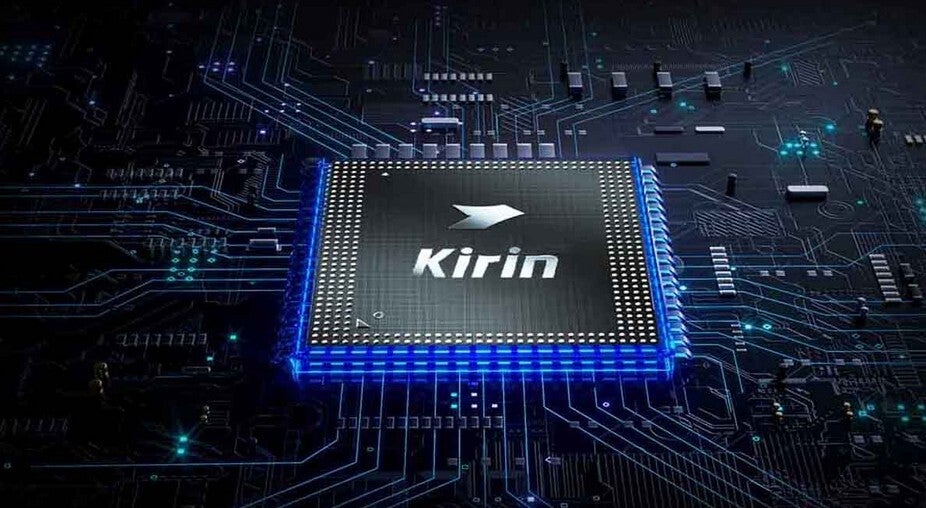
Huawei could equip the Mate 90 series with a powerful and efficient new Kirin processor. | Image by Huawei
While many figured that U.S. sanctions would result in the end of Huawei's smartphone business, the company continues to turn out impressive flagship phones. And Huawei is the global leader in foldables with a top-ranked 48% share of the market.
When the U.S. forced Huawei to stop installing the Google Mobile Services (GMS) version of Android, Huawei initially responded by pre-installing the open source AOSP version of Android with Huawei Mobile Services. The P50 flagship series in 2021 was the first to use Huawei's own HarmonyOS operating system.
Huawei has found a way to succeed despite the U.S. sanctions
Every time the U.S. thought that it had Huawei tied up in the corner, the company was able to escape. Huawei developed its own OS, created its own Huawei Mobile Services ecosystem, and now might be able to design and build advanced chipsets.
Huawei remains innovative, which is borne out by its lead in the foldable market. If you give the company access to the equivalent of cutting-edge chips (the best they can hope for now), the sky just might be the limit for Huawei's smartphone segment once again.


Popular stories

Latest News

Things that are NOT allowed:
To help keep our community safe and free from spam, we apply temporary limits to newly created accounts: