Fixed Wireless Access (FWA) or cellular internet speeds declined for AT&T, T-Mobile, and Verizon subscribers in Q2 and Q3 2025, according to connectivity intelligence company Ookla. It could not be determined whether the drop was due to constrained capacity or seasonal factors.
Lower speeds across the board
AT&T, T-Mobile, and Verizon all use excess capacity on their networks to offer a cable-free broadband internet alternative.
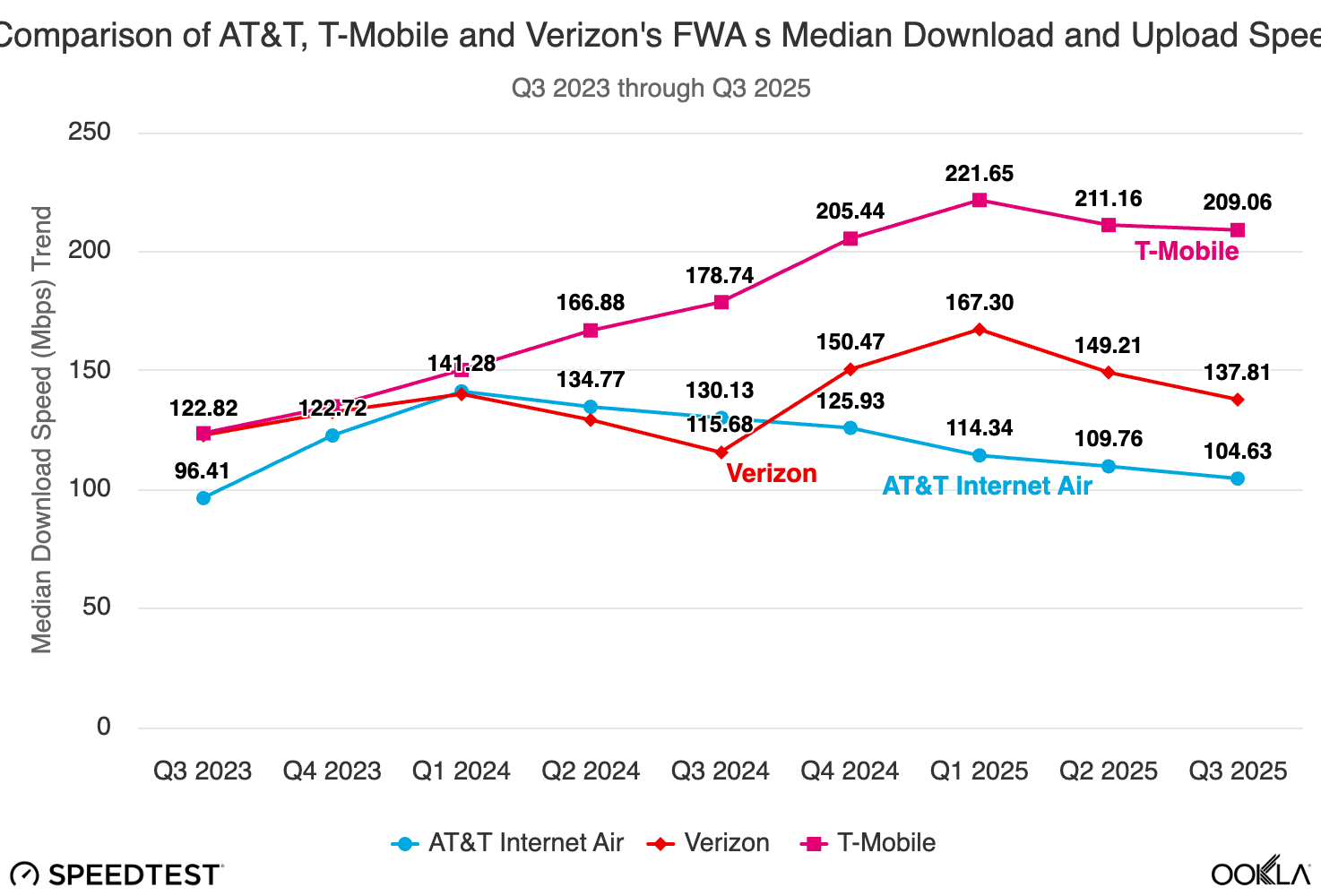
FWA download speeds. | Image Credit - Ookla
Speed tests conducted by Ookla revealed that median download and upload speeds from AT&T, T-Mobile, and Verizon were on the downtick during Q2 and Q3. Median download speeds declined from:
221.65 Mbps in Q1 to 209.06 Mbps in Q3 for T-Mobile
167.30 Mbps in Q1 to 137.81 Mbps in Q3 for Verizon
114.34 Mbps in Q1 to 104.36 Mbps in Q3 for AT&T
Interestingly, Ookla observed a similar trend for Verizon and AT&T during Q2 and Q3 2024. Download speeds bounced back for Verizon users in Q4 2024, but declined further for AT&T subscribers.
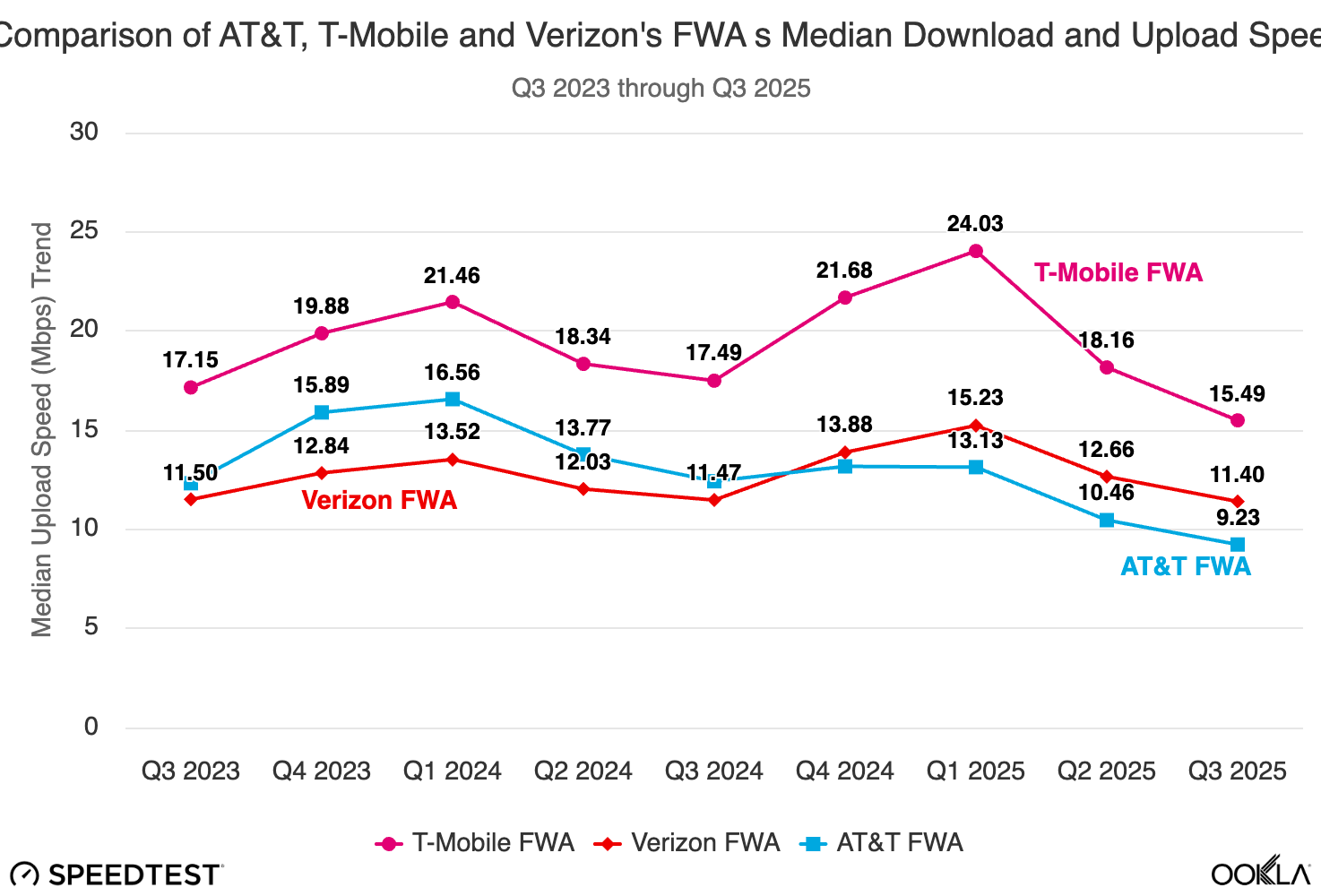
FWA upload speeds. | Image Credit - Ookla
Upload speeds declined from:
24.03 Mbps in Q1 to 15.49 Mbps in Q3 for T-Mobile
15.23 Mbps in Q1 to 11.40 Mbps in Q3 for Verizon
13.13 Mbps in Q1 to 9.25 Mbps in Q3 for AT&T
Recommended For You
There are two possible reasons for lower speeds. The first potential factor is seasonality. During spring and summer, which fall in Q2 and Q3, respectively, trees grow lots of leaves, which can interfere with FWA signals and degrade speeds.
The second factor is network congestion. The influx of 1.04 million new FWA customers in Q3 may have impacted performance as carriers use the same 5G spectrum to serve mobile and FWA customers.
If that is the case, improvements can be expected over time as carriers pick up more spectrum. While the Federal Communications Commission's (FCC) C-band auction is expected in 2027, carriers are already making moves. Verizon is acquiring Starry to use its millimeter wave technology to deliver broadband to multi-dwelling units (MDUs). AT&T recently acquired spectrum from EchoStar and UScellular. T-Mobile purchased 30 percent of UScellular's spectrum in August.
The report also revealed that latency or delay is 50 milliseconds (ms) for T-Mobile users, 54 ms for Verizon subscribers, and 67 ms for AT&T customers. Low latency can improve the gaming and online conferencing experience.
FWA is improving
Wave7 Research Principal Jeff Moore told Fierce Wireless that FWA speeds likely declined due to congestion, "as nothing similar was seen in 3Q24." However, that doesn't mean carriers have exhausted their spectrum, as a December report from New Street Research said that AT&T, T-Mobile, and Verizon could support up to 32 million FWA subscribers. They have only added half of that number so far.
Additionally, Moore says carriers can manage congestion by diverting traffic to fiber and "boosting capacity at individual sites."
How has your FWA experience been?
70 Votes
Splendid.
37.14%
Lacking.
28.57%
Mediocre.
34.29%
T-Mobile is the leader, but AT&T has been getting better
T-Mobile's median download speed of 209.06 Mbps is nearly double that of AT&T. However, the spectrum licenses AT&T has bought from EchoStar cover 400 markets across the US, and the company has already lit up some of the spectrum.
Moore expects AT&T to match or surpass Verizon, with improvements expected in 2026.
Trade in your old phone for cash at ecoATM!
Recycle your used phone and get instant cash. Find out how at ecoATM!
Anam Hamid is a computer scientist turned tech journalist who has a keen interest in the tech world, with a particular focus on smartphones and tablets. She has previously written for Android Headlines and has also been a ghostwriter for several tech and car publications. Anam is not a tech hoarder and believes in using her gadgets for as long as possible. She is concerned about smartphone addiction and its impact on future generations, but she also appreciates the convenience that phones have brought into our lives. Anam is excited about technological advancements like folding screens and under-display sensors, and she often wonders about the future of technology. She values the overall experience of a device more than its individual specs and admires companies that deliver durable, high-quality products. In her free time, Anam enjoys reading, scrolling through Reddit and Instagram, and occasionally refreshing her programming skills through tutorials.
A discussion is a place, where people can voice their opinion, no matter if it
is positive, neutral or negative. However, when posting, one must stay true to the topic, and not just share some
random thoughts, which are not directly related to the matter.
Things that are NOT allowed:
Off-topic talk - you must stick to the subject of discussion
Offensive, hate speech - if you want to say something, say it politely
Spam/Advertisements - these posts are deleted
Multiple accounts - one person can have only one account
Impersonations and offensive nicknames - these accounts get banned
To help keep our community safe and free from spam, we apply temporary limits to newly created accounts:
New accounts created within the last 24 hours may experience restrictions on how frequently they can
post or comment.
These limits are in place as a precaution and will automatically lift.
Moderation is done by humans. We try to be as objective as possible and moderate with zero bias. If you think a
post should be moderated - please, report it.
Have a question about the rules or why you have been moderated/limited/banned? Please,
contact us.





Things that are NOT allowed:
To help keep our community safe and free from spam, we apply temporary limits to newly created accounts: