While AT&T, T-Mobile, and Verizon were busy arguing over who provides the most value (or who masks their price increases the best), the connectivity landscape was changing. Download and upload speeds are no longer reliable metrics for assessing the health of a network. Instead, it's the ability to handle AI workloads, but maybe the Big Three didn't get the memo?
US carriers falling behind global providers
How smoothly an AI app runs depends on upload speeds, how a network performs under stress, and cloud connectivity. To add to the complexity, text-based activity, video generation, and agentic activity all affect the network differently, relying mostly on aspects that traditional speed tests don't even look at.
AI traffic revolves less around capacity and more around how data moves. AI demands fast uploads, a continuous connection, and the ability to process frequent bursts of data instead of long, passive download sessions.
A new Ooklareport analyzed 5G data from 86 telecom operators across 22 markets to assess preparedness for AI workloads. AT&T, T-Mobile, and Verizon are embarrassingly behind.
Latency nightmare
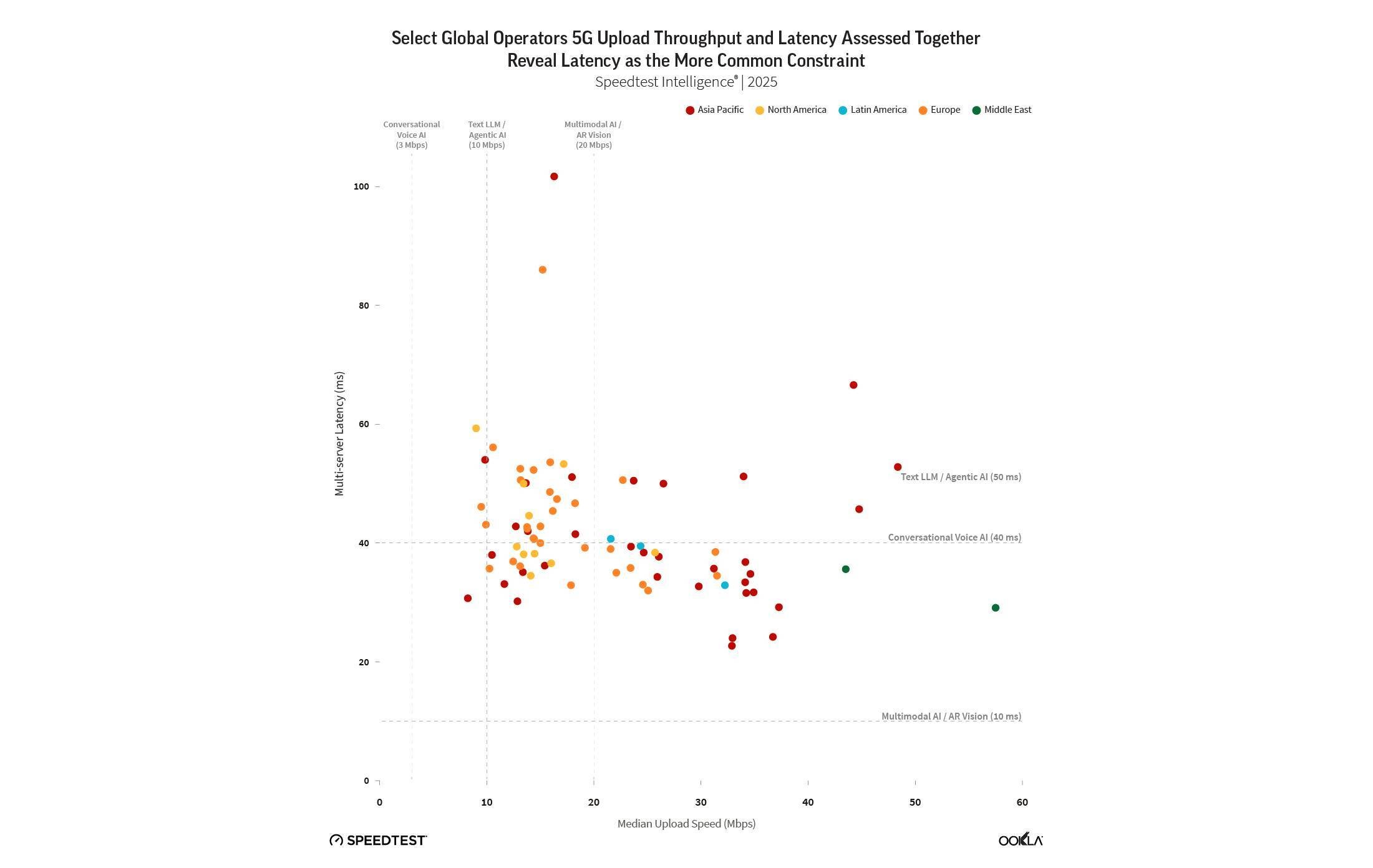
AT&T, T-Mobile, and Verizon need to be more responsive. | Image by Ookla
The report found that latency, or the delay between you doing something and the network responding, influences AI readiness more than download speeds. This explains why networks in Singapore, Malaysia, and Australia respond faster than their Indian counterparts, despite the latter offering fast download speeds.
Recommended For You
And while networks are handling text-based AI just fine, only 13 of the 22 countries tested could meet the under 40 ms latency target required for voice AI. No market meets the sub-10 ms latency target for Augmented Reality (AR) and multimodal vision, meaning they aren't ready for next-level experiences that require processing text, video, audio, and images simultaneously.
The latency situation gets worse under congestion, making baseline low latency even more important.
Upload mismatch
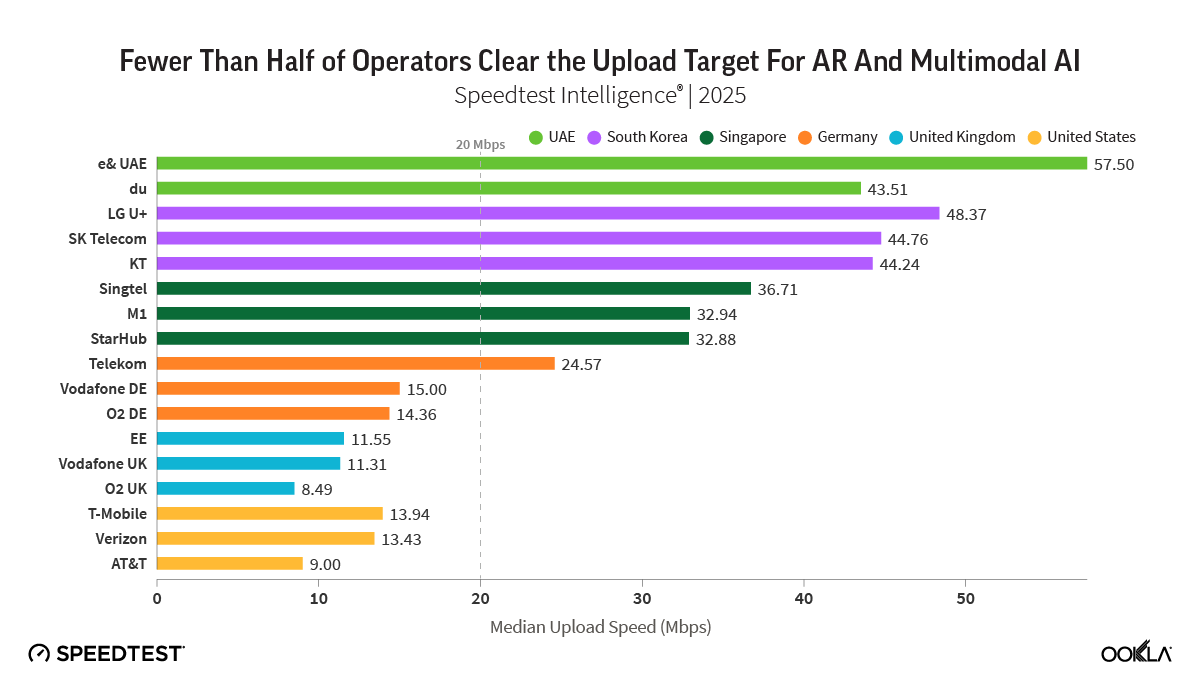
US carriers are also on the lowest rung for upload speeds. | Image by Ookla
Networks were built on the assumption that people consume more data than they produce. With text-based AI traffic, uploads make up 29% of total data volume. For conversational and agentic workloads, it splits evenly with downloads at 50/50.
Meanwhile, operators allocate an inadequate 10% of total network capacity to uploads. Even though upload speeds have been increasing, the throughput mismatch continues.
The US is the worst offender at 5.1%. T-Mobile leads with a median upload speed of 13.94 Mbps, followed closely by Verizon (13.43 Mbps). AT&T is dead last among all carriers tested, with speeds of 9.0 Mbps.
The AI experience also depends on how fast data travels from the the network edge, or the outer boundary of the carrier's network, to the cloud, where AI models live. If there are network jitters, or variation in delays, the whole experience can fall apart.
What do the results say about the Big Three?
55 Votes
They are behind global carriers.
30.91%
They are doing fine for now.
14.55%
They should get to work.
54.55%
Why is T-Mobile ahead in the US?
All three US carriers allocate 20% of their midband spectrum to upload. The difference in speed is due to how the networks are optimized. T-Mobile notably launched 5G-Advanced uplink Tx switching in 2025, which allows devices to dynamically switch between different uplink paths.
T-Mobile is also the only one to meet latency requirements for text-based AI.
Interestingly, 5G SA deployment doesn't guarantee strong latency performance when there is congestion, with T-Mobile recording 653.6 ms, AT&T 682.6 ms, and Verizon 715.5 ms.
The fix
The main reason American carriers trail behind their European counterparts comes down to Time Division Duplex (TDD) spectrum. TDD forces a single frequency band to handle both uplink and downlink, necessitating a trade-off. In the US, upload always loses.
Frequency Division Duplex (FDD) avoids this balancing act by using two separate lanes for uploading and downloading, allowing for a continuous two-way transmission.
A mature, nationwide 5G SA network would address these issues by enabling better uplink scheduling and a wider range of carrier aggregation combinations.
Is your AI experience going to suffer if you are with these carriers? Probably only if you also subscribe to their 5G home internet. If you have cable or fiber, you are probably fine.
Free Galaxy A17 5G with Straight Talk
Get a free Galaxy A17 with Straight Talk. To claim this deal, you need to pair the phone with activation on a Silver Unlimited Plan or higher. This tier costs $45 per month. Offer valid through 01/10/27 while supplies last online.
Anam Hamid is a computer scientist turned tech journalist who has a keen interest in the tech world, with a particular focus on smartphones and tablets. She has previously written for Android Headlines and has also been a ghostwriter for several tech and car publications. Anam is not a tech hoarder and believes in using her gadgets for as long as possible. She is concerned about smartphone addiction and its impact on future generations, but she also appreciates the convenience that phones have brought into our lives. Anam is excited about technological advancements like folding screens and under-display sensors, and she often wonders about the future of technology. She values the overall experience of a device more than its individual specs and admires companies that deliver durable, high-quality products. In her free time, Anam enjoys reading, scrolling through Reddit and Instagram, and occasionally refreshing her programming skills through tutorials.
A discussion is a place, where people can voice their opinion, no matter if it
is positive, neutral or negative. However, when posting, one must stay true to the topic, and not just share some
random thoughts, which are not directly related to the matter.
Things that are NOT allowed:
Off-topic talk - you must stick to the subject of discussion
Offensive, hate speech - if you want to say something, say it politely
Spam/Advertisements - these posts are deleted
Multiple accounts - one person can have only one account
Impersonations and offensive nicknames - these accounts get banned
To help keep our community safe and free from spam, we apply temporary limits to newly created accounts:
New accounts created within the last 24 hours may experience restrictions on how frequently they can
post or comment.
These limits are in place as a precaution and will automatically lift.
Moderation is done by humans. We try to be as objective as possible and moderate with zero bias. If you think a
post should be moderated - please, report it.
Have a question about the rules or why you have been moderated/limited/banned? Please,
contact us.












Things that are NOT allowed:
To help keep our community safe and free from spam, we apply temporary limits to newly created accounts: