T-Mobile-Verizon battle over misleading ad claims continues (T-Mobile responds)
T-Mobile has allegedly failed to comply with NARB recommendations over misleading claims found in some advertisements.
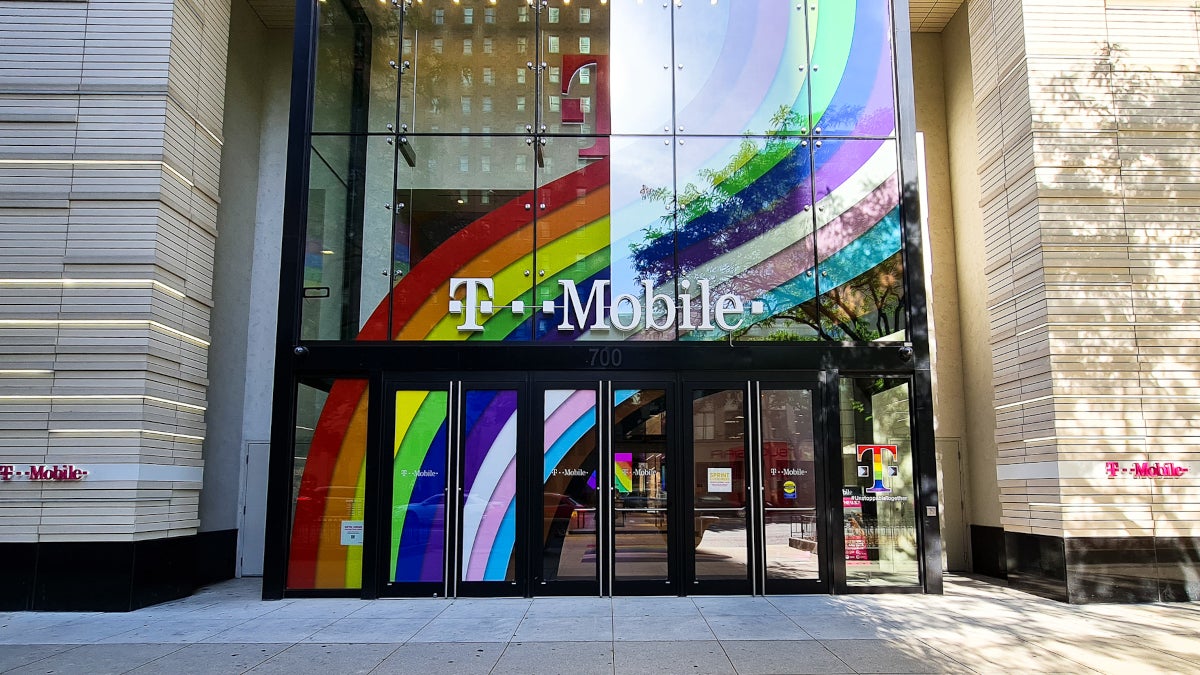
T-Mobile failed to comply with recommendations made by the National Advertising Review Board (NARB) over the carrier's cost savings claims for its cellular service plans made during T-Mobile advertisements. This ruling was made by the NARB, which is the appellate body of BBB National Programs and reviews decisions made by the National Advertising Division (NAD). The original complaint was made to the NAD by T-Mobile competitor Verizon (Case #7415) regarding the former's cost savings claims for its cellular service plans.
T-Mobile appealed NAD's decsion to the NARB
The NAD recommended that T-Mobile stop using certain claims. These claims were made in a brochure titled "Save on Every Plan," in two commercials titled "Top Three Plays of the Day" and "Holidays Are Coming in Hot: Families: Save 20%," on a T-Mobile USA press release, and on T-Mobile’s Savings Calculator website. T-Mobile turned around and appealed NAD’s decision to NARB (NARB Panel #7415-340). In the appeal, the NARB affirmed the decision made by the NAD recommending that T-Mobile stop making the following claims in its ads:
"Families can switch and save 20% vs. the other big guys plans plus streaming services."
"Switch and save versus AT&T and Verizon’s comparable plans plus streaming."
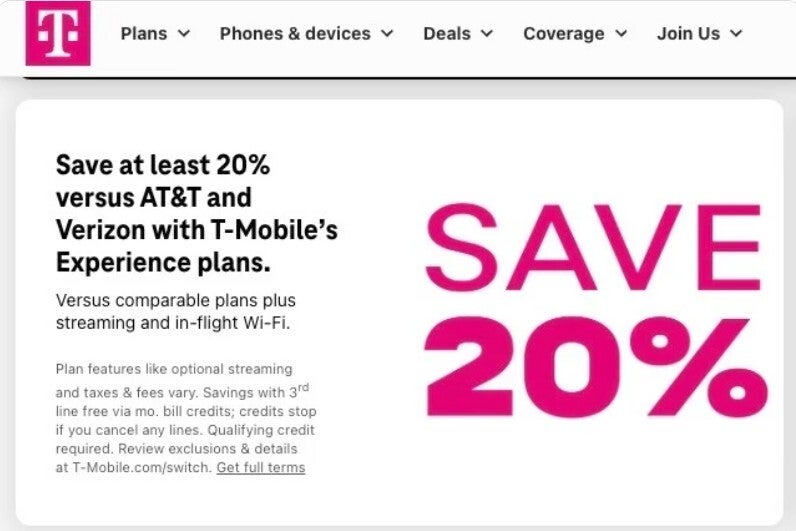
T-Mobile is accused of making misleading claims. | Image credit-T-Mobile
The NARB also felt that T-Mobile should change its advertising in order to eliminate making certain implied claims. The carrier said that it would comply with the decision even though it "disagrees with the panel’s decision." Despite promising to comply with the NARB, T-Mobile's revised advertising, according to Verizon, still conveyed the same misleading message that consumers switching to T-Mobile from Verizon could save 20% through lower plan costs alone.
T-Mobile added a disclaimer to its claims
Verizon requested a compliance inquiry and the NARB started a compliance review. In October 2025, T-Mobile was asked to change the claims under review. Once again, T-Mobile agreed to comply. The latter added a disclaimer after its claim that consumers switching to T-Mobile from Verizon can save 20%. The disclaimer said, "By getting built-in benefits they leave out." Verizon, probably wondering how built-in benefits could mean "lower plan costs alone," demanded a second compliance review which was started by the NARB last month.
"We disagree with the NARB's conclusions. Over the course of this review, we engaged at every stage, carefully reviewing the recommendations and making substantive changes to our advertising that we believe went well beyond minor revisions and reflect the accurate and substantiated savings the Un-carrier delivers. Many T-Mobile customers save more than the advertised 20% through included benefits others charge for, and disagreement from competitors does not change that fact. We continue to set the standard for giving customers more savings and value that adds up to real money in their pockets. While we do not agree with the decision, we take the self-regulatory process seriously and continue to uphold integrity, clarity and transparency when advertising to consumers."
-T-Mobile
T-Mobile responded by saying that it had already made what it called "substantial changes," acted in good faith, and said that the new claims made in its ads were different than the ones that had been reviewed previously. In return, the NARB said that the disclaimers added by T-Mobile were not enough to allow "reasonable consumers" to understand that the T-Mobile- Verizon price comparisons as put forth by T-Mobile in its advertisements included "the cost of ancillary services beyond basic cellular service."
At this point, what could the NARB do but say that T-Mobile did not make a bona fide attempt to comply with the recommendations and decisions in NARB Panel 340, even though it had had more than enough time to do so. Actually, the NARB could have escalated the matter and turned it over to the Federal Trade Commission (FTC), which wields a more lethal spanking belt than the NARB.
Verizon continues to accuse T-Mobile of making a misleading claim about a pricing comparison
But before that could take place, T-Mobile told the NARB that it planned to re-open the proceeding in order to bring to light new substantiations for its claims. And thus, an NAD case that started last May continues to have T-Mobile and Verizon, not to forget the NARB and the NAD, jawing away at each other in an effort to substantiate a claim made by T-Mobile that seems fairly easy to prove or disprove.
The problem is that T-Mobile said n widely disseminated ads that consumers switching to T-Mobile from Verizon can save 20%. Verizon says that this is a misleading claim since it includes the price of some perks awarded to T-Mobile customers such as free Netflix or Hulu streaming. Verizon says that a reasonable consumer expects savings from a carrier to mean a lower phone bill, not a bundle of perks.
The pair had squared off in June 2025 when T-Mobile accused Verizon of misleading consumers by calling itself "America’s Largest Network." Verizon based this on the number of postpaid subscribers it had. T-Mobile claimed that the largest carrier should refer to the one with the largest geographic coverage, an area where T-Mobile had been making huge strides. The NAD's ruling forceds Verizon to specifically state that when it claims to be the nation's largest wireless carrier, it is referring to subscriber count and not geographic coverage.


Popular stories





Latest News


Things that are NOT allowed:
To help keep our community safe and free from spam, we apply temporary limits to newly created accounts: