T-Mobile Essentials Saver 2.0 is the cheapest postpaid plan T-Mobile will sell you directly, at $55 a month for one line, or $50 if you let them AutoPay it out of a debit card or bank account. That puts it in the same bracket as AT&T's $50 entry plan and just above Verizon's $45 Simplicity, but the three are not offering the same thing at all. It runs on the same network as the $105 flagship, with the same towers and the same coverage map. This is the plan for someone who wants real T-Mobile service, not an MVNO renting space on it, and is willing to give up every perk to get there.
Everything you get for $50
Pricing is simple, mostly because there is not much of it:
1 line: $55 a month, or $50 with AutoPay
2 lines: $90 a month, or $80 with AutoPay
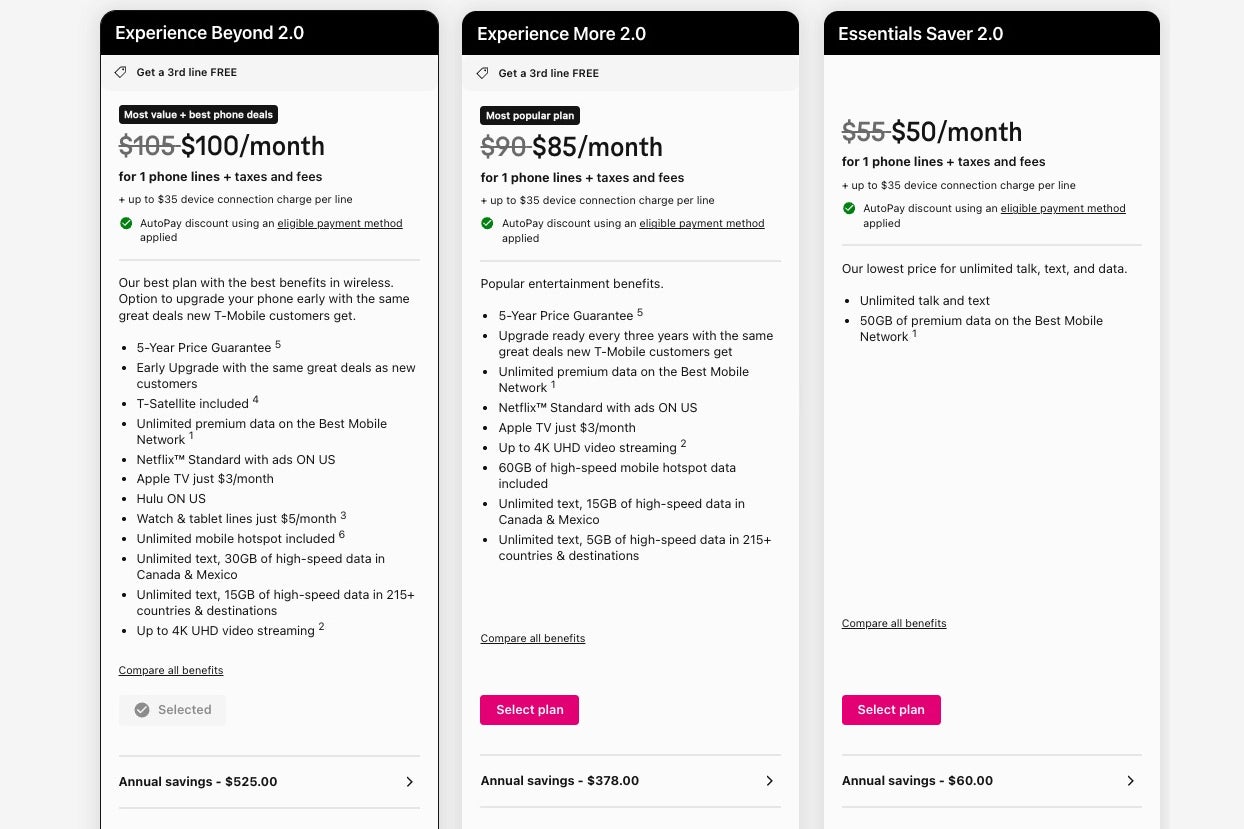
The gap between the cheapest plan and the flagship is mostly a list of things Essentials Saver does not get. | Image by T-Mobile
That is the whole table. Essentials Saver caps out at two lines, so families are out of scope entirely and need to look at Essentials 2.0 instead, which starts at $65 and scales to five. T-Mobile is also running a free third line on Experience Beyond 2.0 and Experience More 2.0 right now, which is not something this plan can take. Here is what the money buys:
Unlimited talk, text and data on T-Mobile's own 5G and LTE network
50 GB of premium data before you get deprioritized on busy towers
Unlimited mobile hotspot, but capped at 3G speeds of roughly 600 kbps
Unlimited talk and text in Canada and Mexico, with data at up to 128 kbps
Free texting to 210+ countries
Scam Shield and T-Mobile Tuesdays
Recommended For You
The 50 GB figure is the one that matters, and it is more generous than it sounds. AT&T's $50 Value 2.0 plan gives you 5 GB of premium data before the same treatment, so T-Mobile is handing you ten times the priority allowance at the same price. Most people never come close to 50 GB in a month, which means most people on this plan are never deprioritized at all.
What you give up is everything else. There are no streaming perks, no Netflix or Hulu, no included international data, and T-Satellite is a $10 monthly add-on rather than something bundled in. If you want to make an actual phone call to another country, the Stateside International Talk feature costs $15 a month on top.
The fine print: taxes, fees and limits
Taxes and fees are not included. T-Mobile charges $4.49 per line in Regulatory Programs and Telco Recovery fees, plus federal and local surcharges that typically run $0.36 to $4.79 per line, so budget around $56 to $60 all in.
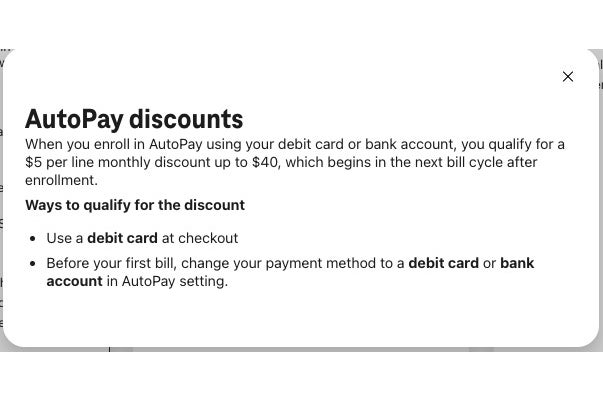
The $50 rate requires AutoPay with an eligible payment method. A credit card does not qualify, so it is a debit card or a bank account, and without it you are paying $55.
Deprioritization is how this plan is different from the expensive ones. After 50 GB you are not cut off or throttled to a fixed speed, you are simply served after higher-tier customers when a tower is congested. On an empty tower at 2am you would not notice.
If you do hit the ceiling and want it lifted, another 50 GB of premium data costs $35, which is most of a second month of service.
Video is capped at 480p permanently, not just after the threshold. That is a carrier policy rather than a network limit, and it applies to every stream on every day of the month.
The hotspot is technically unlimited and practically decorative. At roughly 600 kbps it will load a webpage and nothing else, so treat this as a plan with no tethering rather than one with slow tethering.
Typical speeds run 127 to 455 Mbps down and 6 to 33 Mbps up, slightly below what T-Mobile quotes for its top plans.
There is a $35 device connection charge per line at activation, though the early termination fee is $0.
T-Mobile's $5 per line discount only applies if you hand over a debit card or bank account. | Image by T-Mobile
None of that is hidden, which is worth something. T-Mobile publishes all of it on the plan's own broadband label, and the tradeoffs are the point of the plan rather than a surprise buried in it.
T-Mobile has the largest 5G footprint in the country and generally the fastest speeds, and buying the cheapest plan does not put you on a lesser version of it. The network held up worse than usual this summer, though. It went down on July 27, T-Mobile said it was fixed by July 28, and then a fresh round of problems hit East Coast states and cities on July 30.
The bigger concern is what the company has been doing to existing customers. We covered the forced migration off grandfathered plans like Simple Choice, ONE and Magenta, which moved roughly 8 million people onto modern plan variants at up to $6 more per line.
One 71-year-old customer took his case to the FCC over it, and analysts still expect most affected customers to stay put rather than switch.
That history matters more on a budget plan than on a flagship one, because the people who pick the cheapest tier are the people least able to absorb a surprise increase. Onboarding itself is easy, with eSIM support and broad bring-your-own-phone compatibility. The plan is not a limited-time offer, but T-Mobile has a habit of closing plans to new customers and moving everyone along eventually.
What is the competition up to?
Three plans sit close to this one, and they come at it from different directions:
Verizon Simplicity, $45 a month with AutoPay, or $55 without. Unlimited premium data with no threshold at all, 10 GB of hotspot, 720p video and taxes on top.
AT&T Unlimited Value 2.0, $50 a month. Just 5 GB of premium data, 3 GB of hotspot, 480p video and taxes on top.
Visible and US Mobile Unlimited Starter, both $25 a month with taxes included, and Visible spends most of the year discounted to $19 with a code. Visible runs on Verizon with unlimited hotspot at slow speeds, and US Mobile lets you pick between all three networks with 20 GB of hotspot.
Sorting the wins: the MVNOs are half the price with taxes already inside, Verizon Simplicity gives you unlimited premium data for $5 less than this, and AT&T's entry plan is the one Essentials Saver clearly beats on the strength of that 50 GB allowance.
There is a fourth option, and it is T-Mobile's own. We covered how the carrier has been quietly selling a Super Essentials Saver plan inside Walmart stores since August 6, at $25 a month with AutoPay or $30 without, carrying the same 50 GB of premium data, the same 3G hotspot and the same Canada and Mexico coverage as the plan you are reading about.
The catches are real. It is in-store only, new accounts only, capped at two lines, and the signage calls it limited time. Still, it is the same service on the same network for half the money, and T-Mobile never announced it anywhere.
The cons follow the same lines. The MVNOs put you behind every postpaid customer on the network whenever a tower gets busy, which is the whole reason they can charge $25. Verizon's 10 GB hotspot ceiling is small but still ten times more usable than 600 kbps. AT&T is charging the same money for a tenth of the priority data.
If price is genuinely the only thing driving the decision, US Mobile at $25 with taxes included is still the cleanest buy, since it does not care whether you are a new customer or how far you live from a Walmart. But if you are switching to T-Mobile anyway and there is one nearby, paying $50 directly for a plan sitting on a shelf at $25 is a hard thing to talk yourself into.
The verdict
T-Mobile Essentials Saver 2.0, $55 a month for one line, or $50 with AutoPay.
Pros:
Real T-Mobile postpaid service on the country's largest 5G network
50 GB of premium data, ten times what AT&T gives you at the same price
No contract, no early termination fee and no data overage charges
Every limitation is published up front on the plan's broadband label
Cons:
The hotspot is 600 kbps, which is not usable for anything real
Video is locked at 480p on every stream, all month
No perks, no included international data, and T-Satellite costs $10 extra
Capped at two lines, and excluded from T-Mobile's best device deals
Is it a good pick? For the right person, yes. If you are on Wi-Fi most of the day, you do not tether, and you have made peace with 480p video, this is a clean way to get genuine T-Mobile priority for around $56 all in. If any of those three is not true, you are paying postpaid prices for a plan that behaves like a budget one.
What I keep coming back to is that $25 gap between this and a good MVNO. I have spent the last couple of years switching carriers on a single line looking for exactly this kind of value, and the honest answer is that priority data on a busy tower is real and most people will never notice it. That is a strange thing to pay $300 a year for.
Mint Mobile is now allowing you to get whichever plan you like for either three, six, or 12 months for just $15/mo. If you go for the six-month unlimited service, for instance, you'll now have to pay just $90 upfront instead of $210.
Johanna Romero is a Senior News Writer at PhoneArena, covering mobile technology news across Android, iOS, wearables, and the Google ecosystem she knows best. Drawing on 15 years in IT and tech support from 2007 to 2022, she brings a user-friendly eye for the practical features and lesser-known tricks readers care about. Google named her an official #TeamPixel member in 2022, and she also reviews the latest devices on her YouTube channel, JoJo the Techie.
A discussion is a place, where people can voice their opinion, no matter if it
is positive, neutral or negative. However, when posting, one must stay true to the topic, and not just share some
random thoughts, which are not directly related to the matter.
Things that are NOT allowed:
Off-topic talk - you must stick to the subject of discussion
Offensive, hate speech - if you want to say something, say it politely
Spam/Advertisements - these posts are deleted
Multiple accounts - one person can have only one account
Impersonations and offensive nicknames - these accounts get banned
To help keep our community safe and free from spam, we apply temporary limits to newly created accounts:
New accounts created within the last 24 hours may experience restrictions on how frequently they can
post or comment.
These limits are in place as a precaution and will automatically lift.
Moderation is done by humans. We try to be as objective as possible and moderate with zero bias. If you think a
post should be moderated - please, report it.
Have a question about the rules or why you have been moderated/limited/banned? Please,
contact us.












Things that are NOT allowed:
To help keep our community safe and free from spam, we apply temporary limits to newly created accounts: