Rumored T-Mobile misstep could be its undoing
T-Mobile has more to lose than gain from a potential merger with its German owner.
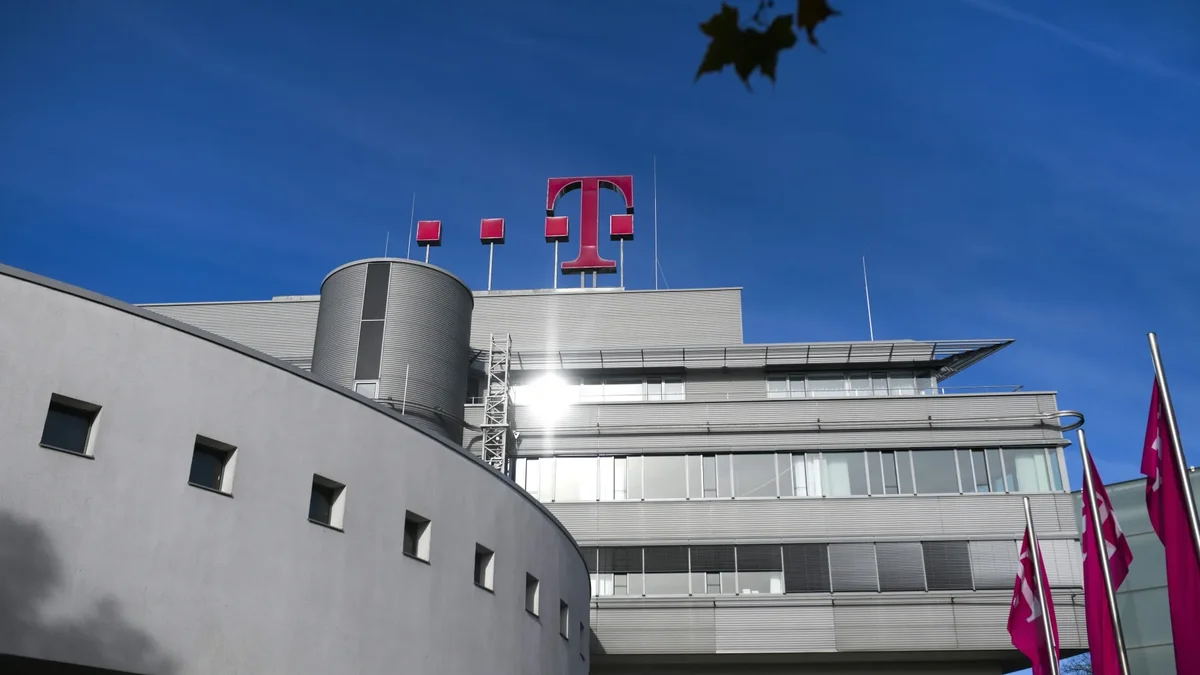
Deutsche Telekom headquarters in Germany. | Image by Bloomberg
T-Mobile parent Deutsche Telekom (DT) is reportedly eyeing a full integration with it. While the German-based company holds a 53% stake, the two currently operate as separate entities. Merging them might create a global telecom titan, but DT stands to gain more from the transaction.
Seeking Alpha isn't buying the consolidation rumors, and for good reason.
If stock market movements are any indication, T-Mobile has been underperforming its peers for 8 months. Despite that, its growth potential remains strong, provided it doesn't get dragged back under DT's wing.
DT entered the US in 2001 with its $56 billion acquisition of VoiceStream Wireless, which was rebranded to T-Mobile. A decade later, T-Mobile USA was bleeding subscribers and DT unsuccessfully attempted to offload it to AT&T.
While a merger would give the German company a lift, the stock price of the combined entity would likely tank as wary investors jump ship.
Moreover, while the merger would create a bigger company, it wouldn't make it more efficient. Despite both being telecom companies, T-Mobile and DT are hardly alike, due to the difference in the markets they operate in. The different landscape, regulatory frameworks, and legal systems mean that there are likely a few overlapping roles, so the companies would not save on costs by merging.
T-Mobile also doesn't need DT to raise capital, as it's financially strong enough as an independent company.
The last eight months may have been tough, but T-Mobile's fixed-wireless service, rural expansion, and customer service automation could help put it back on track.
Embroiling itself in a messy, cross-continental merger would invite lawsuits and shift focus away from core operations.
While DT may want to ride on T-Mobile's coattails, the latter will only be weighed down by the consolidation.
The student has outpaced the master
Seeking Alpha isn't buying the consolidation rumors, and for good reason.
DT entered the US in 2001 with its $56 billion acquisition of VoiceStream Wireless, which was rebranded to T-Mobile. A decade later, T-Mobile USA was bleeding subscribers and DT unsuccessfully attempted to offload it to AT&T.
T-Mobile was eventually merged with the publicly-listed MetroPCS in 2013. It's now the second-largest carrier in the US. It has a bigger market value than its parent and generates the lion's share of DT's profit.
T-Mobile is two-thirds of the market value of Deutsche Telekom. The reason it is the best performing European telco is because of T-Mobile.
Roger Entner, Recon Analytics analyst, April 2026
Not the answer to DT’s problems
T-Mobile also doesn't need DT to raise capital, as it's financially strong enough as an independent company.
They have always wanted to bring this in-house.
Roger Entner, Recon Analytics analyst, April 2026
Not the answer to T-Mobile's problems either
Despite recent bumps, T-Mobile has a profitable path to growth
The pressure on T-Mobile's stock began building up after AT&T and SpaceX purchased spectrum from EchoStar.
T-Mobile's initial growth was fueled by its stellar customer service and disruptive moves. After it acquired Sprint, a triopoly was created. To protect its turf, T-Mobile has started leaning on the carrier playbook of raising rates and blocking competition by hoarding spectrum.
T-Mobile — and AT&T and Verizon, for that matter — aren't interested in the kind of margin-sapping competition that was seen during the John Legere Un-Carrier era. T-Mobile is instead exploring other growth avenues, such as home internet, which threaten cable companies like Comcast and Charter.
Thus, T-Mobile's lower stock prices aren't a cry for help from DT. Instead, it's a sign that the competitive spirit needs to be revived.
Competition from Verizon and cable companies is hampering T-Mobile's growth. Investors probably saw that as a sign that T-Mobile would reduce prices, hence the stock decline.
Meanwhile, the company is pursuing workforce reduction by moving toward a self-service model centered on the T-Life app. Some of the customer apathy appears to be a result of this relentless digitalization push. As the app improves over time, this could prove to be a smart move.
The pressure on T-Mobile's stock began building up after AT&T and SpaceX purchased spectrum from EchoStar.
T-Mobile's initial growth was fueled by its stellar customer service and disruptive moves. After it acquired Sprint, a triopoly was created. To protect its turf, T-Mobile has started leaning on the carrier playbook of raising rates and blocking competition by hoarding spectrum.
Thus, T-Mobile's lower stock prices aren't a cry for help from DT. Instead, it's a sign that the competitive spirit needs to be revived.
Competition from Verizon and cable companies is hampering T-Mobile's growth. Investors probably saw that as a sign that T-Mobile would reduce prices, hence the stock decline.
Meanwhile, the company is pursuing workforce reduction by moving toward a self-service model centered on the T-Life app. Some of the customer apathy appears to be a result of this relentless digitalization push. As the app improves over time, this could prove to be a smart move.
What would be the impact of a DT and T-Mobile merger?
110 Votes
More monopolistic power.
34.55%
Better operations.
6.36%
Worse service.
59.09%
T-Mobile can still thrive
The last eight months may have been tough, but T-Mobile's fixed-wireless service, rural expansion, and customer service automation could help put it back on track.
Embroiling itself in a messy, cross-continental merger would invite lawsuits and shift focus away from core operations.
While DT may want to ride on T-Mobile's coattails, the latter will only be weighed down by the consolidation.
No time like the current
The timing is suspicious. President Donald Trump is more likely to approve deals than any other president. Srini Gopalan, who replaced Mike Sievert in November, headed DT Germany before joining T-Mobile as chief operating officer in March.
DT sending one of its own to the US suggests it has been planting the seeds for this takeover for a while.
Srini was sent here to bring the whole thing much closer to the US.
Roger Entner, Recon Analytics analyst, April 2026


Popular stories



Latest News



Things that are NOT allowed:
To help keep our community safe and free from spam, we apply temporary limits to newly created accounts: