T-Mobile takes the lead on a new breed of networks
T-Mobile wants AI to orchestrate its network to deliver a seamless experience for its customers.
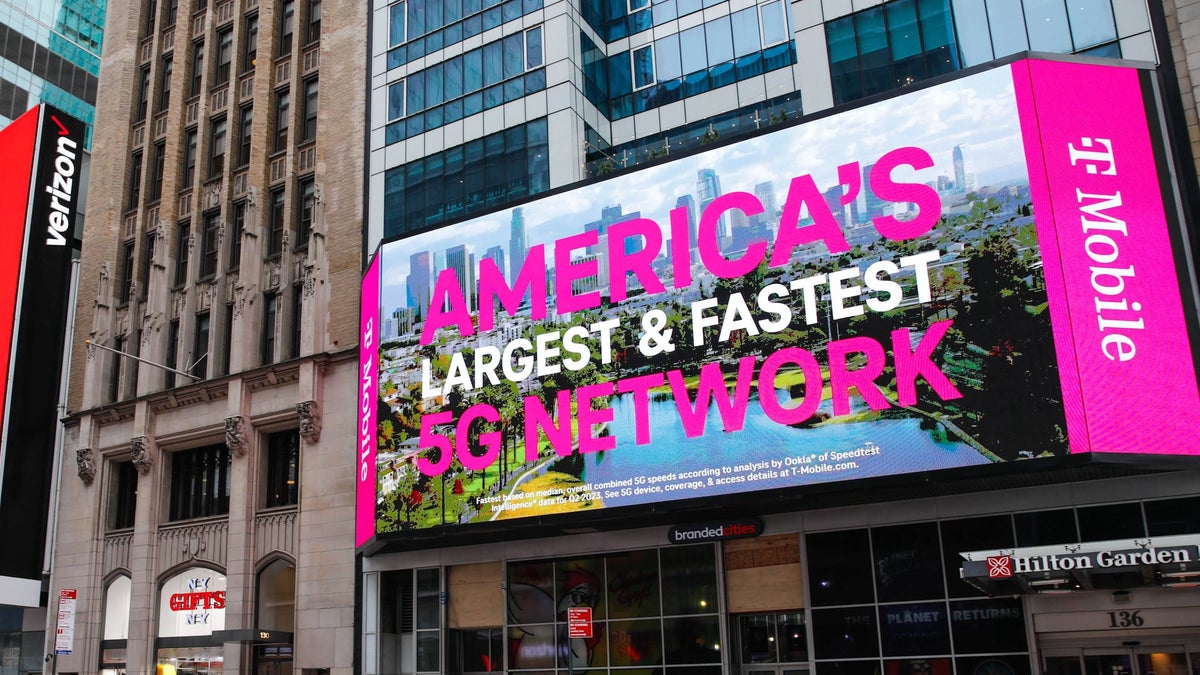
T-Mobile wants to ensure continuous connectivity for customers. | Image by PCMag
T-Mobile's reputation as an affordable provider might be getting increasingly contentious, but nobody can question its grip on technology. As the only carrier to turn on a 5G Advanced network, T-Mobile is now exploring ways to push the boundaries of network autonomy.
T-Mobile's Chief Network Officer, Ankur Kapoor, recently sat down with Fierce Wireless at DTW Ignite 2026.
The conversation centered around autonomous networks, a new breed of connectivity that can observe, adapt, and make decisions without human supervision. T-Mobile wants to move beyond automating the core, radio access network, and IP infrastructure and extend it to the customer experience.
The goal is not just to achieve operational efficiency, but also to fix customer pain points.
T-Mobile is already executing the vision it has for its network. One example is Dynamic CX, an AI-driven capability introduced last month that helps the network adapt in real time as demand shifts. That's crucial during events such as football matches, where thousands of people uploading the same clip can bring a network to its knees. It builds on the company's Self-Organizing Network (SON) tech, which continuously monitors and tweaks performance.
The beauty of the tech lies in its ability to improve service without a customer having to spell out the problem.
Another area of focus is network slicing, which carves up the network into multiple virtual lanes tailored to specific needs. T-Mobile has deployed 20 network slices so far, including at major events.
The company wants to create dynamic slices next, which would give customers specialized connectivity services without requiring extensive manual intervention from it.
While T-Mobile's massive 5G lead over AT&T and Verizon has started to normalize, the company still has a chance to maintain or extend it. That becomes vital as satellite threats from SpaceX and Amazon loom on the horizon.
Kapoor boasted about the company's enviable low- and mid-band spectrum position, which balances capacity and reach. The ability to keep up with the demands of an overflowing stadium crowd is something SpaceX can't pull off right now.
Of course, the average customer doesn't spend their life living in a stadium or auditorium. While T-Mobile's efforts are commendable, most customers are unlikely to experience them frequently enough to derive any true value from them. Still, if there is one company you can rely on to have your back at a crowded event, it's T-Mobile.
A truly autonomous network
T-Mobile's Chief Network Officer, Ankur Kapoor, recently sat down with Fierce Wireless at DTW Ignite 2026.
The conversation centered around autonomous networks, a new breed of connectivity that can observe, adapt, and make decisions without human supervision. T-Mobile wants to move beyond automating the core, radio access network, and IP infrastructure and extend it to the customer experience.
Already on it
T-Mobile is already executing the vision it has for its network. One example is Dynamic CX, an AI-driven capability introduced last month that helps the network adapt in real time as demand shifts. That's crucial during events such as football matches, where thousands of people uploading the same clip can bring a network to its knees. It builds on the company's Self-Organizing Network (SON) tech, which continuously monitors and tweaks performance.
Another area of focus is network slicing, which carves up the network into multiple virtual lanes tailored to specific needs. T-Mobile has deployed 20 network slices so far, including at major events.
The company wants to create dynamic slices next, which would give customers specialized connectivity services without requiring extensive manual intervention from it.
Is T-Mobile the connectivity king?
357 Votes
No one even comes close to T-Mobile in connectivity.
35.57%
All three are pretty good.
25.21%
Even MVNOs are fine.
39.22%
The technological edge
While T-Mobile's massive 5G lead over AT&T and Verizon has started to normalize, the company still has a chance to maintain or extend it. That becomes vital as satellite threats from SpaceX and Amazon loom on the horizon.
We do have the best spectrum position in the country.
Ankur Kapoor, T-Mobile's Chief Network Officer, July 2026
The reality check
Of course, the average customer doesn't spend their life living in a stadium or auditorium. While T-Mobile's efforts are commendable, most customers are unlikely to experience them frequently enough to derive any true value from them. Still, if there is one company you can rely on to have your back at a crowded event, it's T-Mobile.


Things that are NOT allowed:
To help keep our community safe and free from spam, we apply temporary limits to newly created accounts: