It doesn't matter whether you're on AT&T, T-Mobile or Verizon – all of the country's best telcos are bound to alter and your phone service will change.
I'm not talking about price hikes, although that's a future we can't escape (we're already living it).
I'm talking about the extraterrestrial side of things.
Changes from above
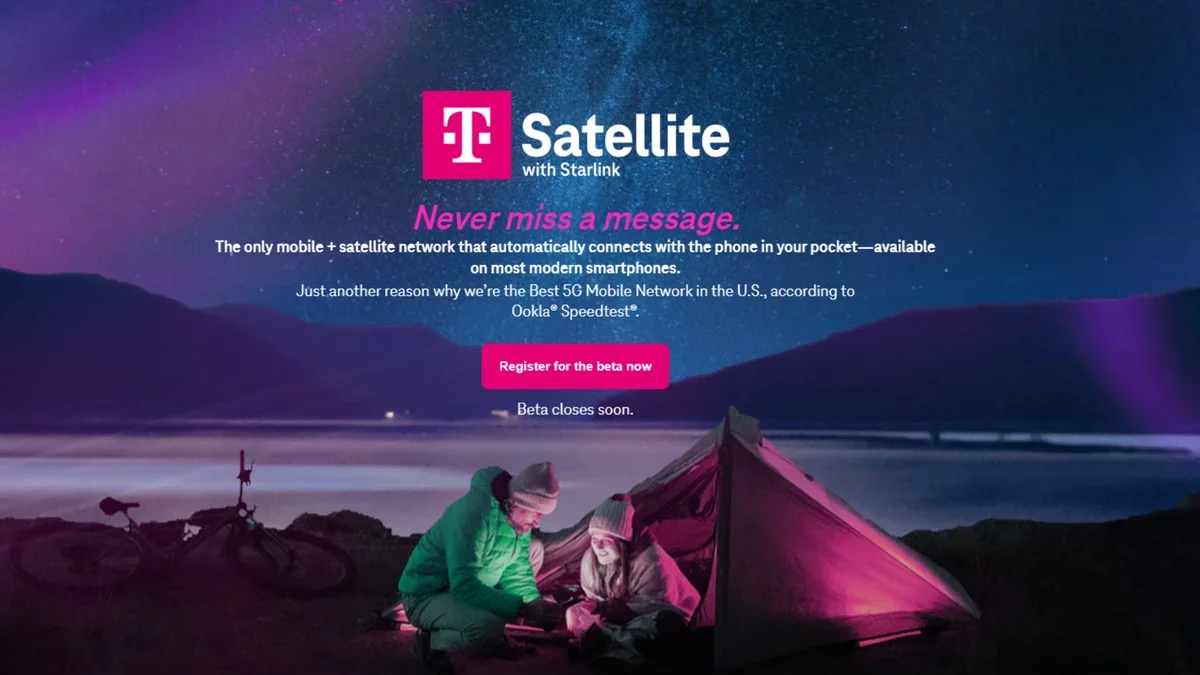
T-Mobile already launched T-Satellite in partnership with Starlink. | Image by T-Mobile
There's a new update by GSMA, the global industry organization representing the interests of mobile network operators and companies. It focuses on one of the most significant changes coming to smartphones: satellite connectivity.
According to the report, SpaceX's headline-producing IPO valuation shows that investors believe Starlink isn't planning to stay a niche satellite internet provider. Instead, the company is expected to compete directly with traditional mobile carriers you and I know so well… especially as satellite services and AI-powered connectivity get hyped even further.
Honestly, how often do you need satellite connectivity?
164 Votes
Almost never.
73.17%
Once or twice per year.
13.41%
Once a month, maybe.
4.88%
All the time!
8.54%
They're not giving it up
Naturally, phone carriers aren't standing still.
Around the world, 132 telecom companies already offer some form of satellite service and partnerships between carriers and satellite providers continue to grow.
But the recent announcement that AT&T, Verizon and T-Mobile are creating a joint satellite venture is maybe the clearest sign yet that carriers want to stay in control of this new technology instead of relying entirely on outside companies. The SpaceX CEO Elon Musk, the world's richest man, should expect a pushback from the Big 3.
Recommended For You
GSMA's report goes on to highlight that by working together on a shared satellite network, the three US carriers can lower costs, have more influence over future satellite technology and avoid depending on a single satellite operator.
This is a smart move, since they want satellites to become another part of their own networks rather than handing that responsibility over to companies like SpaceX.
On a bigger scale
This strategy could also benefit satellite companies such as AST SpaceMobile. Although its planned satellite network will be much smaller than those of Starlink or Amazon, AST already has dozens of planned partnerships with telecom operators and could play the role of a neutral infrastructure provider for carrier-backed satellite projects.
Billions of people would access satellite phone services
The GSMA also estimates that more than 6 billion people could eventually have access to satellite-enabled mobile services through existing and future partnerships. China and India represent the largest potential markets because of their populations, while satellite coverage is also expanding across Europe and Latin America.
Governments are also paying attention to who controls these satellite networks. The report notes that many European countries want to protect their communications infrastructure and reduce dependence on major US and Chinese technology companies.
Free Galaxy A17 5G with Straight Talk
Get a free Galaxy A17 with Straight Talk. To claim this deal, you need to pair the phone with activation on a Silver Unlimited Plan or higher. This tier costs $45 per month. Offer valid through 01/10/27 while supplies last online.
Sebastian is one of PhoneArena’s senior opinionators. A veteran news writer with almost 20 years of experience in media and technology, he not only covers all the hot news about Galaxies and iPhones, but often provides hot takes on industry trends. He’s fascinated with camera-focused flagships from the likes of Oppo and Vivo, as well as foldable phones.
A discussion is a place, where people can voice their opinion, no matter if it
is positive, neutral or negative. However, when posting, one must stay true to the topic, and not just share some
random thoughts, which are not directly related to the matter.
Things that are NOT allowed:
Off-topic talk - you must stick to the subject of discussion
Offensive, hate speech - if you want to say something, say it politely
Spam/Advertisements - these posts are deleted
Multiple accounts - one person can have only one account
Impersonations and offensive nicknames - these accounts get banned
To help keep our community safe and free from spam, we apply temporary limits to newly created accounts:
New accounts created within the last 24 hours may experience restrictions on how frequently they can
post or comment.
These limits are in place as a precaution and will automatically lift.
Moderation is done by humans. We try to be as objective as possible and moderate with zero bias. If you think a
post should be moderated - please, report it.
Have a question about the rules or why you have been moderated/limited/banned? Please,
contact us.












Things that are NOT allowed:
To help keep our community safe and free from spam, we apply temporary limits to newly created accounts: