AT&T is one step closer to its dream years-long effort to retire its aging copper phone network, as the Federal Communications Commission (FCC) has approved the next step of the carrier's transition for roughly 184,000 customers in California.
Ma Bell will be replacing decades-old landline infrastructure with fiber and wireless-based alternatives, although the process is far from over.
There's some time left
The telco will enforce the shift gradually. | Image by AT&T
Under the plan, customers who still rely on copper-based phone service will be able to keep using it until it is officially discontinued on or after June 1, 2027. The telco says those customers will instead be moved to AT&T Phone-Advanced, a service that works over fiber or wireless networks while remaining compatible with traditional home telephones, fax machines, security systems and medical monitoring devices.
The carrier stressed that the transition will take about a year and will only happen in places where reliable wireless or fiber service is already available. According to AT&T, no customer will lose access to voice calling or 911 services, and rural communities without dependable coverage won't be affected.
When was the last time you used a traditional phone line?
29 Votes
Can't even remember, probably more than 10 years ago.
62.07%
It's been 5 years or so.
20.69%
I did it last year.
3.45%
Today.
13.79%
Months of disputes
Earlier this year, the company sued the California Public Utilities Commission (CPUC), arguing that outdated state rules force it to maintain an expensive copper network that hardly any people still use. AT&T has also asked the FCC to rule that California's requirements conflict with newer federal policies designed to speed up the retirement of legacy phone networks.
Recommended For You
California, however, sees things differently (as it is often the case).
State officials argue they have never prevented carriers from replacing copper with fiber and accuse AT&T of misrepresenting the state's position. Regulators say California has supported fiber deployments for years and insist it isn't forcing carriers to preserve outdated technology forever.
Who uses traditional phone lines?
According to AT&T, only about 3% of the homes it serves in California still use traditional landline service. Despite that small number, the company estimates it spends around $1 billion every year maintaining the aging network, money that would surely be better invested in other things.
The company says shutting down most of its copper infrastructure in California could save roughly 300 million kilowatt-hours of electricity every year by 2030. Many Californians love to hear about energy cuts, so that's a good move by AT&T's PR team.
More investments
AT&T has also promised to invest $19 billion in California through the end of the decade. That plan includes expanding its fiber network to more than 9 million homes and businesses across the state and adding about 1,200 new cell sites.
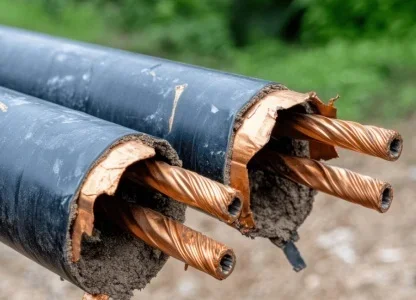
Beyond it all, there's another reason that many believe copper's time has passed long ago: theft.
By the end of 2025, AT&T had recorded more than 10,400 copper theft incidents across the US, causing over $82 million in damage. California accounted for more than 7,300 of those cases and roughly $54 million in losses, making it the hardest-hit state. That's because California still has copper left.
AT&T says organized theft has become so widespread that keeping the old network running is no longer just expensive because of maintenance, but because criminals repeatedly target copper cables.
Taken together, aging infrastructure, rising maintenance costs, widespread copper theft and the rapid expansion of fiber networks all point in the same direction. The question is no longer whether copper telephone lines will disappear, but how quickly regulators and carriers can agree on the path forward.
Mint Mobile's 6-month plans now cost $10/mo
$10
/mo
$35
$25 off (71%)
Mint Mobile is celebrating its 10-year anniversary with a special offer on its six-month subscription plans. For a limited time, you can get your preferred tier (6GB, 17GB, 23GB or unlimited) for just $10/mo. That saves you between 50% and 71% on the carrier's mobile plans, making it way easier to recommend.
Sebastian is one of PhoneArena’s senior opinionators. A veteran news writer with almost 20 years of experience in media and technology, he not only covers all the hot news about Galaxies and iPhones, but often provides hot takes on industry trends. He’s fascinated with camera-focused flagships from the likes of Oppo and Vivo, as well as foldable phones.
A discussion is a place, where people can voice their opinion, no matter if it
is positive, neutral or negative. However, when posting, one must stay true to the topic, and not just share some
random thoughts, which are not directly related to the matter.
Things that are NOT allowed:
Off-topic talk - you must stick to the subject of discussion
Offensive, hate speech - if you want to say something, say it politely
Spam/Advertisements - these posts are deleted
Multiple accounts - one person can have only one account
Impersonations and offensive nicknames - these accounts get banned
To help keep our community safe and free from spam, we apply temporary limits to newly created accounts:
New accounts created within the last 24 hours may experience restrictions on how frequently they can
post or comment.
These limits are in place as a precaution and will automatically lift.
Moderation is done by humans. We try to be as objective as possible and moderate with zero bias. If you think a
post should be moderated - please, report it.
Have a question about the rules or why you have been moderated/limited/banned? Please,
contact us.







Things that are NOT allowed:
To help keep our community safe and free from spam, we apply temporary limits to newly created accounts: