AT&T is taking on phone scammers in a new way – with a digital AI assistant that can answer your calls for you.
AT&T tests new AI digital receptionist
Having AI screen calls is quickly becoming the norm, and AT&T is also stepping into the game. The carrier is piloting a new digital receptionist, rolling out to select customers throughout the year.
AT&T already offers tools like its ActiveArmor spam and scam filters, but this experiment takes things further. Instead of just blocking sketchy numbers, the digital receptionist actually talks to callers to figure out what’s going on.
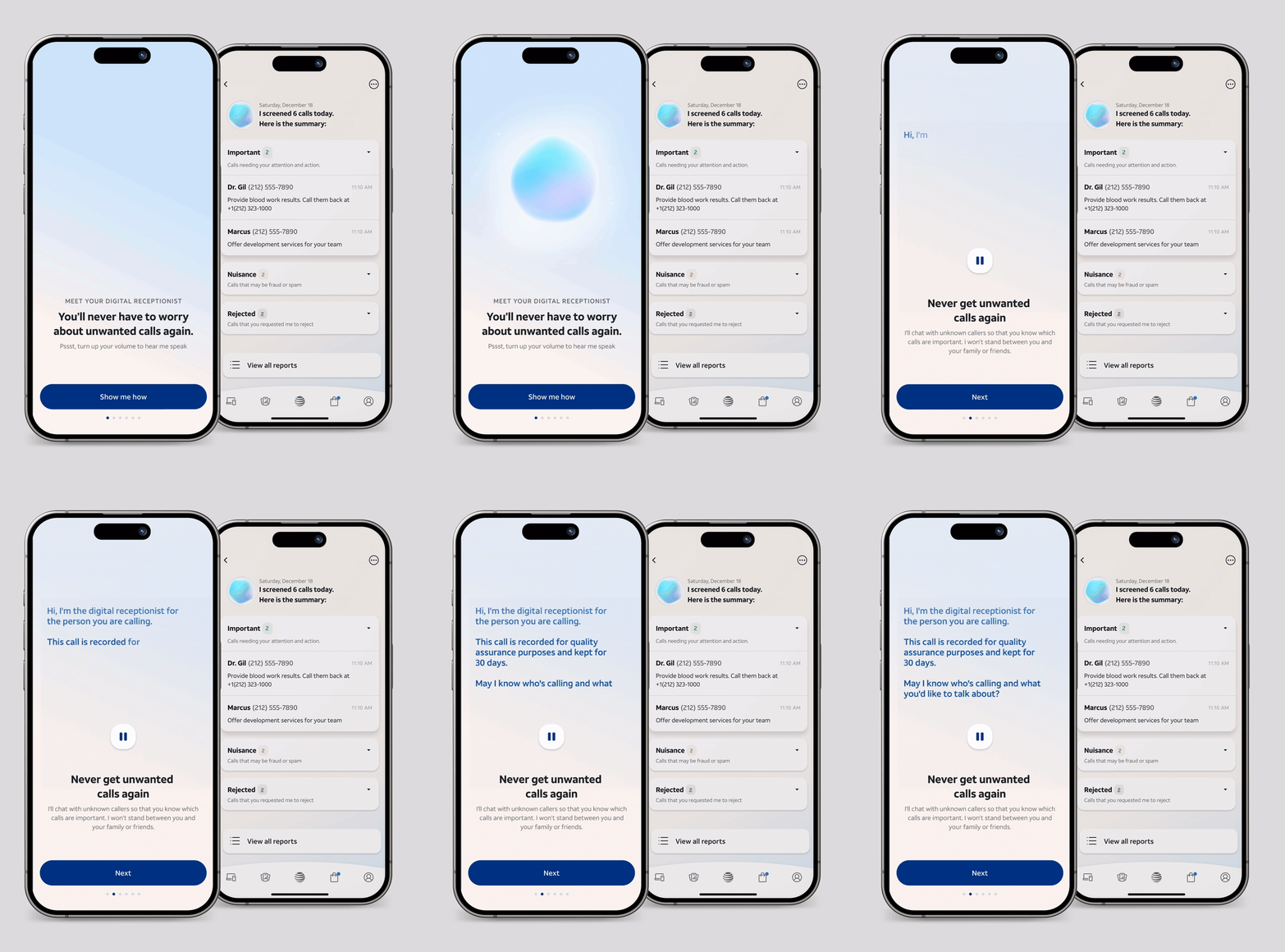
The digital receptionist can handle incoming calls and filter out spam, so customers spend more time talking to the people they actually want to reach. | Image credit – AT&T
It uses advanced voice-to-voice tech and agentic AI to screen calls, powered by large language models (LLMs) that process speech, generate responses, and turn them back into natural-sounding audio. AT&T says it’s designed to feel as quick and natural as talking to a human.
This is just a taste of what AI agents could do with your phone to make your life easier. Eventually, a future AI agent could autonomously connect you to make reservations at the hottest restaurant. Just tell it the name of the restaurant, and it will connect you – or even book your reservation – all on its own. This digital receptionist could also eventually handle phone calls that are important, but you can’t take at the time, by getting directions from you in real time with text prompts.
– AT&T, September 2025
Would you let an AI receptionist answer your calls?
51 Votes
Yes – finally, no more spam headaches.
43.14%
Maybe – only for unknown numbers.
37.25%
No – I’d rather handle calls myself.
9.8%
Not sure – depends how reliable it is.
9.8%
Why a digital receptionist could change how you answer calls
Think of it as having a personal assistant built into your phone. It answers calls on your behalf, asks questions like “Who’s calling?” and “What’s this regarding?”, and then decides what happens next. It can figure out if the caller is human, how urgent the call is, and whether it meets your own criteria.
Recommended For You
If it’s important, the receptionist connects the call and then disappears from the conversation. If it’s something the AI can handle – like taking a message or confirming a delivery window – it does that instead.
This type of call screening is starting to spread. Apple, for example, just introduced its own Call Screening in iOS 26. It automatically answers unknown numbers, asks for the caller’s name and reason, then rings your phone with that info so you can decide. You can also send unknown callers directly to voicemail. AT&T’s twist is that it’s carrier-level, so it could reach far more users, regardless of whether they own an iPhone, Galaxy, or a budget phone.
AI vs AI feels like the right fight
With AI advancing so quickly – and scammers using it to their advantage – it’s promising to see carriers fight back with the same tools. AT&T’s approach has the potential to give every customer a built-in layer of protection, not just those on the latest flagship devices.
Sure, it might be annoying at first to fine-tune who gets screened and who doesn’t, but if it spares you from endless robocalls and scam attempts, the tradeoff is worth it. Of course, the real test will be how smooth and reliable it feels once more users get access. For now, it is just a trial, but it could end up becoming a default feature that changes how we deal with calls entirely.
Tello Halloween Promo: $10GB for $10/mo
Don’t miss this scary-good deal: 10 GB for $10/mo. Save $5/mo for your first 3 months. Offer valid now through November 9, 2026.
Tsveta, a passionate technology enthusiast and accomplished playwright, combines her love for mobile technologies and writing to explore and reveal the transformative power of tech. From being an early follower of PhoneArena to relying exclusively on her smartphone for photography, she embraces the immense capabilities of compact devices in our daily lives. With a Journalism degree and an explorative spirit, Tsveta not only provides expert insights into the world of gadgets and smartphones but also shares a unique perspective shaped by her diverse interests in travel, culture, and visual storytelling.
A discussion is a place, where people can voice their opinion, no matter if it
is positive, neutral or negative. However, when posting, one must stay true to the topic, and not just share some
random thoughts, which are not directly related to the matter.
Things that are NOT allowed:
Off-topic talk - you must stick to the subject of discussion
Offensive, hate speech - if you want to say something, say it politely
Spam/Advertisements - these posts are deleted
Multiple accounts - one person can have only one account
Impersonations and offensive nicknames - these accounts get banned
To help keep our community safe and free from spam, we apply temporary limits to newly created accounts:
New accounts created within the last 24 hours may experience restrictions on how frequently they can
post or comment.
These limits are in place as a precaution and will automatically lift.
Moderation is done by humans. We try to be as objective as possible and moderate with zero bias. If you think a
post should be moderated - please, report it.
Have a question about the rules or why you have been moderated/limited/banned? Please,
contact us.










Things that are NOT allowed:
To help keep our community safe and free from spam, we apply temporary limits to newly created accounts: