Apple has reportedly asked the White House for permission to buy memory from CXMT, China's largest memory maker and a blacklisted supplier it would normally avoid. The AI data-center boom has sent memory and storage prices climbing across the best phones you can buy, and that squeeze is already reaching the iPhone 17 Pro Max and the Galaxy S26 Ultra.
Apple is courting a supplier it usually steers clear of
We reported that Apple has gone looking for memory in an unusual place, putting a request to the White House more than a month ago. The company wants permission to buy from ChangXin Memory Technologies, or CXMT, which the U.S. has designated a Chinese military company and which is widely believed to have ties to the People's Liberation Army.
Apple isn't actually banned from buying those chips, so this is about avoiding the fallout rather than getting around a legal block. The bigger exposure is the Defense Department, which can't buy products built with components from blacklisted firms, and clearance would keep that business safe.
How are rising memory prices changing your next phone plan?
244 Votes
I'll hold onto my current phone way longer now
31.97%
I'll buy the cheapest storage tier and cope
62.7%
I'll pay up, a good phone is worth it to me
2.87%
Prices won't change what I buy at all
2.46%
Why memory suddenly costs a fortune
The real driver here has very little to do with phones directly. The buildout of AI data centers has created enormous demand for memory, both the High-Bandwidth Memory (HBM) stacked onto AI accelerators and the NAND flash that storage relies on, and that has pushed prices up across the whole industry.
Recommended For You
Phone memory comes from the same pool, so when data centers are buying everything in sight, the chips headed for your next handset get pricier too. And, of course, manufacturers tend to pass that along like clockwork.
If you're holding a Galaxy S26 Ultra or a Pixel 10 Pro instead of an iPhone, this affects you too as this isn't an Apple-only problem. The same crunch is lifting prices across Android, and budget phones tend to feel it worse, since there's less margin to absorb the cost.
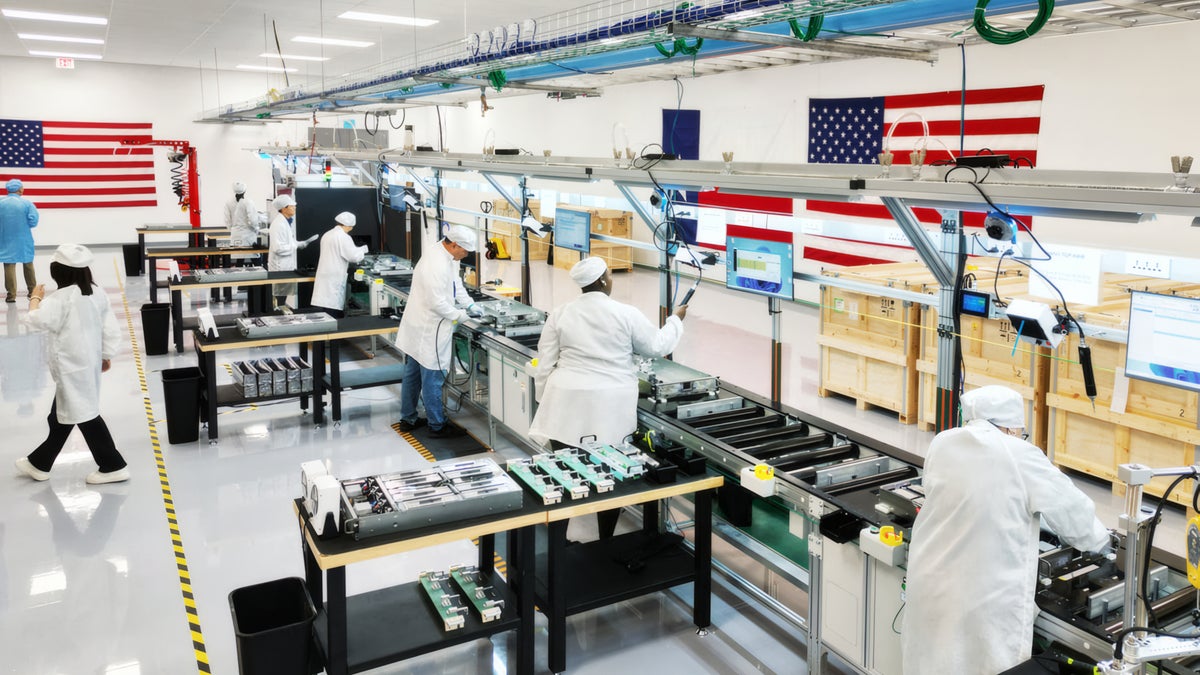
Apple's data center in Maiden, North Carolina, the kind of buildout that's squeezing memory supply. | Image by Apple
Apple isn't even TSMC's biggest customer anymore
Here's a sign of how much the ground has shifted: Apple is no longer TSMC's number one customer. Nvidia has taken that spot, with the AI chipmaker now accounting for roughly 19% to 22% of TSMC's revenue against Apple's 18% or so.
That reshuffle reframes Apple's position. For years it could throw its weight around as the customer everyone wanted to please, and a good chunk of that leverage has shifted to whoever is feeding the AI boom. Going to the White House for a memory workaround is what that looks like in practice.
What it means for your next phone
Strip away the geopolitics and the part that weighs on us is simple: phones are getting more expensive, and the storage tiers aren't getting any more generous. We made the case earlier that the next Pro iPhones are very likely to carry a price increase, and the same memory math is reshaping Apple's other hardware too.
The people who should pay closest attention are anyone planning an upgrade in the next year, or anyone who buys the cheaper storage option and regrets it later. If prices keep climbing, holding onto a working phone a little longer starts to look less like settling and more like the sensible move.
What if Washington says no?
The obvious question is what happens if that clearance never comes through. If the White House turns Apple down, the company is left leaning harder on the same Korean suppliers, Samsung and SK Hynix, that everyone else is already competing for.
That likely means paying more or accepting tighter supply, neither of which improves the pricing picture for us. I'm assuming Apple wouldn't have asked in the first place if the easy options were still on the table.
Where this leaves us
A company as cautious as Apple doesn't go courting a blacklisted, PLA-linked supplier on a whim, so the simple conclusion is that the memory crunch is bad enough to override its usual instincts. That is the part that stays with me, not the politics of it, but what that level of effort signals about where prices are heading.
None of this is confirmed to change a single spec on your next phone yet, and I'm hopeful the worst-case price predictions don't pan out. Still, I'd rather we all saw the cause clearly now, so the next time storage gets pricier and the base tier stays the same stingy size, nobody is left wondering why.
More on the memory squeeze:
See where the current iPhone 17 Pro Max landed in our review
Johanna Romero is a Senior News Writer at PhoneArena, covering mobile technology news across Android, iOS, wearables, and the Google ecosystem she knows best. Drawing on 15 years in IT and tech support from 2007 to 2022, she brings a user-friendly eye for the practical features and lesser-known tricks readers care about. Google named her an official #TeamPixel member in 2022, and she also reviews the latest devices on her YouTube channel, JoJo the Techie.
A discussion is a place, where people can voice their opinion, no matter if it
is positive, neutral or negative. However, when posting, one must stay true to the topic, and not just share some
random thoughts, which are not directly related to the matter.
Things that are NOT allowed:
Off-topic talk - you must stick to the subject of discussion
Offensive, hate speech - if you want to say something, say it politely
Spam/Advertisements - these posts are deleted
Multiple accounts - one person can have only one account
Impersonations and offensive nicknames - these accounts get banned
To help keep our community safe and free from spam, we apply temporary limits to newly created accounts:
New accounts created within the last 24 hours may experience restrictions on how frequently they can
post or comment.
These limits are in place as a precaution and will automatically lift.
Moderation is done by humans. We try to be as objective as possible and moderate with zero bias. If you think a
post should be moderated - please, report it.
Have a question about the rules or why you have been moderated/limited/banned? Please,
contact us.














Things that are NOT allowed:
To help keep our community safe and free from spam, we apply temporary limits to newly created accounts: