New packaging for Apple's A20 Pro chip should keep the iPhone 18 Pro series feeling cool
With everyone worried about chips and phones heating up, processors are getting improved thermal management tools.
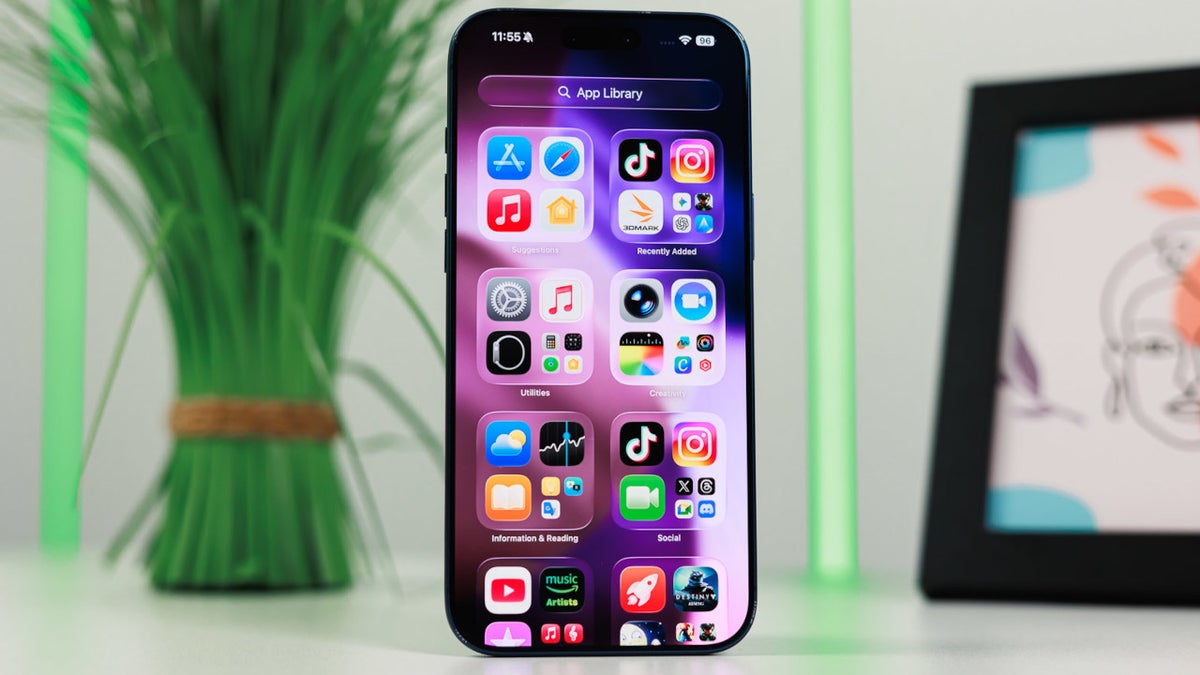
Apple A20 Pro chip has improved thermal management | Image by PhoneArena
Last September, just days before Apple unveiled the iPhone 17 series, we told you that 2026's iPhone 18 line would be cooler thanks to a new packaging design for the A20 chip called Wafer-Level Multi-Chip Module (WMCM). With this new structural architecture, the application processor (AP) and memory (DRAM) are placed side-by-side and connected horizontally using a Redistribution Layer (RDL). This moves the memory chip away from the AP, enhancing thermal dissipation.
The RDL is an extra wiring layer that reroutes a chip's input/output connection pads to new locations. This makes the chip easier to connect to a circuit board or to other chips. The APs are integrated side-by-side at the wafer stage before the latter is diced. This architecture eliminates the sub-substrate layer and reduces the interconnect paths, reducing the thickness of the package.
Chipmakers and phone manufacturers are more worried than ever about cooling off the inside of a phone
With Apple moving to 2nm A20 Pro APs for the iPhone 18 Pro and iPhone 18 Pro Max, heat dissipation is more important than ever as more powerful CPUs generate more heat. Last year, Apple added a vapor chamber cooling system to the iPhone 17 Pro and iPhone 17 Pro Max for the first time.
Does thermal management rank as one of your major concerns?
120 Votes
Yes-no one wants to be able to fry an egg on their phone
55.83%
It is a concern but not my biggest one
32.5%
Not at all as a hot phone has never bothered me
11.67%
When the processor inside one of the two iPhone 17 Pro models gets hot, the liquid water inside the chamber absorbs it, boils instantly, and turns into vapor. The vapor travels to the cooler areas of the chamber and releases the heat and then returns to the hot spot of the chamber. This is done for several cycles as it continuously moves heat away from the processor.
Vapor chambers do double-duty in the war against heat
With the vapor chamber keeping the processor cool, it allows the component to continue to deliver higher performance during processor-intensive tasks like gaming. Additionally, the vapor chamber acts as a heat sink with its large copper surface physically spreading the heat across the inside of the device preventing hot spots from occurring.
Why the Gate-All-Around transistor architecture is so important
In addition to being the first 2nm AP inside an iPhone, the A20 Pro will be the first to feature Gate-All-Around (GAA) transistor architecture. This uses horizontal nanosheets placed vertically so that the gate covers the channel on all four sides. The previous FinFET architecture only covered three sides.
With GAA, current leaks are reduced, and the drive current is increased. This is the amount of current that flows through a transistor when it is turned on. Faster drive current means that a transistor can switch from "on" to "off" faster, improving its performance.
A tweet from leaker Reptalica includes a leaked image of the iPhone 18 Pro motherboard. In the tweet, Reptalica writes that the A20 Pro AP has the same die size as the A19 Pro, and he adds that the Neural Processing Unit (NPU) seems to be "beefed up." This means that the A20 Pro should improve the performance of on-device AI features on the premium iPhone 18 models.
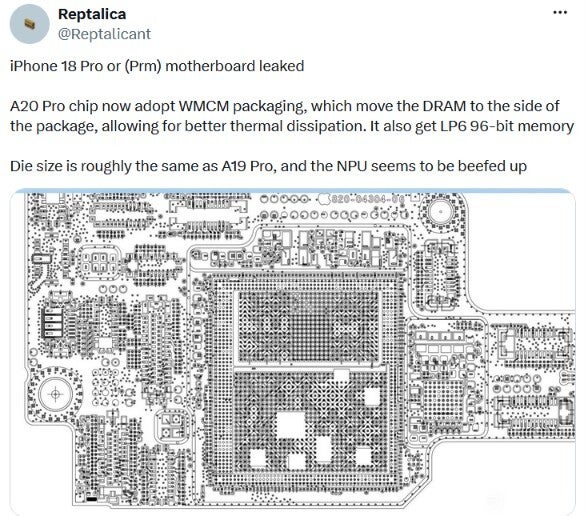
Tweet claims to show leaked image of iPhone 18 Pro motherboard. | Image by X
The A20 Pro will also include LPDDR5X 96-bit RAM. The chip seems designed to improve AI performance and keep the chip cooler during tasks that require heavy processing power.
Samsung is making changes with the Heat Path Block for the Exynos 2600
Thermals were also the focus of the Exynos 2600 AP, which powers the Galaxy S26 and Galaxy S26+ in markets like Europe, South Korea, and India (most of Asia, really), Africa, the Middle East, and South America. For the Exynos 2600, Samsung added what it called the "Heat Path Block (HPB)." This is a copper heat sink placed on top of the processor, forcing the memory chip to be moved to the side.
For the Exynos 2700, Samsung is using a new Side-by-Side (SbS) architecture. This leaves the AP and DRAM next to each other with the second-generation Heat Path Block on top of both. As a result, heat from both the processor and the DRAM is drawn to the HPB, improving the Exynos 2700's thermals.
Qualcomm is trying something similar with the Snapdragon 8 Elite Gen 6 Pro. Last week, Reptalica said in a separate tweet that Qualcomm's version of the Heat Path Block has not been as effective as Samsung's.


Popular stories






Latest News






Things that are NOT allowed:
To help keep our community safe and free from spam, we apply temporary limits to newly created accounts: