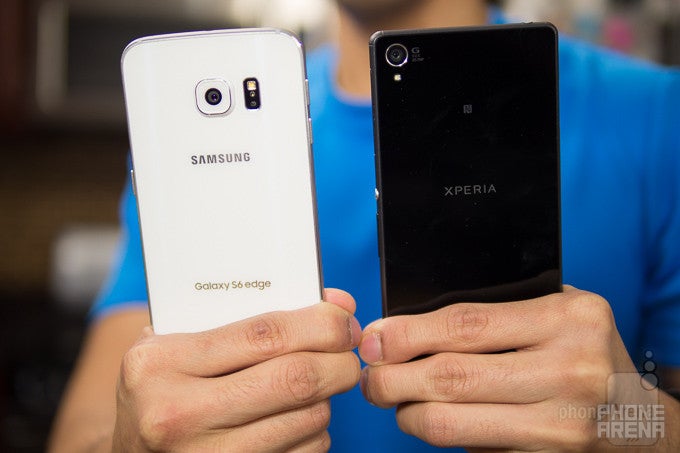
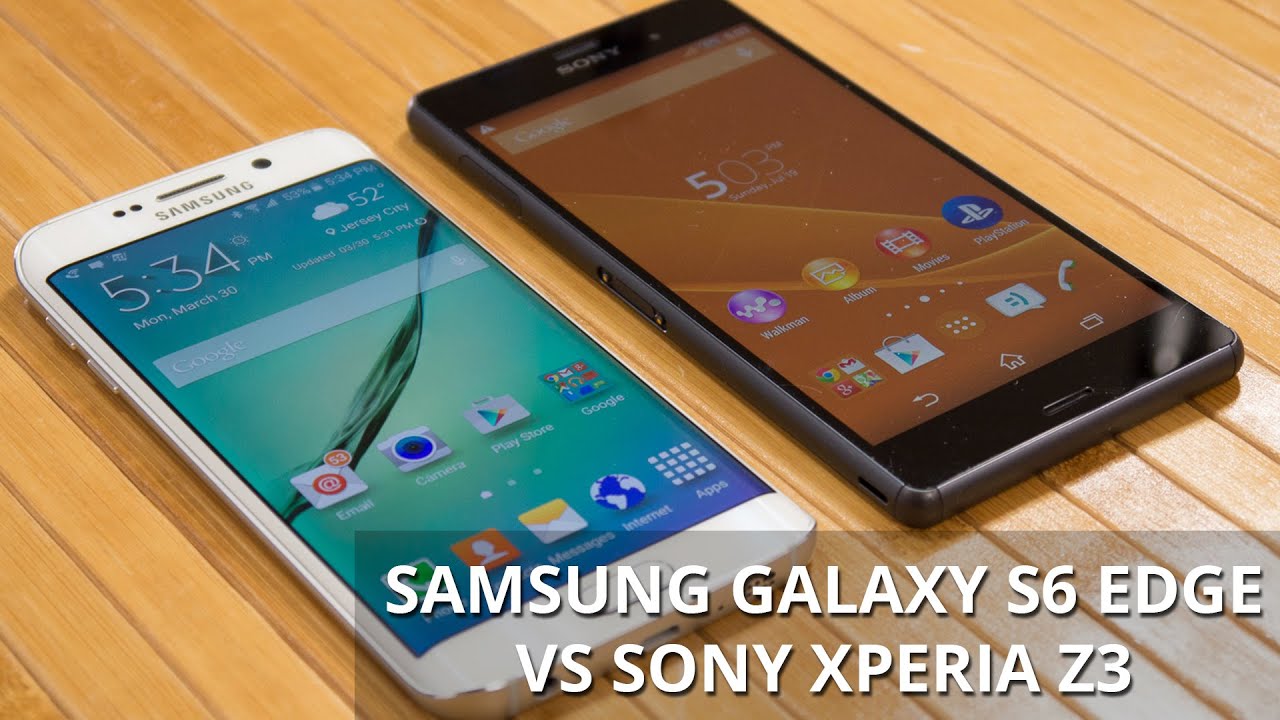
Samsung Galaxy S6 edge vs Sony Xperia Z3

Introduction
We’ve said it before, and we’ll say it again. The Sony Xperia Z3 has arguably the most underrated designs around! Being good looking is one thing, but the designers over at Sony’s camp delivered an impressive offering in the Xperia Z3 – one that adds a higher degree of water-resistance protection, which isn’t something we tend to see too much of nowadays in flagships.
On the flip side, the Samsung Galaxy S6 edge bears one eye-catching aesthetics with is unique dual-curved screen. Add to that, Sammy’s transformation is realized with the unveiling of its latest flagship smartphones, mainly because the designs now feature that premium quality that was non-existent with its previous efforts. Between them, we know the advantages that come along with being the newer product, especially from a specifications point, but the Xperia Z3 can’t be neglected either.
Design
The S6 takes charge with its dramatically different design, one that’s now premium in nature, but the Xperia Z3 is one of the last remaining flagships to offer a water resistant construction.
With every new Galaxy S release, Samsung has historically built upon the base by refining what's already there and adding some extra on top. With the Galaxy S6, however, the electronics giant has focused far more on the latter than on the former. To that end, instead of the plasticky shell of the Galaxy S5, Samsung has adopted a metal frame that hugs the device all over and nestles within two sheets of Corning Gorilla Glass 4 – one placed in front of the display, and the other to protect the rear.
At the same time, too, it’s able to accommodate a handy, and always useful microSD card slot and dedicated shutter key. Not surprisingly, the Galaxy S6 edge earns adulation and commendation for its stark redesign, one that’s undoubtedly now deemed as premium, but we can’t neglect to forget about the Xperia Z3’s design either.

5.59 x 2.76 x 0.28 inches
142.1 x 70.1 x 7 mm
4.66 oz (132 g)

5.75 x 2.83 x 0.29 inches
146 x 72 x 7.3 mm
5.36 oz (152 g)

5.59 x 2.76 x 0.28 inches
142.1 x 70.1 x 7 mm
4.66 oz (132 g)

5.75 x 2.83 x 0.29 inches
146 x 72 x 7.3 mm
5.36 oz (152 g)
See the full Samsung Galaxy S6 edge vs Sony Xperia Z3 size comparison or compare them to other phones using our Size Comparison tool.
Display
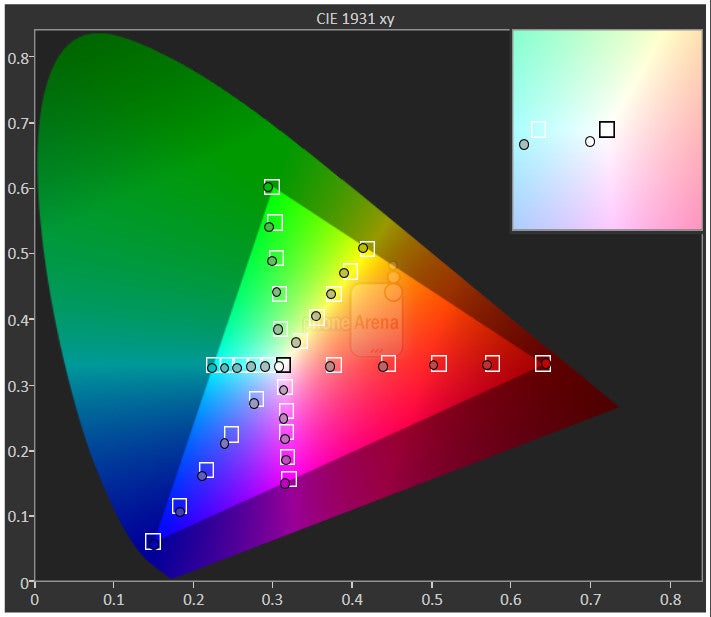
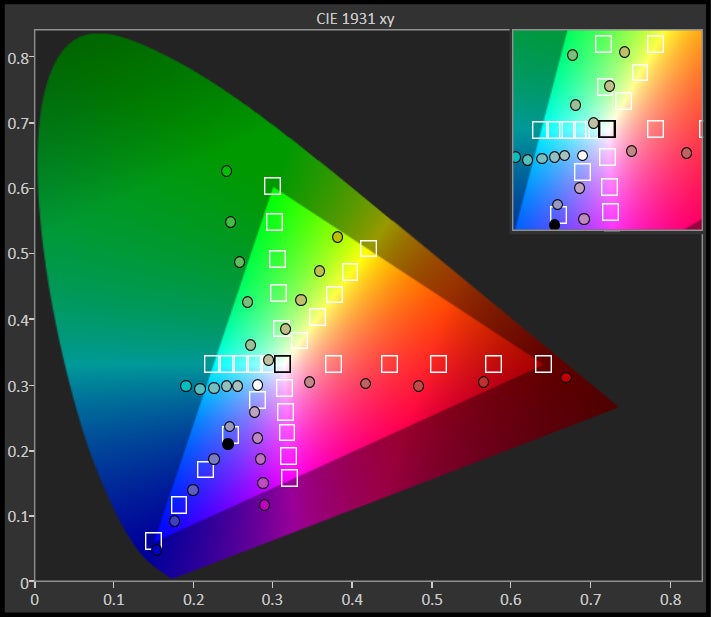
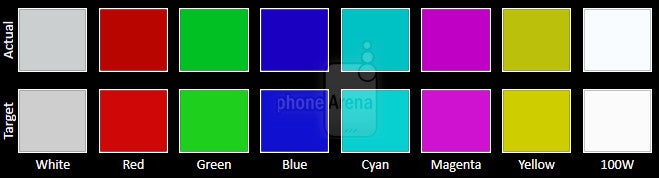
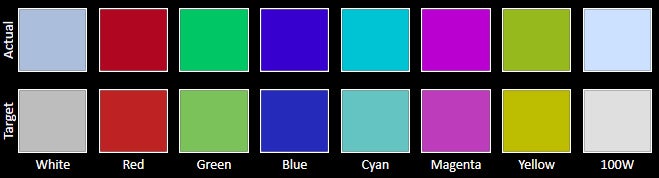
Not only is the S6 edge’s display cool looking, it’s also one of the brightest and most color accurate.
Being almost a year newer has its advantages, especially knowing Samsung’s insatiable appetite for pushing the boundaries. Clearly within the flagship range, the Xperia Z3’s 5.2-inch 1080 x 1920 LCD display has several good qualities about it, but it looks daunting on paper in comparison to the Galaxy S6 edge’s dazzling 5.1-inch 1440 x 2560 Super AMOLED dual-curved display.
In all fairness, it’s quite difficult in deciphering the detail superiority of the Galaxy S6’s display over the Xperia Z3 when looking at the two from a normal distance – they’re both sharp and pleasing to the eye. Moving ever so closer, however, that’s when we begin to visualize the astounding level of detail produced by the quad-HD resolution of the Galaxy S6 edge’s screen. For practical usage, though, there’s no denying that they’re both on equal ground.Now, let's talk about color calibration. With the Samsung Galaxy S6 edge set in the non-default Basic display mode, we're looking at a spot-on color temperature of 6800K (6500K being the desired optimal value), while the Xperia Z3 offers the very unsatisfactory 10324K. In real terms, this means that the Xperia Z3’s display is cold (or bluish) and that's especially visible with whites and various shades of gray. In comparison, Samsung's device offers realistic whites that are... well, white!
Details and colors aside, the Z3’s LCD-based display shines strongly at 713 nits, making it especially easy to view outdoors with the sun present. Once known to be the among the worst display technologies when it came to maximum brightness, Super AMOLED has taken a great leap forward in recent memory, as the S6 edge’s Super AMOLED display musters up a respectable 553 nits.


Interface and Functionality
TouchWiz receives a new, more toned down redesign, but it’s still a power house experience in comparison to Sony’s Xperia UI.
While Samsung's Galaxy S devices have always shipped with nothing less than the best available at the time in terms of hardware, we've often found ourselves wishing it did more on the software side. Its proprietary TouchWiz layout has often proved sluggish and less responsive than what some competitors had to offer – a sight that the Samsung faithful only tolerated because of the smorgasbord of extra features the platform gave them access to. With the Galaxy S6 edge, however, the company has finally come to sense, and has carried out a number of software optimizations that make the Galaxy S6's software both easier to understand and faster than ever before.
The TouchWiz UI on the Galaxy S6 edge
Although it hasn’t made the jump to Lollipop, which is rather unnerving because it’s been around for some time now, Sony's Xperia UI running on top of Android 4.4.4 KitKat is a bit closer to the stock look than Samsung's TouchWiz, as it has way less extra functions. It adds some light multitasking tools like the Small Apps suite, which lets you hover up to five windowed apps, resize and move them around. What separates it from the Galaxy S6 edge is its tight PlayStation integration – where it can be set up for remote play, as in being able to stream most of your PlayStation 4 games directly to the Xperia Z3.
The interface of the Sony Xperia Z3
Visuals have never been a strong point for TouchWiz, but with this new version, however, Samsung has added support for third-party themes. Sure, it’s an appreciable thing to have, mainly because the themes help to mask TouchWiz’s otherwise bland visual presentation. On the software feature side, TouchWiz still adheres to the needs of power users because of its exhausted set of software features – they include the fingerprint scanner (still embedded in the physical Home button) that is now of the touch, not swipe, type, finally allowing for a hassle-free unlock. In addition, TouchWiz also offers software features like MultiWindow (run two apps simultaneously), and Private and Car modes (hide sensitive content / dashboard with bigger icons and essential apps only).
Processor and Memory
Both are impressively responsive, but the Galaxy S6 edge’s new piece of silicon exhibits more fluidness with its execution.
For the longest time, Samsung and Qualcomm worked together on the former's flagship lines, though the chip maker didn't always get all the orders – the rest went to Samsung's then fledgling semiconductor division making the Exynos chipsets. With the Galaxy S6 edge, however, Samsung was ready for a monumental shift, and Qualcomm is no longer part of the game. Instead, the S6 edge relies on a home-grown Exynos 7420.
The newness of the Galaxy S6 edge allows it to benefit over the Xperia Z3, which is powered by a last-generation quad-core 2.5GHz Qualcomm Snapdragon 801 MSM8974-AC processor. In dissecting its performance, it seems to be great, both around the interface, and within apps, including 3D games. There isn't any occasional choppiness that would hinder the experience, but as we meticulously compare their responses, it’s just a smidgen behind the Galaxy S6 edge’s exquisite fluidness. Don’t get wrong, most people would be satisfied by its responsiveness, but a higher level is achieved by Sammy’s pride and joy – plus, the benchmarks show the awesome muscle power of the Galaxy S6 edge.
Internet and Connectivity
Smooth browsing is what we've been getting with each and every flagship for the past few years, and Samsung's and Sony's offerings don't fail to deliver just that. Courtesy of their powerful internals, both devices handle even asset-heavy pages with ease and don't struggle when navigating through them. That said, whereas both devices rely on Chrome for your browsing needs, Samsung's Galaxy S6 edge comes with its own default solution that is an equally great performer.
Web browsing with the Samsung Galaxy S6 edge
Chrome on the Sony Xperia Z3
On the connectivity front, you'll hardly find much to complain about, regardless of whether you go for the Galaxy S6 edge or the Xperia Z3. Both devices offer support for a wide array of LTE bands, 5GHz Wi-Fi, Bluetooth (4.0 for the Xperia Z3, 4.1 for the Galaxy S6), NFC, DLNA, and MHL. Still, the Galaxy S6 edge pulls ahead because of its infrared blaster for control over home electronics, and Samsung Pay – the company's new mobile payments solution that works hand-in-hand with the handset's NFC chip.
Camera
Fantastic looking photos are snapped by the two, but things just look better with the Galaxy S6 edge camera.
Sony's flagship sports a 20.7-megapixel 1/2.3” Exmor RS sensor, and Sony touts the new 25mm G Lens optics (f2.0), and other changes under the hood, such as boasting up to 12800 ISO sensitivity. Meanwhile, Samsung's Galaxy S line has always been synonymous with great camera quality, and the company wasn't about to drop the ball with the Galaxy S6 edge. Instead of focusing on the software side of performance, Samsung has taken a two-pronged approach by making sure to deliver some exciting hardware updates, too. To that end, the Galaxy S6 edge's 1/2.6”, 16-megapixel rear camera comes with a wider-than-before f/1.9 aperture lens and an optical stabilization gizmo attached to it.
Camera interface of the Samsung Galaxy S6 edge
Camera interface of the Sony Xperia Z3
Both phones produce high-quality photos, worthy of being converted to 4” x 6” printouts – and even larger layouts because of the amount of detail they capture. Combing through the results, ones captured outdoors where sunlight is plentiful, we’d give the Galaxy S6 edge the slight, minor advantage in overall quality. In particular, its warmer color reproduction makes our snapshots livelier in tone, whereas with the Xperia Z3, it exhibits a profound cooler tone; bluish in tone and sometimes washed out too. The cooler production is more prominent indoors under artificial lighting – florescent to be exact.
Sample images
Sample Videos
Multimedia
We have no complaints about the multimedia prowess of both phones.
Both galleries offer grid thumbnail views, and allow for rich picture editing from within the apps, as well as sport plenty of sharing options. Best of all, there are enough fun editing tools at their disposal to further enhance the look of photos. Video playback is excellent on both handset, too, as they support quite a handful of video codecs out of the box. Watching videos isn’t an issue with either of them, thanks in part to their sharp displays, but we have an extra layer of multi-tasking with the S6 edge’s experience – videos can essentially be played in their own windows, which can be placed on top of whatever we’re doing.
Music players
The Xperia Z3 also flaunts Sony's Digital sound Enhancement Engine (DSEE), which brags to upconvert crappy tracks to a higher-resolution format – we can attest that there is a slight difference, though not as stark as if the tunes were high quality in the first place. Sony offers two waterproof stereo speakers at the front, which sound clean, but are somewhat muffled, while the Galaxy S6 edge only offers one speaker along the bottom edge, which is strong enough, but with a thinner and subdued quality.
Call Quality
Battery
Most likely related to its beefier sized battery, a 3100 mAh one, the Sony Xperia Z3 delivers a longer tally in our battery benchmark test. In fact, it musters up a total time of 9 hours and 29 minutes from a single charge – whereas the S6 edge’s smaller 2600 mAh battery inches out at a respectable 8 hours and 11 minutes. Still, it has to be noted that the S6 edge ran our battery test at a slightly lower display brigthness, due to software limitations in TouchWiz. In practical day-to-day usage, however, we find their batteries to provide the usual 1-day of juice with normal usage.
Even though the Xperia Z3 has the endurance, it requires an exorbitant 235 minutes to fully charge its battery. Time isn’t always on our side, so it’s quite refreshing to know that the S6 edge’s rapid charging system gets it juiced in no time at all – an impressive 83 minutes to be exact! Additionally, if charging via the usual microUSB cable isn’t your thing, the S6 edge also has the convenience of being charged wirelessly.
Conclusion
Right off the bat, there’s something to say about a smartphone that’s just beginning its life. From the specs standpoint, the Samsung Galaxy S6 edge clearly has a lot to offer over the Xperia Z3. Comparing the two on paper, it’s almost a knock out for the newer Galaxy S6 edge, not only for its cutting-edge specs, but also for the tremendous effort on Samsung’s part to deliver a premium looking smartphone.
However, as we’ve experience several times, specs alone don’t dictate a phone’s true performance – and the Sony Xperia Z3 proves that in this particular comparison. True, its hardware is older and not quite as pushing the boundaries as its rival, but nevertheless, the end result is a smartphone that impresses on several fronts. Solidifying things even more, it’s one of the few remaining flagship smartphones to offer true water-resistant protection against submersion, which is something it has over Sammy’s new pride and joy.
From a cost standpoint, all fingers point to the Sony Xperia Z3, which, at this point, can be grabbed at a fantastic discount if you search in the right places. To be fair, though, the lower cost attached to the Xperia Z3 now makes perfect sense, as the Xperia Z3 has been on the market for some time. Conversely, the Galaxy S6 edge has just recently become available, so it’s going to cost a pretty amount to pick up at the moment.
Of course, the mounds of money you fork over to pick up the Galaxy S6 edge is worth it, as it’s an impressive thing that’s best experienced up close and personal – albeit, the Xperia Z3 is still worth a shot even now, more so if you’re all about savings.

Samsung Galaxy S6 edge
Pros
- Faster chipset
- Lighter, thinner, more compact
- Cool aesthetics with its dual-curved display
- Excellent camera
- Rapid & wireless charging
- Deeper set of software features
Sony Xperia Z3
Pros
- Water resistant design
- Expandable storage via microSD slot
- Longer battery life
- Tight integration with PlayStation
- Lower price



Popular stories
Latest News

Things that are NOT allowed:
To help keep our community safe and free from spam, we apply temporary limits to newly created accounts: