T-Mobile's Saw explains what makes 6G a great opportunity for carriers
T-Mobile's network chief says 6G will help carriers disseminate kinetic tokens as wireless providers dive into the AI pool.
T-Mobile's CTO discusses 6G, kinetic tokens, and more. | Image by PhoneArena
The whole set of circumstances that led to T-Mobile's early 5G domination in the US is unlikely to be repeated. Verizon and AT&T both decided to use faster mmWave spectrum to build out their 5G networks only to come to the realization that because mmWave airwaves do not travel long distances and are blocked by trees and buildings, using this spectrum would slow down their 5G rollout and make it too costly.
How one decision by T-Mobile led it to become the US 5G leader
T-Mobile decided to take a different route and go with mid-band spectrum for its 5G build out. While mid-band is slower than mmWave, it is faster than low-band. These signals also travel longer distances than mmWave (although not as far as low-band).
At this time, mid-band spectrum was scarce, but T-Mobile knew exactly where to find some. Sprint had a massive holding of 2.5GHz spectrum and obtaining those airwaves is why T-Mobile paid $26.5 billion for Sprint. You didn't think that T-Mobile paid so much for Sprint's operations, did you?
T-Mobile used its "Triple Layer Cake" strategy to immediately get a jump on AT&T and Verizon
T-Mobile promoted its "Triple Layer Cake" strategy. The bottom layer uses low-band 600MHz spectrum for nationwide service. While this is the slowest of the three bands, low-band signals do travel the longest and can easuly penetrate buildings and trees. Thus, low-band is perfect for nationwide 5G service.
By the time Verizon and AT&T realized their mistake, T-Mobile was the 5G leader in the US and both AT&T and Verizon were forced to spend a ton of money to win mid-band C-band licenses in an auction. It was expensive, there were issues with C-band signals interfering with aircraft altimeters, but at the end of the day it was worth it as Verizon and AT&T were able to increase their download data speeds to compete with T-Mobile.
Just because the actions taken by all three carriers are not going to repeat, this doesn't mean that T-Mobile wouldn't love the opportunity to be the 6G leader in the US just as it arguably remains with 5G in the States. T-Mobile Chief Technology Officer John Saw sat down to chat with Chetan Sharma, founder and CEO of Chetan Sharma Consulting. The latter is a management consulting firm focused on the mobile and wireless industry.
You see, Saw replaced the carrier's longtime network chief Neville Ray in 2024 after joining T-Mobile in 2020 via the Sprint acquisition. He says that the carriers have a great opportunity in front of them to convert wireless, AI, and computing into an array of new products, services, and capabilities that will determine what the wireless providers' contributions will be to the industry over the next decade.
T-Mobile CTO Saw had his "The Graduate" moment; instead of plastics, he spoke about 5G Advanced
Speaking to those attending his chat while representing a wireless firm, Saw gave them a piece of advice. "Roll out 5G Advanced," he said. The next level of 5G service, considered to be the bridge between 5G and 6G, Saw might have made this comment to point out that T-Mobile is the lone wireless provider in the US to offer nationwide 5G Advanced service.
However, it's more likely that Saw was making a helpful recommendation. The tech used to drive this level of wireless will allow those firms who heed his advice to create useful AI features. Saw said, "I think it’s our opportunity to move up the food chain to monetize new capabilities, instead of selling SIM cards and giving away free, expensive foldable smartphones."
Carriers will have their big AI opportunity distributing kinetic tokens
T-Mobile's CTO sees the real growth in wireless coming with physical AI and kinetic tokens. Unlike information tokens that can be described as data units that describe, summarize, or predict, kinetic tokens represent physical action. The physical movements of self-driving cars, robots, and drones are good examples. And Saw sees the carriers as being able to profit from this. "When tokens move – when things move with AI – I think it gives telecom operators a license to play in a big opportunity with physical AI," T-Mobile's CTO said.
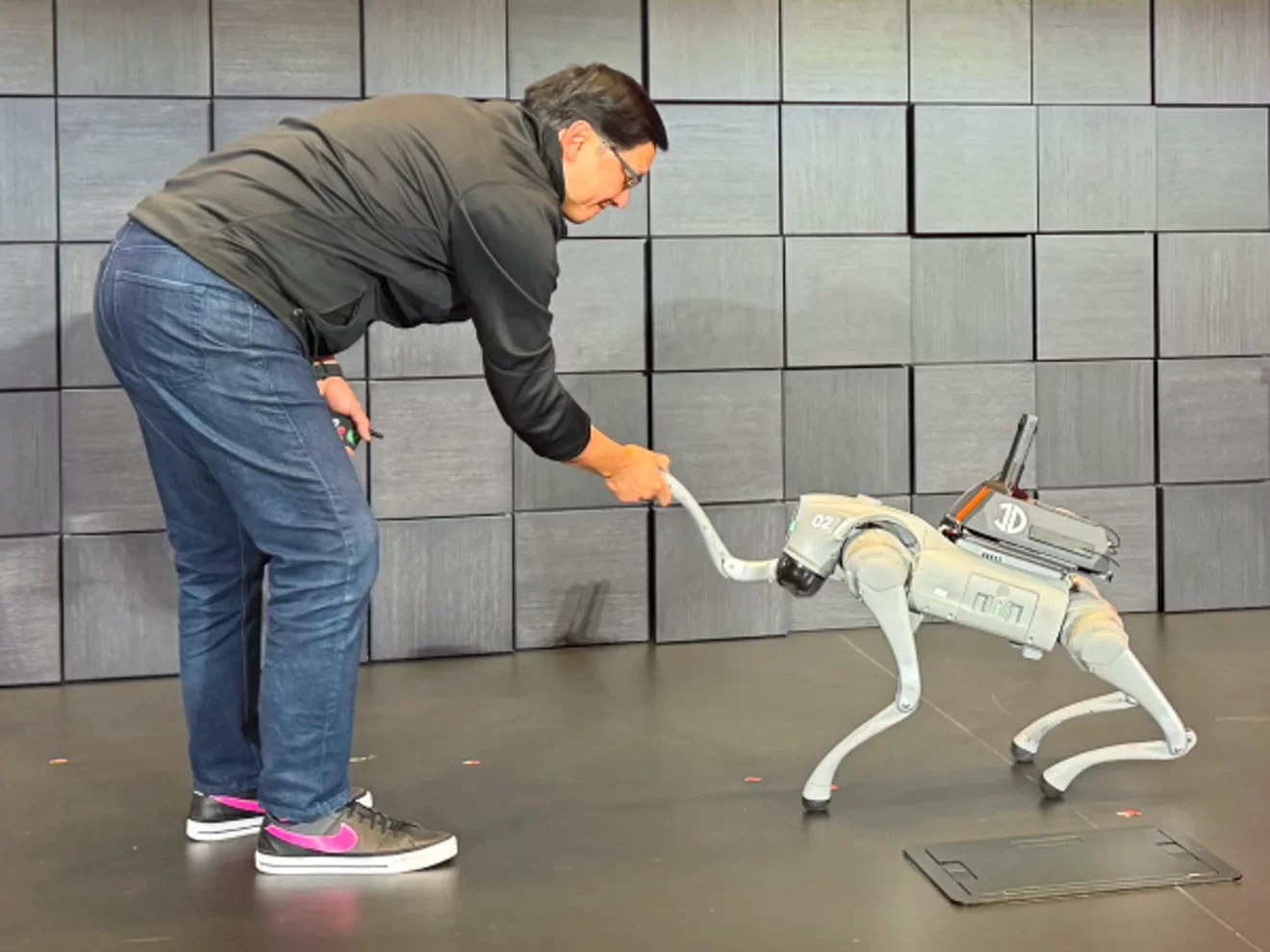
T-Mobile CTO John Saw and a robotic dog. | Image by T-Mobile
Saw pointed out that when you move a robot's arm, it needs to know where it is located in space. It has to be synced with the physical world. A humanoid robot cleaning an office after a meeting has to know the difference between dirty napkins that go in the trash and important work papers that need to be filed. Saw expects carriers to play a big role in the advancement of physical AI in the 6G era, expected to start in 2029 or 2030.
Check out some other great articles like these:


Popular stories




Latest News


Things that are NOT allowed:
To help keep our community safe and free from spam, we apply temporary limits to newly created accounts: