Google demonstrates new on-device AI features for Pixel 10
At Google I/O India, the company showed off exciting new features for Pixel's next-generation on-device AI.
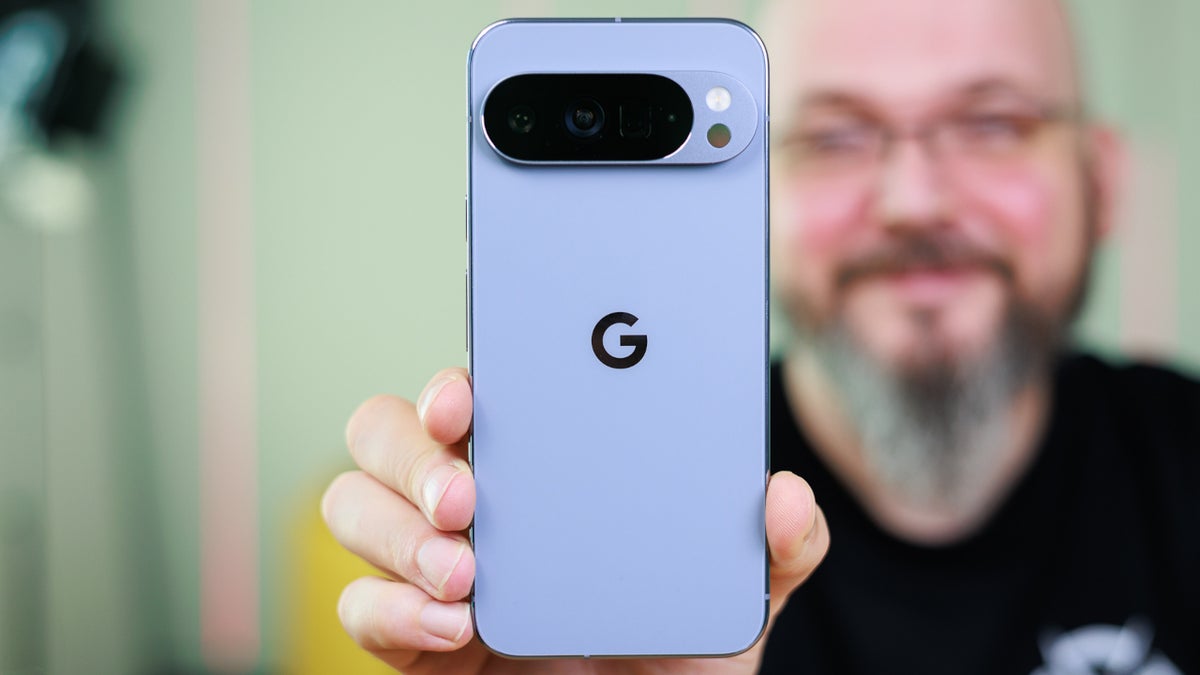
Pixel 10 gets improved on-device AI features | Image by PhoneArena
Moving AI processing from the cloud to your smartphone is a big deal. Cloud-based AI might allow for unlimited computing power, but on-device AI (also known as "Edge AI") delivers more privacy, faster responses, more reliability, and efficiency. It also allows you to use AI while offline.
Google's custom SoC and TPU drive the next-gen on-device AI for the Pixel 10 series
When you use cloud-based AI to write a personal letter, edit a personal photo, or take any type of action using personal data, you run the risk of having your data stolen once it arrives at a third-party server. At that point, your personal data could be stored or used to train future models.
On-device, your data uses your phone's Neural Processing Unit (NPU) to process your prompt and come up with the response, which it surfaces on your phone's display. With this in mind, Google is working hard to have Pixel handsets handle more AI locally on-device. To this end, Google is giving developers more tools so they can build their apps that run locally on Pixel handsets.
Gemma 4 E2B works with the Tensor Processing Unit ASIC to keep personal data more secure
Google has recently introduced Gemma 4 E2B optimized for its Tensor Processing Unit (TPU). The TPU is an application-specific integrated circuit (ASIC) designed by Google that is used to handle the complex math that drives neural networks and is used in matrix multiplication and addition. Gemma 4 E2B, according to Google, is "a state-of-the-art, powerful, yet remarkably lightweight model designed to run natively on the Pixel TPU."
Which phone line does the best job of offering useful AI features?
302 Votes
iPhone
2.98%
Pixel
87.09%
Galaxy
7.95%
Another phone line
1.99%
Gemma 4 makes sure that your personal data does not leave your device, keeping your data private during offline edge AI applications.
During the recently concluded Google I/O India, the company demonstrated offline AI agents that can help Pixel 10 users plan their next trip, help them decide which recipe they want to try, and help take control of the smart home devices they own. With FunctionGemma, they can use Mobile Actions to verbally enable or disable Wi-Fi connectivity on their phones and launch Google Maps. They can also type in their request to turn Wi-Fi on or off and open Google Maps.
At Google I/O India, Google demonstrated how several AI tasks could be used without an internet connection
Google also demonstrated how it can have AI handle several tasks on the Pixel 10 line without an internet connection. This also showed off how AI can use different inputs such as text, images, and audio. This is called "Rich Offline Multimodal Interactions." At Google I/O India, Google demonstrated the ability to handle AI Chat, even while 30,000 feet up in an airplane.
Google also showed those in attendance how AI can identify images such as various objects and plants without being connected to the internet. Additonally, lectures can be transcribed using AI, while everything is kept private and on-device.
Edge AI applications in the real world
Some real-world examples were given by Google, showing how on-device AI can help industries now. There were two examples mentioned by Google:
- Retail: Users can create local in-store shopping maps from recipe ideas, helping them gather the ingredients they need even if completely offline.
- Automobile: Mechanics can make on-the-spot visual diagnostics from photos of faulty parts.
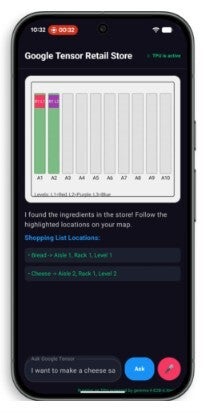
On a Pixel, a user can create a shopping map helping him find the ingredients for a particular recipe in a certain store. | Image by Google
Let me be clear about AI as it pertains to Pixel handsets. Google has always outdone Apple and Samsung when it comes to using AI to make life easier for users. A good example of this is a feature like Hold for Me, which debuted on the Pixel 5 in 2020.
With this feature, when you are put on hold, Google can have AI sit on your call, freeing you up to do other things rather than listen for the other party to return to the call. When that does occur, the Pixel alerts you and gives you a button to tap so you can return to the call.
This is indeed a feature that can make you more efficient, improving your life even if just by a tad. Apple did add a similar Hold Assist, but not until 2025.
Google's presentation at I/O India indicates that the company will not sit back when it comes to AI use on current and future Pixel handsets, and I want to tell you that I'm here for it.


Popular stories




Latest News





Things that are NOT allowed:
To help keep our community safe and free from spam, we apply temporary limits to newly created accounts: