Verizon just put itself in the driver’s seat – literally
Kodiak AI trucks use Verizon 5G to drive themselves.

The next truck you see rolling down the highway might not have a driver at all – and Verizon’s network could be what keeps it moving. That’s thanks to a new partnership with Kodiak AI.
AI is everywhere these days – smartphones, TVs, cars – and Kodiak AI is taking it to a whole new level with autonomous trucking. Its Kodiak Driver is a virtual AI driver that can operate trucks around the clock for long-haul, industrial, and even defense applications.
Humans can still step in remotely for specific situations, like low-speed maneuvers, using what Kodiak calls “Assisted Autonomy,” which is where Verizon steps in.
Verizon Business is now providing the connectivity and IoT support that makes all of this work. Its 5G and LTE networks, along with the ThingSpace IoT platform, let Kodiak’s driverless trucks communicate with remote operators and command centers in real time. This keeps trucks and human supervisors perfectly synced, even over long distances.
How does it all work, you wonder? Well, Verizon’s ThingSpace platform gives Kodiak teams full control of their fleet. They can monitor connectivity, manage devices, troubleshoot problems, and even push software updates over the air. Remote operators can review camera feeds and sensor data in real time to guide trucks safely, improving day-to-day operations and overall safety.
The low-latency connection is key. It ensures that when a human steps in for Assisted Autonomy, there’s almost no delay between what the operator sees and how the truck responds. On busy highways, this could mean fewer accidents caused by AI hesitation or human fatigue.
I get it – one of the biggest worries for drivers is seeing a massive semi-truck driving itself down the highway. I think about it too. The good news is that 5G near-zero delay helps cut down the chances of accidents.
Still, I can’t help but wonder what happens if the 5G signal drops mid-trip. Some Verizon users have reported this happening. But with Verizon doubling down on expanding and improving its network, I’m hopeful that these driverless trucks will stay connected and safe on the road.
I’m still a little cautious about fully embracing the driverless truck and cars future, mostly because it hinges on flawless connectivity. But there are some big positives here. Autonomous trucks don’t need rest breaks like human drivers, so they can operate nearly 24/7. They are also programmed to drive in the most fuel-efficient way possible.
All that adds up to real-world savings. Faster deliveries, lower fuel costs, and more efficient logistics could eventually help bring down shipping costs – and that might trickle down to the prices we pay at the store.
I just hope carriers like Verizon, T-Mobile, and AT&T, which handle millions of connected devices across the US, keep improving their networks. Reliable connectivity is the backbone of this whole driverless revolution, and it has to work every time.
Driverless trucks powered by AI and 5G
AI is everywhere these days – smartphones, TVs, cars – and Kodiak AI is taking it to a whole new level with autonomous trucking. Its Kodiak Driver is a virtual AI driver that can operate trucks around the clock for long-haul, industrial, and even defense applications.
Verizon Business is now providing the connectivity and IoT support that makes all of this work. Its 5G and LTE networks, along with the ThingSpace IoT platform, let Kodiak’s driverless trucks communicate with remote operators and command centers in real time. This keeps trucks and human supervisors perfectly synced, even over long distances.
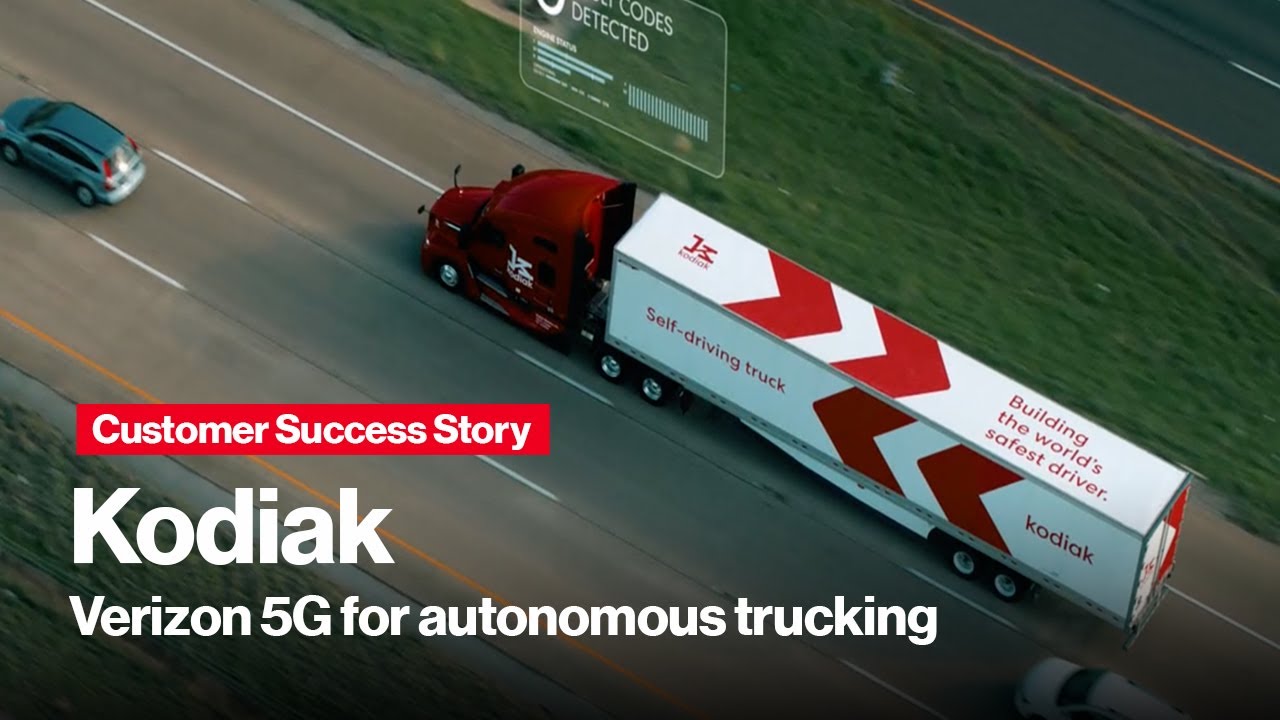

Verizon’s 5G allows for Kodiak AI autonomous trucking. | Video credit – Verizon
Kodiak’s cutting-edge approach to logistics showcases the vast potential of the future of transportation powered by AI and connectivity. Our IoT solutions, 5G network, and data platforms are now underpinning connected-vehicle operations of every size and scale. And now with AI catalyzing new enthusiasm for autonomous mobility, reliable connectivity and data services have never been more important.
– Daniel Lawson, Senior Vice President, Global Solutions, Verizon Business, December 2025
How does it all work, you wonder? Well, Verizon’s ThingSpace platform gives Kodiak teams full control of their fleet. They can monitor connectivity, manage devices, troubleshoot problems, and even push software updates over the air. Remote operators can review camera feeds and sensor data in real time to guide trucks safely, improving day-to-day operations and overall safety.
What it means for everyone else
I get it – one of the biggest worries for drivers is seeing a massive semi-truck driving itself down the highway. I think about it too. The good news is that 5G near-zero delay helps cut down the chances of accidents.
Still, I can’t help but wonder what happens if the 5G signal drops mid-trip. Some Verizon users have reported this happening. But with Verizon doubling down on expanding and improving its network, I’m hopeful that these driverless trucks will stay connected and safe on the road.
Do you think 5G connectivity is reliable enough to keep autonomous trucks safe?
44 Votes
Absolutely, 5G is fast and consistent.
11.36%
Mostly, but occasional drops are concerning.
25%
No, current networks aren’t ready yet.
61.36%
Unsure, I don’t know enough about 5G.
2.27%
The future is coming
I’m still a little cautious about fully embracing the driverless truck and cars future, mostly because it hinges on flawless connectivity. But there are some big positives here. Autonomous trucks don’t need rest breaks like human drivers, so they can operate nearly 24/7. They are also programmed to drive in the most fuel-efficient way possible.
All that adds up to real-world savings. Faster deliveries, lower fuel costs, and more efficient logistics could eventually help bring down shipping costs – and that might trickle down to the prices we pay at the store.
I just hope carriers like Verizon, T-Mobile, and AT&T, which handle millions of connected devices across the US, keep improving their networks. Reliable connectivity is the backbone of this whole driverless revolution, and it has to work every time.
And if you are wondering how the big three carriers compare when it comes to coverage, speed, and overall reliability, we’ve got you covered. Our dedicated comparison guides break down everything from network performance in cities and rural areas, to 5G availability, data speeds, and customer satisfaction, so check them out:
- T-Mobile vs Verizon vs AT&T: Reliability, plans, coverage
- T-Mobile vs Verizon: plan prices, phones, and network coverage
- AT&T vs T-Mobile: Which is better, coverage, tips
- Verizon vs AT&T: plan prices, phones, and network coverage


Popular stories




Latest News




Things that are NOT allowed:
To help keep our community safe and free from spam, we apply temporary limits to newly created accounts: