Editorials · Readers Voice
I was wrong about the Pixel 11 Pro modem, and 9 in 10 of you set me straight
Google's one genuine hardware win this year is not landing the way I assumed it would.
This article may contain personal views and opinion from the author.
We may earn a commission if you make a purchase from the links on this page.

The Pixel 11 Pro and Pixel Watch 5 in Canyon. | Image by Google
Pixel 11 Pro trade-in offers are the most aggressive I have seen on a new Google flagship, so we asked you which part of the trade still bothers you most. 543 of you weighed in, and it was not the thermometer everyone had been arguing about. It came down to memory and money, the same two things the Galaxy S26 Ultra gets judged on.
Pixel 11 Pro RAM was your biggest sticking point
Nearly half of you, 46.59%, pointed at the entry 256GB Pixel 11 Pro dropping to 12GB of RAM, which pushes 16GB up to the 512GB tier. Another 34.62% went with paying $100 more for a smaller upgrade, which puts 81.21% of you on price and specs rather than any single feature.
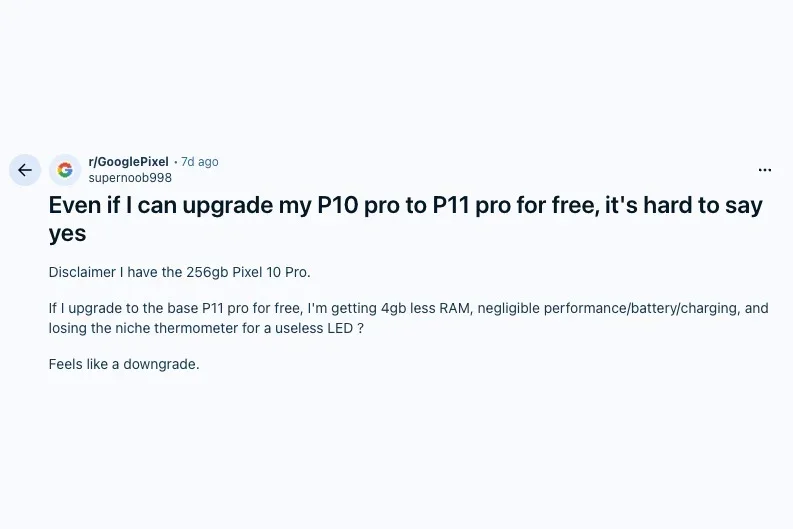
The post that kicked off the thread, from a Pixel 10 Pro owner weighing a free upgrade. | Image by supernoob998 via Reddit
The thermometer, the complaint that got the loudest on Reddit, finished third at 10.68%. Only 8.1% said the new modem was enough to sell them on it, which is the part I didn't expect, since we made the case that Google was betting you would not notice the missing memory and the modem was supposed to be the thing that made up for it.
Which part of the Pixel 11 Pro trade bothers you most?
1389 Votes
Dropping to 12GB of RAM at the entry tier
40.68%
Losing the thermometer for the HiLight LED
12.24%
Paying $100 more for a smaller upgrade
34.63%
Nothing, the new modem sells me on it
12.46%
Why 12GB is now the flagship norm, even on the Galaxy S26 Ultra
So the complaint underneath all of this is really about the math rather than any one feature. Google asked for more and handed back less, and a discount doesn't change the spec sheet you're living with for the next four or five years. It should be noted that Google isn't doing this in isolation, though.
TrendForce's May memory research put the average selling price of LPDDR5X, the memory that goes into phones like this one, up 78 to 83% quarter over quarter in the second quarter of 2026, on top of several quarters of increases before that. Their read on what that does to flagships is blunt: 12GB is becoming the mainstream high-end configuration while 16GB adoption declines.
Average smartphone memory is still climbing, to a projected 8.5GB across the market in 2026, but that growth is happening at the bottom of the range while the top quietly settles back down. The 12GB entry tier was likely coming whether any of us liked it or not, on a Pixel or anywhere else.
That shows up on the competition too. In our Galaxy S26 Ultra versus iPhone 17 Pro Max review we found Samsung running 12GB at both the 256GB and 512GB tiers and only reaching 16GB at 1TB, and the iPhone 17 Pro sits at 12GB as well. So if you own either of those, the Pixel 11 Pro is sitting on exactly the amount of memory you already have.
Which means there isn't much here for rival owners to feel smug about, and not much to worry about either, since the memory gap between these three phones is basically gone. What actually separates them now is what each company charged to get there, and that's a fairer fight than the RAM number on its own suggests.
The people this touches are the ones buying at 256GB, since that is exactly where the 16GB became 12GB. Getting last year's memory now means paying for a storage tier you might not need.
I came into this thinking the modem was the redeeming part of the Pixel 11 Pro, and 8.1% of you told me plainly that it is not. That's fair. A better modem fixes something Pixel owners have complained about for years, but it's invisible until the moment you need it, and nobody's paying $100 more for a spec they can't see.
Still, I would rather Google spend next year's headline moment on the unglamorous fix than on a light on the back of the phone. I am hoping the Pixel 12 gets that order right, because the 81% of you who voted on price and memory just told Google exactly what the pitch should be.
That shows up on the competition too. In our Galaxy S26 Ultra versus iPhone 17 Pro Max review we found Samsung running 12GB at both the 256GB and 512GB tiers and only reaching 16GB at 1TB, and the iPhone 17 Pro sits at 12GB as well. So if you own either of those, the Pixel 11 Pro is sitting on exactly the amount of memory you already have.
Which means there isn't much here for rival owners to feel smug about, and not much to worry about either, since the memory gap between these three phones is basically gone. What actually separates them now is what each company charged to get there, and that's a fairer fight than the RAM number on its own suggests.
More on the Pixel 11 Pro and its rivals:
Who the 12GB entry tier actually changes things for
The people this touches are the ones buying at 256GB, since that is exactly where the 16GB became 12GB. Getting last year's memory now means paying for a storage tier you might not need.
What I would want Google to lead with next year
I came into this thinking the modem was the redeeming part of the Pixel 11 Pro, and 8.1% of you told me plainly that it is not. That's fair. A better modem fixes something Pixel owners have complained about for years, but it's invisible until the moment you need it, and nobody's paying $100 more for a spec they can't see.
Still, I would rather Google spend next year's headline moment on the unglamorous fix than on a light on the back of the phone. I am hoping the Pixel 12 gets that order right, because the 81% of you who voted on price and memory just told Google exactly what the pitch should be.
If you want to follow me online:


Popular stories




Latest News



Things that are NOT allowed:
To help keep our community safe and free from spam, we apply temporary limits to newly created accounts: