While AT&T and Verizon hesitate, T-Mobile goes all-in to benefit customers
AT&T, T-Mobile, and Verizon are all baking AI into their networks.
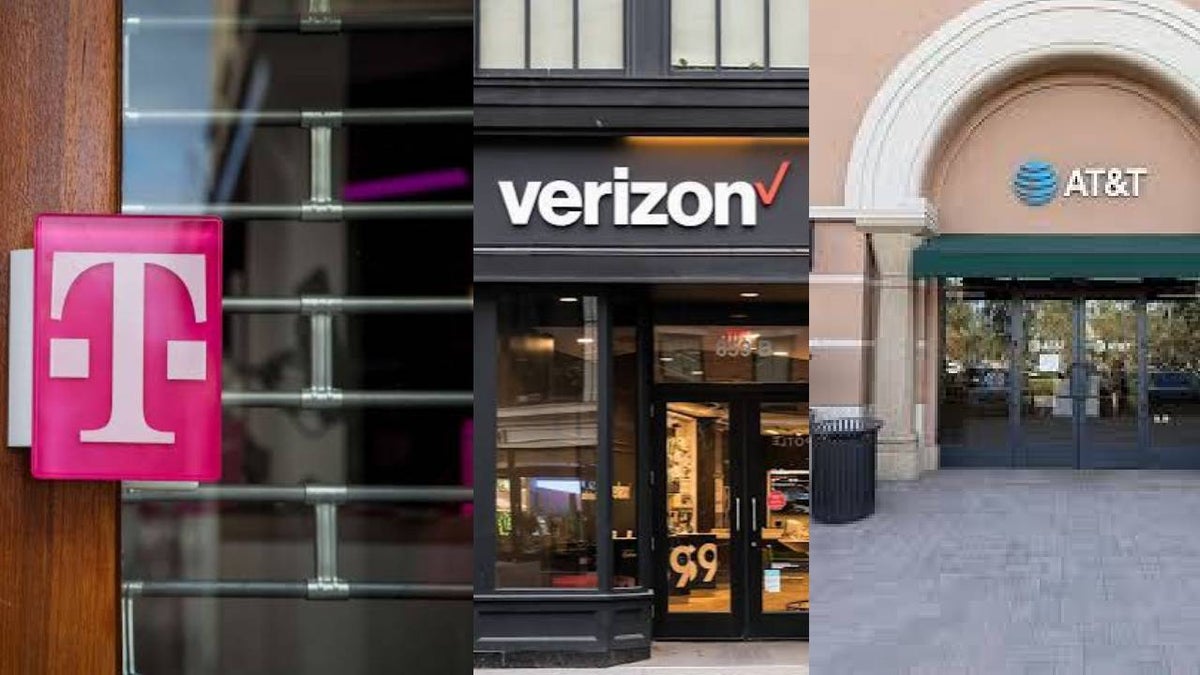
T-Mobile has a clear strategy. | Image by PhoneArena
T-Mobile is using AI to improve how customers are served, and we aren't just talking about customer service bots. While those certainly exist, the carrier is also using AI to improve network performance. AT&T and Verizon are taking a more cautious approach.
T-Mobile has been vocal about complementing data center operations in the age of physical AI, but everyday customers have something to look forward to, too.
The company expects Nokia's Artificial Intelligence-Radio Access Network (AI-RAN) equipment to achieve 50% spectral efficiency by the end of 2027, scaling up to 100% by the end of 2028.
For the uninitiated, AI-RAN integrates AI into RAN, which is the bridge linking devices to the core network.
This isn't just a far-off theory. T-Mobile Executive Vice President and Chief Network Officer Ankur Kapoor, noted 10% spectral efficiency gains and 15% higher downlink speeds during live testing, with some demonstrations hitting over 30%. This means the company can squeeze more out of its spectrum, which wasn't possible before.
The tech will unlock more capacity and boost speeds for fixed wireless access (FWA) or 5G Home Internet customers.
AI-RAN applications often need power-hungry GPUs for high‐performance computing, driving up operational expenses. But as long as users get a noticeably better experience, T-Mobile isn't sweating the extra overhead.
T-Mobile's rivals still appear to be hashing out their strategies. While Verizon CTO Yago Tenorio agrees that placing GPUs at the network edge is great for niche use cases, he remains skeptical about using them for AI inferencing to boost network performance. For now, CPUs can handle those tasks just fine.
While much of the AI talk has centered on business use cases, it's refreshing to see how the tech upgrades day-to-day consumer connectivity. This isn't the first time we have heard of this approach, though.
For instance, T-Mobile's Live Translation feature involves baking real-time AI services into the network infrastructure.
Earlier this year, AT&T and T-Mobile tested Ericsson's AI-native scheduler with link adaptation software. T-Mobile demonstrated that improvements in network performance and spectrum efficiency are possible without using GPUs.
For now, T-Mobile appears to have a clear vision of what it wants. AT&T and Verizon appear more intent on avoiding GPUs to keep costs in check. Which approach will pay off in the long term? We will likely find out around 2027.
A more efficient network
T-Mobile has been vocal about complementing data center operations in the age of physical AI, but everyday customers have something to look forward to, too.
The company expects Nokia's Artificial Intelligence-Radio Access Network (AI-RAN) equipment to achieve 50% spectral efficiency by the end of 2027, scaling up to 100% by the end of 2028.
This isn't just a far-off theory. T-Mobile Executive Vice President and Chief Network Officer Ankur Kapoor, noted 10% spectral efficiency gains and 15% higher downlink speeds during live testing, with some demonstrations hitting over 30%. This means the company can squeeze more out of its spectrum, which wasn't possible before.
AI-RAN isn't theoretical anymore. Live-site testing is showing 10% spectral efficiency gains and 15% higher downlink throughput. Spectrum is our most valuable asset, and we're now able to get more out of what we already own. That’s an efficiency that simply wasn't possible a few years ago.
Ankur Kapoor, EVP and Chief Network Officer at T-Mobile, September 2026
AI-RAN applications often need power-hungry GPUs for high‐performance computing, driving up operational expenses. But as long as users get a noticeably better experience, T-Mobile isn't sweating the extra overhead.
It’s not about how much power these infrastructures are consuming. It’s what are the customer benefits that we can deliver … That’s what we’re going to make decisions on.
Ankur Kapoor, EVP and Chief Network Officer at T-Mobile, September 2026
What about AT&T and Verizon?
T-Mobile's rivals still appear to be hashing out their strategies. While Verizon CTO Yago Tenorio agrees that placing GPUs at the network edge is great for niche use cases, he remains skeptical about using them for AI inferencing to boost network performance. For now, CPUs can handle those tasks just fine.
...do we need to put them in the radio? Absolutely not. Would the experience be better if we put those GPUs on the network? No, it’d be the same at most. Therefore, I think we’re talking about two different things.
Yago Tenorio, Verizon CTO, September 2026
Do you need a GPU for doing just RAN? No, today, you don’t. You can do that with a CPU. And can you embed AI into the radio and do some inferencing? Not for the end use case, but for just getting better at the radio performance … you can embed that onto a CPU. You don’t need a GPU for that.
Yago Tenorio, Verizon CTO, September 2026
AT&T defines AI-RAN as any system that uses AI for troubleshooting and network optimization. Whether AT&T uses CPUs or GPUs comes down to performance requirements and cost constraints.
We have an ability to consume any silicon. If a GPU shows up and it fits the network and it makes sense from a business perspective, we’ll do it. But we won't just do it just for the sake of doing it and trying to establish a playground for third parties.
Rob Soni, VP of RAN Technology at AT&T, September 2026
Which company is going in the right direction?
11 Votes
Customer benefits
While much of the AI talk has centered on business use cases, it's refreshing to see how the tech upgrades day-to-day consumer connectivity. This isn't the first time we have heard of this approach, though.
For instance, T-Mobile's Live Translation feature involves baking real-time AI services into the network infrastructure.
Earlier this year, AT&T and T-Mobile tested Ericsson's AI-native scheduler with link adaptation software. T-Mobile demonstrated that improvements in network performance and spectrum efficiency are possible without using GPUs.
Strategy dictates the winner
For now, T-Mobile appears to have a clear vision of what it wants. AT&T and Verizon appear more intent on avoiding GPUs to keep costs in check. Which approach will pay off in the long term? We will likely find out around 2027.


Popular stories

Latest News


Things that are NOT allowed:
To help keep our community safe and free from spam, we apply temporary limits to newly created accounts: