
T-Mobile is all in on the next hot thing, and customers will reap the rewards
T-Mobile is laying the foundation for a new wave of automation.
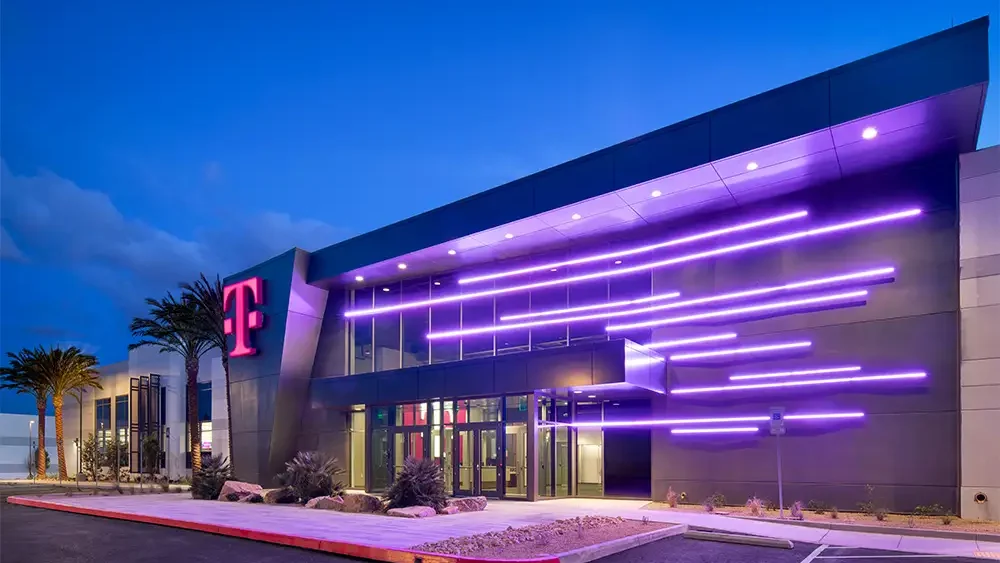
T-Mobile Customer Experience Center | Image by Burke Construction Group
T-Mobile is looking toward the horizon and bringing us along for the ride. Last week, T-Mobile President & CTO John Saw discussed the evolving role of carriers in the AI era. Fierce Wireless caught up with Saw for deeper insights.
In his blog post, Saw talks about physical AI — a new branch of AI that moves beyond data processing to enable autonomous systems to perform real-world actions. Think robots and self-driving vehicles.
Just like Large Language Models (LLMs) operate using informational tokens, physical systems use kinetic tokens to trigger tangible actions.
Since autonomous systems such as self-driving cars require instantaneous feedback, relying on a centralized data center isn't feasible. To minimize delays, processing data locally via edge computing is essential.
Carriers are uniquely positioned to meet these demands because they already handle millions of devices and facilitate real-time communication.
All of this ties into 6G, which will have AI built into the architecture. This will be crucial for physical AI, which requires a network capable of unifying devices, edge computing, and AI to operate harmoniously within the physical world. 6G won't just carry data like 5G; it will act in the real world.
T-Mobile is working with partners Nokia, Ericsson, and NVIDIA to ensure the network can hold both wireless traffic and AI workloads simultaneously without compromising performance.
T-Mobile doesn't expect to replace data centers, but Saw points out that real-world AI systems will need to process data locally. Nvidia President and CEO Jensen Huang previously explained that telecom networks will become the infrastructure for connecting different AI edge systems.
Another advantage carriers have over cloud providers is that they know where devices are and can prioritize important traffic.
While 6G is years away, T-Mobile is already using AI in its 5G Advanced network to decide where to install the next cell site to improve coverage for customers.
T-Mobile was the first carrier in the US to roll out a 5G SA network, and it aims to maintain its lead. The company is one of the founding members of the AI-RAN Alliance, which aims to use AI to increase network efficiency.
Physical AI can be a game-changing move from T-Mobile, allowing households and businesses to fully embrace the next wave of automation.
T-Mobile is preparing for a new world
In his blog post, Saw talks about physical AI — a new branch of AI that moves beyond data processing to enable autonomous systems to perform real-world actions. Think robots and self-driving vehicles.
Since autonomous systems such as self-driving cars require instantaneous feedback, relying on a centralized data center isn't feasible. To minimize delays, processing data locally via edge computing is essential.
All of this ties into 6G, which will have AI built into the architecture. This will be crucial for physical AI, which requires a network capable of unifying devices, edge computing, and AI to operate harmoniously within the physical world. 6G won't just carry data like 5G; it will act in the real world.
T-Mobile doesn't expect to replace data centers, but Saw points out that real-world AI systems will need to process data locally. Nvidia President and CEO Jensen Huang previously explained that telecom networks will become the infrastructure for connecting different AI edge systems.
If you really want to support physical AI, data centers need to be supplemented by the edge. And this is what I’m talking about – edge AI for inferencing – because it is at the edge where the action happens.
John Saw, T-Mobile President & CTO, February 2026
Another advantage carriers have over cloud providers is that they know where devices are and can prioritize important traffic.
While 6G is years away, T-Mobile is already using AI in its 5G Advanced network to decide where to install the next cell site to improve coverage for customers.
When edge-driven workloads like a remotely managed drone, or robots need real-time coordination, a network that can recognize the workloads and provide the necessary QoS allows the carriers to add value.
Roy Chua, AvidThink founder, February 2026
Why it matters
T-Mobile is already using AI to provide a better network experience. T-Mobile's futuristic vision will ensure that by the time autonomous robots and smart factories become commonplace, the foundation to support them will be there.
Is T-Mobile going to dominate 6G?
186 Votes
For sure.
51.08%
I don't think so.
8.06%
Doesn't matter.
40.86%
Maintaining its lead
T-Mobile was the first carrier in the US to roll out a 5G SA network, and it aims to maintain its lead. The company is one of the founding members of the AI-RAN Alliance, which aims to use AI to increase network efficiency.
Physical AI can be a game-changing move from T-Mobile, allowing households and businesses to fully embrace the next wave of automation.


Popular stories

Latest News

Things that are NOT allowed:
To help keep our community safe and free from spam, we apply temporary limits to newly created accounts: